Mucho Gusto Meaning is “Nice to meet you” or “Pleased to meet you” in English. It is a common Spanish phrase used when meeting someone for the first time and politely expressing that you are happy to meet them.
Mucho Gusto can also be understood as “It’s a pleasure to meet you.” The phrase is friendly, polite, and commonly used in Spanish-speaking countries during introductions, conversations, and social situations.
The meaning of ” Mucho Gusto “ is often searched by people who hear the phrase in conversations, movies, travel, or online chats. Understanding what it means and how to respond can help you communicate naturally with Spanish speakers.
What Does Mucho Gusto Mean?
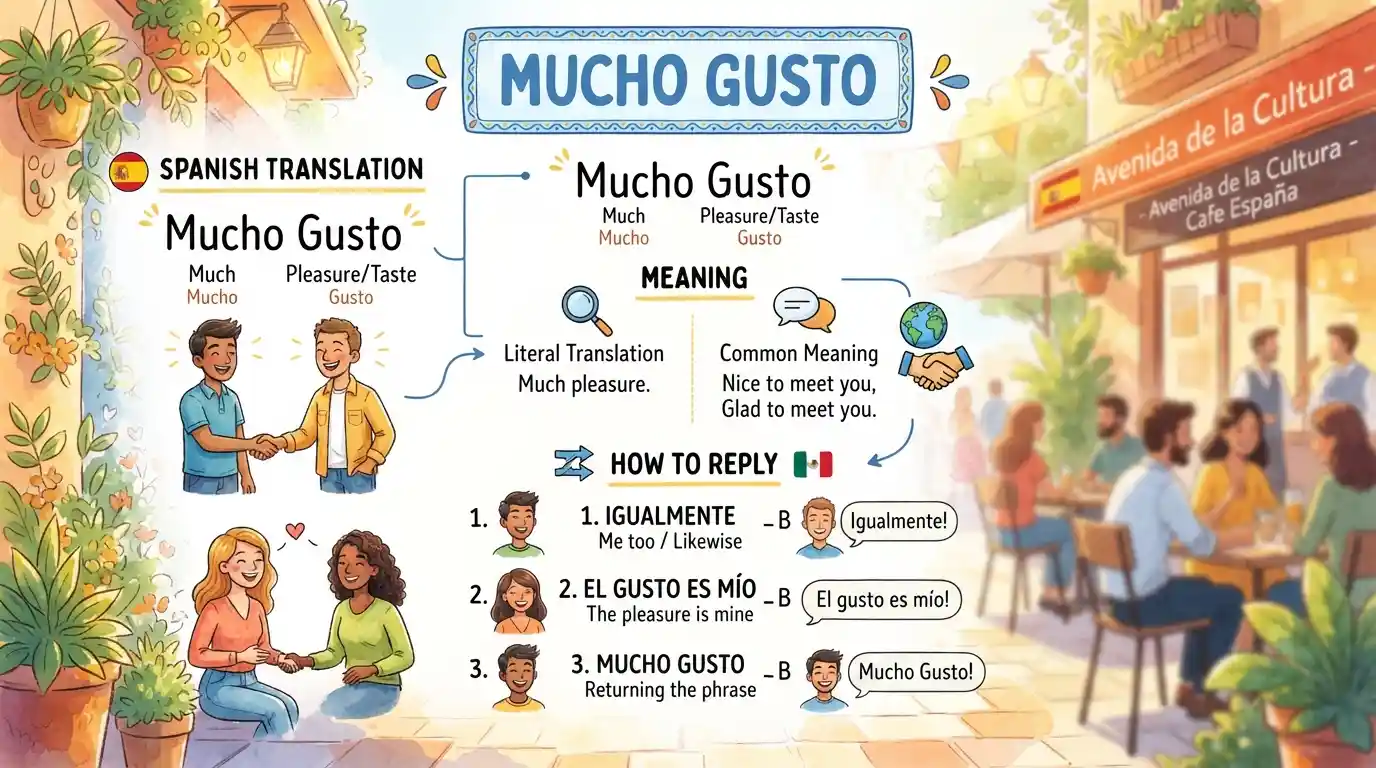
“Mucho gusto” literally translates to “much pleasure” in Spanish, but its natural English meaning is:
- Nice to meet you
- Pleased to meet you
- It’s a pleasure to meet you
It is normally said after someone introduces themselves.
For example:
Person 1: Hola, soy María.
Person 2: Mucho gusto.
This means:
Person 1: Hi, I’m Maria.
Person 2: Nice to meet you.
Quick Mucho Gusto Meaning Table
| Phrase | Meaning | Common Use |
|---|---|---|
| Mucho gusto | Nice to meet you | Meeting someone |
| Mucho gusto meaning in English | Pleased to meet you | Introductions |
| Mucho gusto in Spanish | Much pleasure / Nice to meet you | Spanish conversations |
| Mucho gusto slang | Not really slang | Polite casual speech |
| Mucho gusto response | Igualmente / Mucho gusto | Replying to someone |
Mucho Gusto Meaning in English
In English, mucho gusto is most naturally translated as “Nice to meet you.”
Depending on the situation, it can also mean:
- “Pleased to meet you.”
- “It’s a pleasure to meet you.”
- “Glad to meet you.”
The exact English translation can change slightly, but the basic idea remains the same: you are expressing pleasure about meeting another person.
Mucho Gusto Meaning in Spanish
In Spanish, mucho gusto is a standard phrase used when people meet.
It is not usually considered internet slang. Instead, it is a normal expression used in everyday communication.
You might hear it when:
- Meeting a new friend
- Introducing yourself
- Meeting someone at work
- Meeting a family member of a friend
- Traveling in a Spanish-speaking country
- Starting a polite conversation
Example
Hola, soy Carlos. Mucho gusto.
Meaning:
“Hi, I’m Carlos. Nice to meet you.”
Is Mucho Gusto formal or informal?
“Mucho gusto” can work in both formal and informal situations.
It is polite enough for professional introductions but also natural when meeting someone casually.
For example, you can say:
Mucho gusto, señor García.
This sounds polite and formal.
You can also say:
Hola, Ana. Mucho gusto.
This sounds friendly and natural.
So, you do not need to worry about using it only in formal conversations.
How Do You Respond to Mucho Gusto?
One of the most common responses to “Mucho gusto” is:
“Igualmente.”
“Igualmente” means “Likewise” or “Same here.”
You can also respond:
“Mucho gusto.”
This is a simple and natural response.
Example Conversation
A: Hola, soy Daniel. Mucho gusto.
B: Mucho gusto.
A: ¿Cómo estás?
B: Muy bien, gracias.
In English:
A: Hi, I’m Daniel. Nice to meet you.
B: Nice to meet you too.
A: How are you?
B: Very well, thank you.
Mucho Gusto Meaning in Text
If someone sends “mucho gusto” in a text message, they usually mean “Nice to meet you” or “Pleased to meet you.”
It may appear in a conversation where two people have just been introduced online.
For example:
“Hey, I’m Sofia. I got your number from Alex. Mucho gusto!”
Here, the person is using Spanish to make the introduction sound friendly.
The phrase does not suddenly become slang just because it is used in texting. Its meaning generally stays the same.
Mucho Gusto in Chat
In online chats, mucho gusto can be used when someone introduces themselves.
For example:
“Hi! My name is Leo. Mucho gusto 😊”
The phrase may also be used by Spanish speakers naturally within an English conversation.
For example:
“I’m from Mexico. Mucho gusto!”
In this situation, the person is simply saying “Nice to meet you.”
Mucho Gusto on Social Media
You may see mucho gusto on Instagram, TikTok, Facebook, Snapchat, dating apps, or other social platforms.
It is especially common when people meet through:
- Social media
- Online communities
- Language exchange apps
- Dating apps
- Travel groups
- International friendships
For example:
“Hey! I’ve seen your videos before. Mucho gusto!”
Here, it is a friendly way to acknowledge a new interaction.
Is Mucho Gusto a Slang Phrase?
No, mucho gusto is not slang.
It is a standard Spanish expression.
However, people may use it casually in texts, DMs, comments, and social media conversations. Its casual use does not make the phrase slang.
A simple way to remember it is:
Mucho gusto = standard Spanish phrase meaning “Nice to meet you.”
What Does Mucho Gusto Literally Mean?
The literal meaning of mucho gusto is approximately “much pleasure.”
- Mucho = much / a lot
- Gusto = pleasure/pleasure or enjoyment
But translating every word separately does not give the most natural English sentence.
Instead, English speakers would normally say:
“Nice to meet you.”
This is why dictionaries and language learners commonly explain mucho gusto using that phrase.
Mucho Gusto vs. Encantado
Another Spanish expression you may hear when meeting someone is “Encantado” or “Encantada.”
Both can communicate the idea of being pleased to meet someone.
For example:
Mucho gusto.
= Nice to meet you.
Encantado.
= Pleased to meet you.
Encantada.
= Pleased to meet you.
The form “encantado” or “encantada” can depend on the speaker’s grammatical gender.
Mucho Gusto vs. Hola
These two phrases are different.
Hola means “Hello” or “Hi.”
Mucho gusto means “Nice to meet you.”
You can use them together:
“Hola, mucho gusto.”
That means:
“Hi, nice to meet you.”
For a first meeting, this is a very natural combination.
Mucho Gusto vs. Gracia
Mucho gusto = Nice to meet you.
Gracias = Thank you.
For example:
“Hola, soy Luis. Mucho gusto.”
“Hi, I’m Luis. Nice to meet you.”
You would not normally translate “mucho gusto” as “thank you.”
Examples of Mucho Gusto
Here are some natural examples:
| Spanish Example | English Meaning |
|---|---|
| “Hola, mucho gusto.” | “Hi, nice to meet you.” |
| “Soy María, mucho gusto.” | “I’m Maria, nice to meet you.” |
| “Mucho gusto en conocerte.” | “Nice to meet you.” |
| “Mucho gusto, señor.” | “Pleased to meet you, sir.” |
| “Mucho gusto. Igualmente.” | “Nice to meet you. Likewise.” |
Mucho Gusto in Different Situations
The phrase can be used in many situations.
Meeting Someone for the First Time
This is the most common use.
“Hola, soy Emma. Mucho gusto.”
Meaning:
“Hi, I’m Emma. Nice to meet you.”
Professional Introduction
It can also be used at work.
“Mucho gusto, soy el nuevo gerente.”
Meaning:
“Nice to meet you, I’m the new manager.”
Meeting a Friend’s Family
You may hear:
“Mucho gusto, es un placer conocerlo.”
This expresses respect and pleasure in meeting someone.
Online Introduction
It can also be used in online conversations.
“Hey, I’m Jake. Mucho gusto!”
The speaker may be mixing English and Spanish to sound friendly.
Is Mucho Gusto Romantic?
Not necessarily.
Mucho gusto does not automatically have a romantic meaning.
It is a normal phrase used when meeting someone.
A person can say it to:
- A friend
- A coworker
- A stranger
- A teacher
- A customer
- A family member
- A romantic interest
The context determines whether the conversation is romantic.
For example:
“Hi, I’m Sarah. Mucho gusto!”
By itself, this is simply a polite introduction.
If it appears alongside flirting, compliments, or romantic messages, then the overall conversation may have a romantic tone—but the phrase itself is not romantic slang.
Why Do People Say Mucho Gusto?
People use mucho gusto because it is a simple and polite way to show that they are happy to meet someone.
It can make an introduction feel:
- Friendly
- Respectful
- Polite
- Warm
- Welcoming
It is also one of the easiest Spanish phrases for English speakers to learn.
Common Variations of Mucho Gusto
You may see several related expressions.
Mucho Gusto
The basic phrase means:
“Nice to meet you.”
Mucho Gusto en Conocerte
This can be translated as:
“Nice to meet you.”
It is a more explicit form referring to meeting the person.
Mucho Gusto en Conocerlo
This is a more formal way of saying that it is a pleasure to meet someone, with the pronoun referring to the person being addressed.
Igualmente
This means:
“Likewise.”
It is a very common response to “Mucho gusto.”
Is Mucho Gusto Used in Mexico?
Yes. Mucho gusto is commonly understood and used in Mexico.
It is also used throughout many Spanish-speaking countries, although regional habits and preferred expressions can vary.
You may hear it in places such as:
- Mexico
- Spain
- Colombia
- Argentina
- Chile
- Peru
- Venezuela
- Ecuador
- Puerto Rico
- Dominican Republic
The basic meaning remains the same.
Common Mistakes About Mucho Gusto
Mistake 1: Thinking It Means “I Like You”
The word “gusto” can relate to pleasure or enjoyment, but mucho gusto as a phrase means “Nice to meet you.”
It does not normally mean “I like you.”
Mistake 2: Thinking It Is Slang
Mucho gusto is a standard Spanish expression, not internet slang.
Mistake 3: Translating It Word-for-Word
“Much pleasure” is closer to the literal meaning, but “Nice to meet you” is the natural English translation.
Mistake 4: Assuming It Is Romantic
The phrase is commonly used in ordinary introductions and does not automatically indicate romantic interest.
How to Pronounce Mucho Gusto
A simple English-friendly pronunciation is approximately:
MOO-choh GOOS-toh
The Spanish pronunciation is slightly different from English pronunciation, but this approximation can help beginners.
Try to keep the sounds smooth rather than stressing each word too heavily.
Can You Use Mucho Gusto in English Conversations?
Yes.
People sometimes use mucho gusto while speaking English, especially if they know Spanish or want to add a Spanish touch to the conversation.
For example:
“Hey, I’m Alex. Mucho gusto!”
The person is still communicating:
“Nice to meet you!”
Using the phrase can be natural in bilingual conversations.
Mucho Gusto in Dating or Flirting
If you meet someone through a dating app or social media, you may see:
“Hi, I’m Daniel. Mucho gusto 😊”
This simply means:
“Hi, I’m Daniel. Nice to meet you.”
The emoji or surrounding conversation may make the message flirtier, but mucho gusto itself is not a flirting phrase.
Mucho Gusto in Travel
Travelers often hear mucho gusto when introducing themselves in Spanish-speaking countries.
For example:
Traveler: Hola, soy Mike.
Local: Mucho gusto.
Traveler: Mucho gusto.
This is a simple and polite exchange.
Learning this phrase can be useful when traveling because introductions happen frequently in hotels, restaurants, tours, workplaces, and social situations.
Frequently Asked Questions
What does mucho gusto mean?
Mucho gusto means “Nice to meet you,” “Pleased to meet you,” or “It’s a pleasure to meet you” in English.
Is mucho gusto Spanish?
Yes. Mucho gusto is a Spanish phrase commonly used when meeting someone.¿¿
Es mucho gusto formal?
It can be used in both formal and informal situations. It is generally polite and appropriate for introductions.
What is the best response to mucho gusto?
A common response is “Igualmente,” meaning “Likewise.” You can also simply say “Mucho gusto.”
Does mucho gusto mean I like you?
No. In normal conversation, mucho gusto means “Nice to meet you,” not “I like you.”¿¿
Es mucho gusto slang?
No. It is a standard Spanish expression rather than slang.
Can I say mucho gusto to a friend?
Yes, especially if you are meeting the friend for the first time. However, with someone you already know well, you would normally use a simple greeting instead.
What does mucho gusto mean in texting?
In texting, it usually still means “Nice to meet you” or “Pleased to meet you.” The meaning does not change simply because it is used online.
Final Thoughts
Mucho Gusto means “Nice to meet you,” “Pleased to meet you,” or “It’s a pleasure to meet you.” It is a common Spanish expression used during introductions and first meetings.
The phrase is not slang and does not automatically have a romantic meaning. You can use it in casual conversations, professional introductions, travel situations, online chats, and social interactions.
The easiest way to remember it is:
Mucho gusto = Nice to meet you.
And if someone says “Mucho gusto” to you, a natural response is:
“Igualmente!” — “Likewise!”