
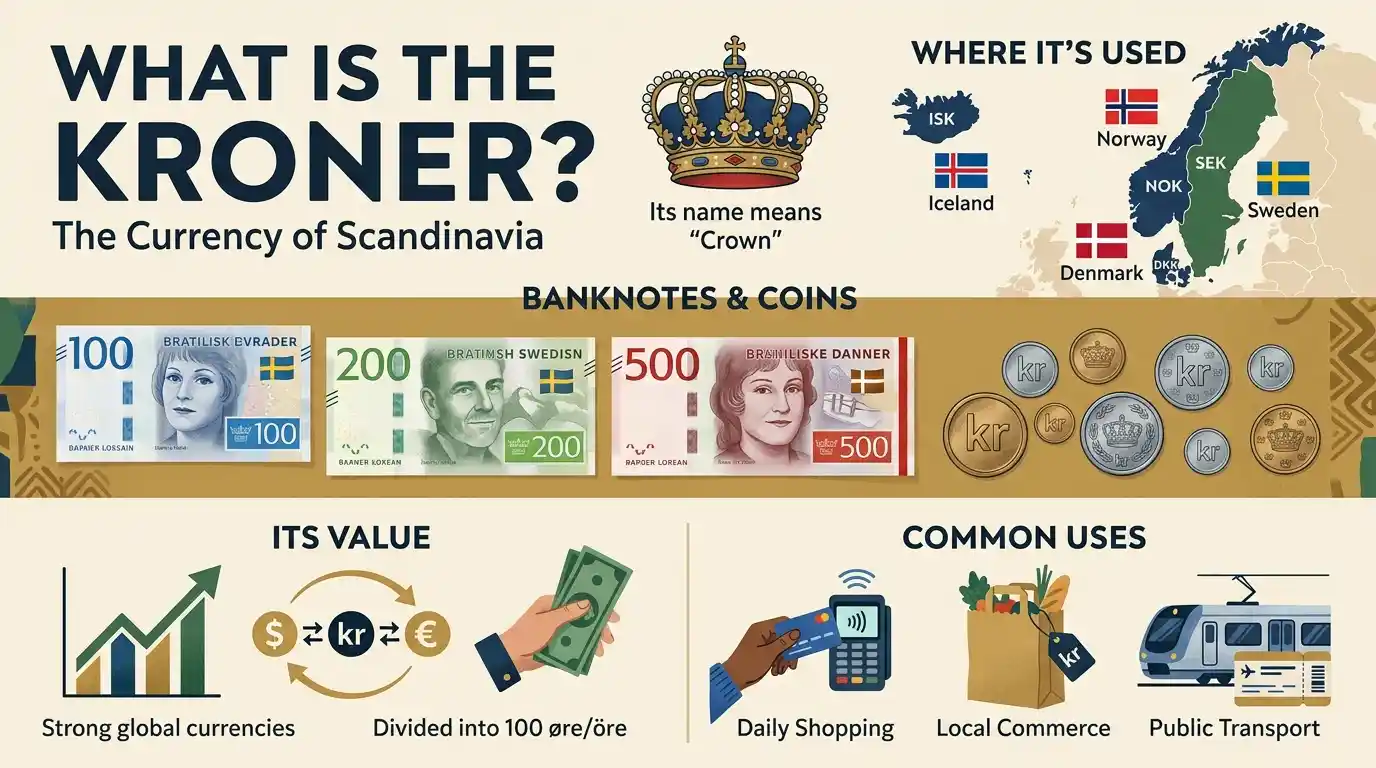
Kroner Meaning refers to the plural form of krone, a currency name used in several Nordic countries. The word is commonly associated with the currencies of Denmark and Norway, while Sweden uses the related term krona.
Kroner Meaning can be confusing because people may use the word when talking about money, prices, salaries, travel, or currency exchange. The exact value of a kroner depends on which country’s currency is being discussed.
The meaning of kroner is especially common in travel websites, international shopping, financial news, and conversations about Scandinavian countries. Understanding the word can make it easier to read prices and understand currency conversions.
What Does Kroner Mean?
Kroner is the plural of krone, which means “crown” in several Scandinavian languages. It is a currency term rather than internet slang.
For example, if someone says, “The ticket costs 200 kroner,” they are talking about an amount of money. The exact currency depends on the country and context.
The word is most commonly connected with Norwegian kroner (NOK) and Danish kroner (DKK).
Quick Kroner Meaning Table
| Term | Meaning | Common Context |
|---|---|---|
| Kroner | Plural of krone | Money and currency |
| Krone | Singular form | One unit of currency |
| Norwegian kroner | Norway’s currency | NOK |
| Danish kroner | Denmark’s currency | DKK |
| Krona | Related currency term | Sweden |
Kroner Meaning in English
In English, kroner simply refers to units of a Scandinavian currency called a krone.
The word comes from the Scandinavian word associated with a crown. You may see it written in English when discussing prices in Denmark or Norway.
For example:
- “The meal costs 300 kroner.”
- “I exchanged my dollars for Norwegian kroner.”
- “The hotel costs 1,000 kroner per night.”
The word itself does not describe a specific amount of money. You need the country or currency code to know exactly which kroner are meant.
Kroner Meaning in Norway
In Norway, the official currency is the Norwegian krone, with the plural commonly written as kroner.
Its international currency code is NOK.
If you are visiting Norway, you may see prices displayed using the krone symbol or currency abbreviation. For example, a price may be written as:
500 NOK
or
500 kroner
Both refer to Norwegian currency when the context is Norway.
Kroner Meaning in Denmark
Denmark uses the Danish krone, and its plural form is kroner.
The international currency code for the Danish krone is DKK.
For example, if a restaurant menu in Denmark says that a meal costs 250 kroner, the amount refers to Danish currency.
This is why simply seeing the word “kroner” may not always be enough to identify the currency. You should check whether the context is Denmark or Norway.
Kroner vs Krone
One common question is the difference between krone and kroner.
Krone is generally the singular form, while kroner is the plural form.
For example:
- 1 krone
- 10 kroner
- 100 kroner
- 1,000 kroner
In everyday English, however, people may use “krone” and “kroner” less strictly, especially when discussing Scandinavian currencies generally.
Kroner vs Krona
Another term that can confuse is krona.
Sweden uses the Swedish krona, while Denmark and Norway use the krone.
Their plural forms also differ:
- Norway: kroner
- Denmark: kroner
- Sweden: kronor
Although these words are related, they refer to different national currencies.
Why Is It Called Kroner?
The word comes from the Scandinavian word for crown.
The crown has historically been associated with monarchy, which explains why several currencies use names related to a crown. The term became connected with Scandinavian currencies and remains in use today.
This is also why you may see related currency names in other countries and historical contexts.
Kroner Meaning in Travel
Travelers often encounter the word kroner when booking hotels, checking restaurant prices, buying transportation tickets, or shopping in Norway and Denmark.
For example:
“The train ticket costs 450 kroner.”
If you are from a country that uses dollars, pounds, euros, or another currency, you may need a currency converter to understand the approximate value.
Remember that exchange rates change, so the value of a certain number of kroner is not fixed compared with other currencies.
Kroner in Currency Conversion
When someone searches for “kroner to dollars” or “kroner to euros,” they are usually looking for the current exchange rate.
For example, someone might ask:
“How much is 1,000 kroner in dollars?”
The answer depends on:
- Which kroner are being discussed
- The current exchange rate
- The date of conversion
- Any fees charged by the bank or exchange service
Norwegian kroner and Danish kroner have different exchange rates, so identifying the country is important.
Is Kroner a Slang Word?
No. Kroner is not normally slang.
It is a standard currency term. You may see it in everyday conversations, news articles, travel guides, financial websites, and official information.
However, people can use the word casually when talking about money.
For example:
“That jacket costs 800 kroner.”
This is an ordinary reference to a price, not slang.
Kroner in Everyday Conversation
People may use kroner in everyday conversations about spending, prices, wages, bills, and purchases.
Examples include:
- “I only have 200 kroner left.”
- “How many kroner did you pay?”
- “The coffee was 60 kroner.”
- “I earned 5,000 kroner this month.”
The meaning is straightforward: the speaker is referring to an amount of currency.
Examples of Kroner Meaning
| Example | Meaning |
|---|---|
| “It costs 100 kroner.” | The price is 100 units of the relevant krone currency. |
| “I have 500 kroner.” | The person has 500 units of that currency. |
| “The hotel is 1,200 kroner.” | The hotel price is 1,200 kroner. |
| “Convert kroner to USD.” | Convert the currency into U.S. dollars. |
| “I paid 300 kroner.” | The person paid 300 units of the relevant currency. |
Kroner in Online Shopping
You may see prices in kroner when shopping on websites based in Norway or Denmark.
For example, an online store might display:
899 kr
or
899 NOK
If you are ordering from another country, check whether the store uses Norwegian or Danish currency and whether international shipping or conversion fees apply.
Kroner Meaning in Financial News
The term also appears in financial news and business reports.
You might read sentences such as:
“The company reported revenue of several million kroner.”
In this context, kroner simply identifies the currency in which the financial amount is measured.
News reports often specify the country or use an international currency code to avoid confusion.
How to Pronounce Krone and Kroner
The pronunciation can vary slightly depending on the Scandinavian language.
In English, krone is often pronounced approximately like “KROH-nuh”, while kroner is commonly pronounced approximately like “KROH-nuh” or “KROH-ner.”
Native pronunciation differs between Norway and Denmark, so these English approximations are only a general guide.
Common Mistakes About Kroner
There are a few common misunderstandings about the term.
1. Thinking all kroner are the same
Norwegian kroner and Danish kroner are different currencies. Always check the country or currency code.
2. Assuming kroner has one fixed dollar value
Exchange rates change regularly, so the value compared with USD, GBP, EUR, or another currency can change.
3. Confusing kroner with Swedish kronor
Sweden uses the krona and kronor rather than krone and kroner.
4. Thinking kroner is slang
Kroner is a standard currency term, not primarily an internet abbreviation or slang expression.
Is Kroner Still Used?
Yes. Kroner remains an important currency term, especially in Norway and Denmark.
You can encounter it in:
- Travel
- Banking
- Shopping
- Restaurants
- Hotels
- Financial news
- Currency exchange
- Online stores
- Everyday conversations
The exact currency depends on the context.
Frequently Asked Questions
What does kroner mean?
Kroner is the plural form of krone, a currency term used mainly for currencies such as the Norwegian krone and Danish krone.
Is kroner a Norwegian word?
Yes. In Norwegian, kroner is the plural of krone and refers to units of Norwegian currency.
What country uses kroner?
Norway and Denmark use currencies whose plural form is kroner. The exact currency is identified by the country or currency code.
Is kroner the same as krona?
No. They are related currency terms, but Sweden uses the krona, with the plural kronor, while Norway and Denmark use krone/kroner.
What is 100 kroner worth?
The value of 100 kroner depends on whether it is Norwegian kroner or Danish kroner and on the current exchange rate with the currency you are comparing it to.
Is kroner slang?
No. Kroner is a standard term for currency and is not normally considered slang.
What is the singular of kroner?
The singular form is krone.
What does NOK mean?
NOK is the international currency code for the Norwegian krone.
What does DKK mean?
DKK is the international currency code for the Danish krone.
Final Thoughts
Kroner means the plural form of krone, a currency term used mainly in Norway and Denmark. The word is commonly seen when discussing prices, travel, shopping, banking, and international currency exchange.
The most important thing to remember is that kroner does not identify one single currency by itself. Norwegian kroner and Danish kroner are different currencies, so the country or currency code provides the necessary context.
Whether you see “kroner” on a travel website, restaurant menu, online store, or financial report, it generally means an amount of money expressed in a Scandinavian krone-based currency.