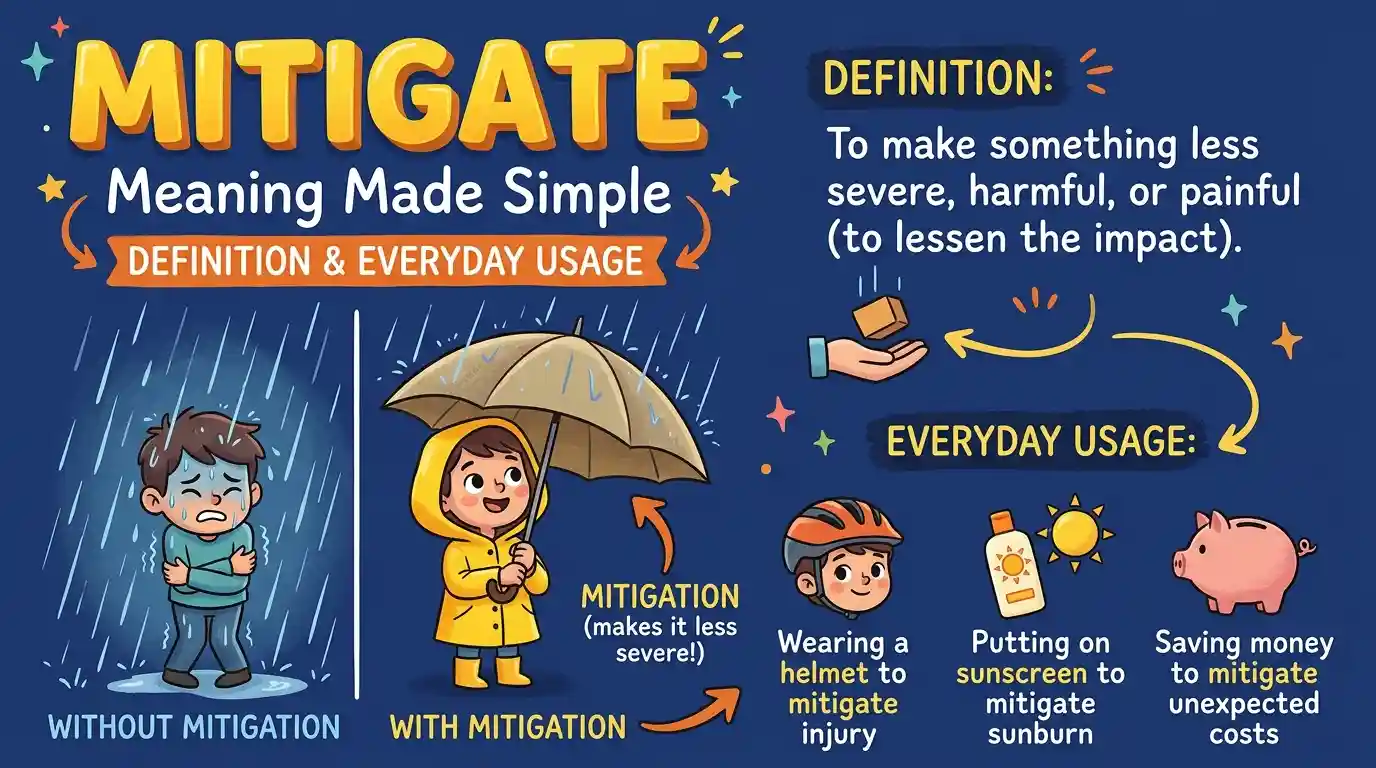
The word mitigate definition & meaning is useful when explaining how to make a problem less serious or harmful. It means reducing the severity of an issue, risk, pain, or difficult situation without necessarily removing it completely.
For example, wearing a helmet can mitigate the risk of a serious injury. Understanding this word can improve your everyday English and help you understand formal writing.
If you enjoy learning unfamiliar terms, you can also explore Anjin Meaning for another word-meaning guide.
What Does Mitigate Mean?
Mitigate is a verb that means to make something less severe, harmful, painful, or serious. It describes an action that reduces the negative effects of a problem instead of necessarily eliminating the problem itself. For example, taking regular breaks may mitigate stress during a busy workday. The stress might not disappear completely, but breaks can make it easier to manage.
People use this word in different situations. A doctor may discuss ways to mitigate pain, a business may introduce policies to mitigate financial risks, and a family may take precautions to mitigate damage from a storm. In each example, the goal is to reduce harm or severity.
Mitigate is a relatively formal word, so you may see it more often in articles, reports, professional discussions, and educational materials than in casual text messages. However, understanding it can help you communicate clearly in both formal and everyday situations.
Mitigate Meaning in English
In English, mitigate means to reduce the intensity, seriousness, or harmful impact of something. It is commonly used when someone takes steps to make a difficult situation less damaging or easier to handle. The word does not promise that the problem will disappear entirely.
For example, planting trees and improving drainage may mitigate the effects of heavy rainfall in a neighborhood. These actions can reduce certain risks, although they may not prevent every flood. Similarly, speaking calmly during an argument may mitigate tension without resolving every disagreement.
The noun form of mitigate is mitigation. It refers to the process or action of reducing harm, severity, or negative consequences. You might hear the phrase “risk mitigation” in workplaces, technology, and business planning.
The pronunciation of mitigate is commonly represented as /ˈmɪt.ɪ.ɡeɪt/. Its main stress falls on the first syllable. Learning the definition, pronunciation, and examples together makes the word easier to recognize and use correctly.
For another vocabulary topic, read Linklater Meaning to explore the meaning and usage of a different term.
Mitigate Meaning in Text
In text messages, mitigate usually means to reduce a problem, ease tension, or make a difficult situation less severe. It is not a common texting abbreviation and does not normally stand for a separate phrase.
Someone might write, “A quick call could mitigate the misunderstanding.” This means that talking on the phone might reduce confusion between two people. Another example is, “Let’s find a way to mitigate the damage.” Here, the sender wants to limit the negative effects of a situation.
Because mitigate sounds formal, people often choose simpler words when messaging friends. They may say “reduce the problem,” “make things easier,” or “calm things down” instead. Still, mitigate can be useful when discussing serious concerns or explaining a practical solution.
Always consider the complete message before deciding what the sender means. The word itself generally refers to reducing severity, but the exact issue being reduced depends on the surrounding sentence.
Mitigate Meaning in Slang
Mitigate does not have a widely established slang definition that replaces its standard English meaning. In casual conversations, people may use it to describe reducing drama, easing awkwardness, or making a disagreement less serious. These uses are extensions of the ordinary definition rather than a separate slang meaning.
For example, “A joke helped mitigate the awkward moment” means that humor made the situation less uncomfortable. Similarly, “We need to mitigate the drama before it gets worse” means that the people involved should take steps to reduce the conflict.
In everyday slang, people are more likely to use words such as “chill,” “calm down,” “ease up,” or “make it better.” Mitigate sounds more formal, so it may stand out in a casual conversation.
If you are learning internet slang, remember that not every unfamiliar word is an abbreviation or trend. Some words keep their regular dictionary meanings even when people use them online. You can also read YNS Meaning to explore another expression used in digital conversations.
Mitigate Meaning on TikTok
On TikTok, mitigate generally means reducing the severity or negative impact of something. The word may appear in educational videos, workplace advice, mental wellness content, safety discussions, and explanations of everyday problems. It is not a widely recognized TikTok-specific acronym.
For example, a creator might post a video saying, “Taking breaks can mitigate burnout.” The message means that regular rest may help reduce exhaustion associated with prolonged stress. Another creator might explain how planning ahead can mitigate problems during a busy week.
You may also see the word in captions discussing online arguments or misunderstandings. In that context, mitigating a conflict means taking steps to lower tension rather than making the situation worse.
TikTok trends change frequently, so a creator could use a word in a particular joke or niche community. However, without a specific trend or caption providing a different meaning, the standard definition is the safest interpretation. Look at the entire video and its caption to understand how the word is being used.
Mitigate Meaning on Snapchat
On Snapchat, mitigate means to make a problem, risk, or uncomfortable situation less severe. It does not have a commonly accepted Snapchat-only slang meaning. Someone might use it in a direct message, private story, or conversation about resolving a disagreement.
For example, a friend might send, “Let’s talk and mitigate the misunderstanding.” This means they want to discuss what happened and reduce the confusion between them. Another message could say, “A little planning will mitigate the stress tomorrow,” meaning preparation may make the next day less stressful.
In casual Snapchat conversations, shorter phrases are usually more natural. People may say “sort it out,” “make it easier,” or “calm things down” instead of mitigate.
If you receive this word in a message, focus on the sentence around it. The sender is most likely talking about reducing the impact of a problem, not using a hidden code or secret abbreviation.
Mitigate Meaning on Instagram
On Instagram, mitigate may appear in educational posts, professional captions, relationship advice, safety tips, and discussions about personal well-being. Its standard meaning remains the same: to reduce the severity or harmful effects of something.
For example, a caption might say, “Healthy boundaries can mitigate unnecessary stress.” This means that clear personal limits may help reduce stressful situations. A business account might write, “Strong security practices help mitigate online risks,” referring to steps that lower the chance or impact of digital problems.
The word is not a special Instagram abbreviation. It is simply a regular English word that can be used in captions, comments, reels, and informational posts.
If you are writing an Instagram caption, choose mitigate when you want a professional or informative tone. For a casual audience, words like “reduce,” “ease,” or “avoid making things worse” may sound more natural. You can explore Franci Meaning for another word-meaning topic.
Mitigate Definition and Examples Table
A simple table makes the meaning of mitigate easier to remember. The word is often connected to problems, risks, pain, stress, and damage. Each example below shows how it works in a different context.
| Word or phrase | Meaning | Example |
|---|---|---|
| Mitigate | Make something less severe | Rest may mitigate fatigue. |
| Mitigate a risk | Reduce potential danger or impact | A helmet can mitigate the risk of injury. |
| Mitigate stress | Make stress less intense | Exercise may mitigate stress. |
| Mitigate damage | Reduce harmful effects | Quick repairs can mitigate water damage. |
| Mitigate a problem | Make an issue less serious | Better planning can mitigate delays. |
| Mitigation | The process of reducing harm | Flood mitigation can protect communities. |
| Mitigating circumstances | Factors that may reduce blame or severity | The court considered the mitigating circumstances. |
The most important point is that mitigate describes a reduction in severity or impact. It does not automatically mean that a problem has been solved completely.
Mitigate Synonyms and Antonyms
Synonyms and antonyms help you understand how mitigate relates to other English words. A synonym has a similar meaning, while an antonym expresses an opposite idea. The best word depends on the context because reducing pain is slightly different from reducing risk or preventing damage.
| Synonym | Meaning | Antonym | Meaning |
|---|---|---|---|
| Alleviate | Make pain or difficulty less severe | Aggravate | Make a problem worse |
| Lessen | Reduce the amount or intensity | Intensify | Make something stronger |
| Reduce | Make something smaller or lower | Worsen | Make a situation worse |
| Ease | Make something less difficult | Exacerbate | Make an existing problem worse |
| Relieve | Reduce pain, pressure, or worry | Escalate | Make a situation more serious |
| Diminish | Make something less strong or important | Increase | Make something greater |
For example, “The treatment may alleviate pain” communicates a similar idea to “The treatment may mitigate pain.” In contrast, “The treatment may aggravate the pain” means that it could make the pain worse.
Use mitigate when you want to emphasize reducing harmful effects. Use a simpler synonym when it makes your sentence clearer or more natural.
Mitigate Meaning in a Sentence
Reading examples is one of the easiest ways to understand how mitigate works in real English. The word is often followed by a noun that identifies the problem, risk, or harmful effect being reduced.
Here are some simple examples:
- Wearing a helmet can mitigate the risk of a head injury.
- Taking a short walk may mitigate stress after work.
- The company changed its policies to mitigate workplace risks.
- Good communication can mitigate confusion among team members.
- The apology helped mitigate the tension between the friends.
- Emergency planning can mitigate the effects of a natural disaster.
- Drinking enough water may help mitigate mild dehydration.
- Insurance can help mitigate certain financial losses.
- The teacher offered extra time to mitigate the effects of the delay.
- Regular maintenance can mitigate the risk of equipment failure.
Notice that each sentence describes an action that reduces a negative effect. The problem may still exist, but its impact becomes less severe or easier to manage.
Mitigate the Risk Meaning
The phrase mitigate the risk means to take steps that reduce the likelihood or potential impact of a harmful event. It is commonly used in business, finance, technology, healthcare, construction, and everyday planning.
For example, backing up important files can mitigate the risk of losing information if a computer fails. A company might train employees to mitigate workplace safety risks. A family could prepare an emergency kit to reduce the impact of a power outage or severe storm.
Risk mitigation does not guarantee that an unwanted event will never happen. Instead, it focuses on preparation, prevention, and reducing possible consequences.
A simple example is wearing a seat belt. It cannot eliminate every danger associated with driving, but it can reduce the risk of serious injury in many crashes. This illustrates why mitigating a risk is different from removing it completely.
Mitigate the Issue Meaning
Mitigate the issue means to reduce the seriousness or negative effects of a problem. The phrase is useful when a complete solution is not immediately available, but action can still make the situation better.
For example, a manager may adjust work schedules to mitigate staffing difficulties. A school might provide extra resources to mitigate learning challenges. A family may create a budget to mitigate financial pressure.
Mitigating an issue can be the first step toward a permanent solution. It can give people time to understand the problem, reduce immediate harm, and decide what to do next.
In simpler English, the phrase means “make the problem less serious” or “reduce the impact of the problem.” The best approach depends on the issue and the available options.
Mitigate a House Meaning
The phrase mitigate a house is not a common standalone expression in standard English. Its intended meaning depends on the context. In property, construction, or insurance discussions, the speaker may mean mitigating damage to a house or reducing risks associated with a property.
For example, repairing a leaking roof can mitigate further water damage. Installing smoke alarms may mitigate certain fire-related risks. Improving drainage around a building may reduce the potential impact of heavy rain.
More natural phrases include “mitigate damage to a house,” “mitigate property damage,” and “mitigate risks to a home.” These expressions explain exactly what is being reduced.
If you encounter “mitigate a house” in a document, check the full sentence to see whether it refers to damage, environmental hazards, insurance, or another property-related concern.
Mitigating Circumstances Meaning
Mitigating circumstances are facts or conditions that help explain why something happened or may reduce the level of blame or severity associated with an action. This phrase is commonly used in legal, disciplinary, and formal discussions.
For example, a decision-maker might consider a person’s difficult circumstances before deciding on an appropriate consequence. These circumstances do not necessarily excuse the action, but they may influence how seriously it is viewed.
In everyday English, the phrase can also refer to factors that make a situation more understandable. A student who submits work late because of an unexpected emergency might explain the circumstances to a teacher.
The key idea is that mitigating circumstances provide context that may lessen the seriousness of a situation or affect how it is judged.
For another vocabulary guide, see Deenie Meaning to explore a different term and its possible interpretations.
How to Use Mitigate Correctly
Use mitigate when you are describing an action that reduces the severity, harm, or negative impact of something. It works well in formal writing, professional communication, academic work, and many everyday explanations.
A useful sentence pattern is action + mitigate + problem or risk.
Examples include:
- Better planning can mitigate delays.
- New safety measures may mitigate the risk of accidents.
- Open communication can mitigate misunderstandings.
- Rest can help mitigate tiredness after a demanding day.
- Regular maintenance can mitigate equipment-related risks.
Avoid using mitigate when you specifically mean that a problem has been completely removed. For example, if a company fixes a broken system entirely, “resolve the problem” may be more accurate. If the company only reduces the system’s negative effects while working on a permanent fix, mitigate is appropriate.
Choosing the correct word makes your writing more precise. When in doubt, ask whether the action reduces the problem or eliminates it. If it mainly reduces the severity or impact, mitigate is usually a good choice.
Frequently Asked Questions About Mitigate
Does mitigate mean reduce?
Yes. Mitigate means to reduce the severity, harm, or negative impact of something. It usually describes making a problem less serious rather than eliminating it completely.
Is mitigate a positive or negative word?
Mitigate is generally neutral in tone, but it often describes a positive action because it involves reducing harm, risk, pain, or difficulty.
What is the noun form of mitigate?
The noun form is mitigation. For example, “Risk mitigation is important when planning a project” means that reducing possible risks is an important part of the plan.
Is mitigate formal or informal?
Mitigate is more common in formal and professional English, although it can be used in everyday conversations. Words such as reduce, ease, and lessen are often more natural in casual messages.
What is the opposite of mitigate?
Common antonyms include aggravate, worsen, intensify, and exacerbate. These words describe making a problem or situation more severe.
Final Thoughts
Mitigate means to make a problem, risk, pain, or harmful effect less severe.
It describes reducing the impact of an issue rather than always removing it completely.
The word is useful in conversations about health, safety, work, relationships, and everyday challenges.On TikTok, Snapchat, and Instagram, it generally keeps its standard English meaning instead of acting as special slang. Learning its synonyms, antonyms, and sentence examples can help you understand and use the word with confidence. Whenever an action makes a difficult situation less harmful or easier to manage, mitigate may be the right word.