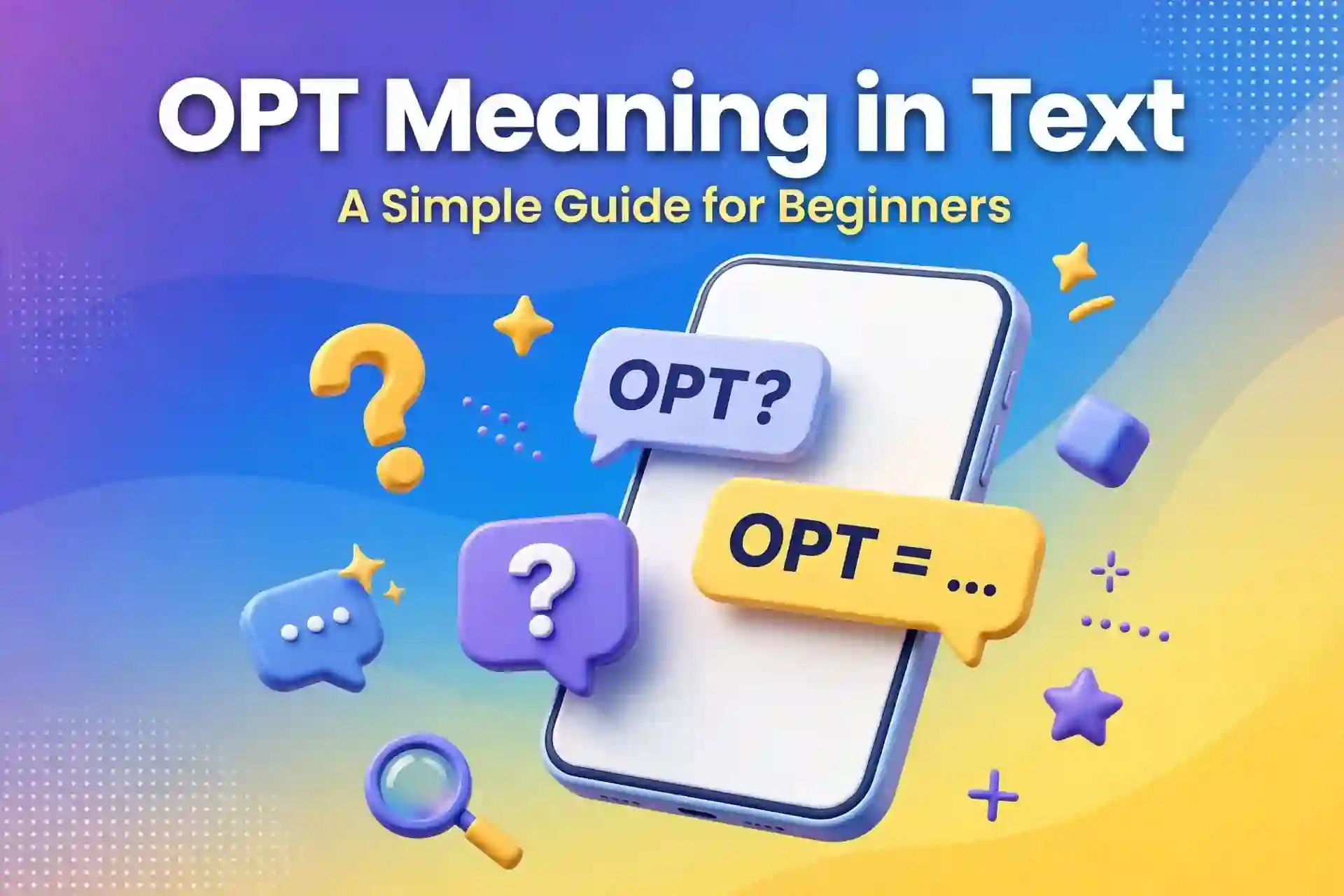
When it comes to online conversations, short forms and abbreviations can make messages confusing. OPT is one of those terms that can have different meanings depending on the conversation. Understanding the opt meaning in text helps you avoid confusion and respond naturally. People may use OPT when discussing choices, preferences, plans, or everyday situations. Its meaning can also change across social media, messaging apps, and professional conversations. This guide explains what OPT means in texting, how people use it, and how to understand it in different situations. You will also find practical examples, common replies, related abbreviations, and tips for using OPT correctly.
What Does OPT Meaning in Text?
OPT usually means “option,” “optional,” or “opt for,” depending on how someone uses it. The surrounding words help you understand the intended meaning.
In everyday texting, opt meaning in text does not have one fixed slang definition. It often appears as a shortened form of a longer word or expression.
Here are the most common meanings:
- Option: A choice between two or more possibilities.
- Optional: Something a person can choose to do or ignore.
- Opt for: To choose or select something.
- Opt out: To decide not to participate in an activity or service.
For example:
- “You have another OPT.” This may mean you have another option.
- “The meeting is OPT.” This may mean attendance is optional.
- “I will OPT for the blue one.” This means the person will choose the blue one.
The exact meaning depends on the sentence. Some people use OPT casually, while others use it as a short form in work-related messages.
OPT Meaning in Text Messages and Online Chats
The opt meaning in text messages depends on the topic, tone, and relationship between the people chatting. A simple sentence can reveal what the sender wants to communicate.
People often shorten words when they want to send quick messages. OPT may appear in casual conversations, group chats, online discussions, and personal messages.
1. OPT meaning in text as Option
This is one of the most understandable interpretations of the abbreviation. Someone may use OPT when discussing available choices.
For example:
- “What is your best OPT?”
- “We have one more OPT.”
- “Choose the best OPT for your project.”
In these examples, OPT refers to an option. The sender wants to discuss a choice or possible solution.
You may see this usage when friends plan activities, compare products, or make decisions.
2. OPT meaning in text as Optional
OPT can also represent something that a person does not have to do. This meaning often appears in instructions, schedules, and group conversations.
For example:
- “The extra class is OPT.”
- “This activity is OPT for everyone.”
- “Attendance tomorrow is OPT.”
The sender means that participation is not compulsory. You can join if you want, but you do not have to.
3. OPT meaning in text as Opt For
Sometimes, people use OPT when they mean choosing something over another possibility.
For example:
- “I will OPT for the second plan.”
- “She decided to OPT for online classes.”
- “We should OPT for a cheaper package.”
In these sentences, OPT connects to the expression “opt for.” It describes a decision or preference.
4. OPT meaning in text as Opt Out
Another related expression is “opt out.” It means choosing not to take part in something.
For example:
- “I want to OPT out of the group.”
- “You can OPT out anytime.”
- “He decided to OPT out of the competition.”
This usage appears in conversations about subscriptions, activities, online services, and personal decisions.
How Is opt meaning in text Used on Social Media?
Social media users often use abbreviations to make captions, comments, and messages shorter. OPT may appear when someone discusses choices, preferences, or participation.
Platforms such as Instagram, TikTok, Snapchat, Facebook, and WhatsApp allow people to communicate quickly. Short forms can make these conversations easier.
Here are some possible examples.
Instagram:
- “Which outfit is the best OPT?”
- “I will OPT for this look.”
- “This feature is OPT for my account.”
TikTok:
- “You can OPT for either trend.”
- “I would OPT for the first video.”
- “That challenge is OPT.”
Snapchat:
- “What OPT do we have?”
- “I will OPT for your idea.”
- “The second plan is my OPT.”
WhatsApp:
- “We have two OPTs for dinner.”
- “This meeting is OPT.”
- “You can OPT out if you’re busy.”
These examples show how the abbreviation may appear in different digital conversations. However, opt meaning in text is not a universally recognized social media slang term. Some users may prefer writing the complete word.
OPT Meaning in Text From a Girl or Guy
When someone sends OPT in a private message, the meaning usually depends on what you were discussing. The abbreviation does not automatically express romantic interest, attraction, or a special feeling.
Understanding the conversation .can help you interpret the message correctly.
When a Girl Uses OPT
A girl might use OPT when discussing plans, preferences, or available choices.
Examples:
- “That’s the best OPT.”
- “I’ll OPT for the first one.”
- “You have another OPT.”
- “This is an OPT activity.”
She may simply be sharing her opinion or explaining a decision.
If she sends OPT while discussing an outfit, restaurant, or weekend plan, she probably means an option or choice.
When a Guy Uses OPT
A guy may also use OPT to discuss decisions or possibilities.
Examples:
- “We have another OPT.”
- “I’ll OPT for this one.”
- “That sounds like a good OPT.”
- “You can OPT out.”
These messages do not have a hidden romantic meaning. They communicate a preference or decision.
Does OPT Have a Flirty Meaning?
OPT does not have a standard flirty meaning in everyday texting. A person may use it during a romantic conversation, but the abbreviation itself does not show attraction.
For example:
“You’re my best OPT.”
This sentence could sound playful or romantic because of its wording. The affectionate tone comes from the complete message, not from OPT alone.
Real-Life Examples of opt meaning in text
Examples make abbreviations easier to understand. The following conversations show how people might use OPT when discussing different situations.
Example 1: Choosing a Restaurant
Person A: Where should we eat tonight?
Person B: We have two OPTs.
A: What are they?
Person B: Pizza or burgers.
Here, OPT means options. Person B is suggesting two possible places or food choices.
Example 2: Discussing a Class
Person A: Do I need to attend the extra session?
B: No, it’s OPT.
Person A: Great! Thanks for telling me.
In this conversation, OPT means optional. The student does not have to attend.
Example 3: Choosing an Outfit
Person A: Which dress should I wear?
B: OPT for the black one.
Person A: Good idea!
Here, the sender uses OPT as part of “opt for.” They recommend choosing the black dress.
Example 4: Leaving an Activity
Person A: Are you joining the weekend event?
B: No, I’ll OPT out this time.
Person A: No problem!
This example uses the expression opt out. The person chooses not to participate.
How to Reply When Someone Says OPT
Your response should match the meaning of the original message. You do not need to use another abbreviation if you are unsure about the sender’s intention.
Here are some natural replies for different situations.
If OPT Means Option
Try these responses:
- “What other options do we have?”
- “I like the first one.”
- “Let’s compare both choices.”
- “That sounds like a good option.”
- “Which one would you recommend?”
If OPT Means Optional
You can respond with:
- “Okay, thanks for letting me know.”
- “Great! I’ll decide later.”
- “So, I don’t have to attend?”
- “Thanks for clarifying.”
- “I’ll join if I have time.”
If OPT Means Opt For
You can say:
- “That’s a smart choice.”
- “I agree with your decision.”
- “I’ll choose the same one.”
- “Why did you prefer that option?”
- “That works for me.”
If OPT Means Opt Out
Try these replies:
- “That’s completely fine.”
- “You can skip it if you want.”
- “I understand your decision.”
- “No pressure at all.”
- “Thanks for telling me.”
If You Do Not Understand OPT
It is perfectly fine to ask the sender for clarification.
You can say:
- “What do you mean by OPT?”
- “Do you mean option?”
- “Can you explain that?”
- “What does OPT stand for here?”
- “Are you saying it’s optional?”
A simple question can prevent misunderstandings.
Different Meanings of OPT in Other Contexts
OPT does not always refer to an option or a personal choice. The abbreviation also has established meanings in education, employment, technology, and other fields.
Understanding these meanings helps you avoid confusing a casual text with a specialized term.
1. OPT in Education and Immigration
OPT stands for Optional Practical Training in the United States immigration and education context.
It is a temporary employment authorization for eligible F-1 international students. It allows students to gain practical work experience related to their major field of study.
There are two main types:
- Pre-completion OPT: Students may participate before completing their academic program, subject to applicable rules.
- Post-completion OPT: Students may participate after completing their academic program.
2. OPT in Technology
In technology-related conversations, OPT may appear as an abbreviation for different technical terms.
Its meaning depends on the software, device, or subject being discussed. It may appear in file names, system settings, programming discussions, or technical instructions.
3. OPT in Business Conversations
Business professionals may use OPT when discussing available choices, plans, or decisions.
For example:
- “Review the OPT before approving the proposal.”
- “We need another OPT for the client.”
- “The team will OPT for the lower-cost package.”
4. OPT in Gaming and Online Communities
Gaming communities use many short forms to communicate quickly. OPT may appear when players discuss possible strategies, settings, or choices.
For example:
- “That’s my best OPT for this match.”
- “You can OPT out of the event.”
- “Let’s OPT for another strategy.”
OPT vs. Similar Texting Abbreviations
Some abbreviations look similar or express related ideas. Knowing the differences can help you understand messages more accurately.
| Term | Meaning | Example |
| OPT | Option, optional, or opt for | “Choose the best OPT.” |
| BTW | By the way | “BTW, are you coming?” |
| IMO | In my opinion | “IMO, this looks better.” |
| IDK | I don’t know | “IDK what to choose.” |
| FYI | For your information | “FYI, the class is optional.” |
| N/A | Not applicable or not available | “That section is N/A.” |
| ASAP | As soon as possible | “Send it ASAP.” |
Common Mistakes People Make When Using OPT
People sometimes misunderstand abbreviations because they assume every short form has one universal meaning. OPT is especially easy to misinterpret without context.
Avoid these common mistakes.
1. Assuming OPT Always Means Option
OPT can represent several expressions. It may refer to something optional or appear in the phrase opt for.
Read the complete sentence before deciding what the sender means.
2. Confusing OPT With a Romantic Expression
OPT does not automatically mean someone likes you. It does not have a standard romantic or flirty definition.
Look at the complete conversation before interpreting someone’s feelings.
3. Ignoring the Conversation Topic
A discussion about university employment may involve Optional Practical Training. A discussion about dinner may involve food options.
The topic often provides the strongest clue.
4. Using OPT in Formal Writing
Abbreviations can make casual messages shorter. They may also make professional communication unclear.
Tips for Understanding OPT in Different Conversations
You can understand unfamiliar abbreviations by looking at a few simple clues. These habits work for OPT and many other texting expressions.
- Read the complete sentence: Never judge an abbreviation by its letters alone.
- Check the topic: Identify whether the conversation involves choices, education, work, or technology.
- Look at the surrounding words: Expressions such as “for” and “out” can change the meaning.
- Consider the sender: A classmate may use OPT differently from an employer or immigration adviser.
- Ask for clarification: A quick question is better than making an incorrect assumption.
- Avoid unnecessary abbreviations: Use clear language when messaging someone who may not understand texting slang.
These tips can make online conversations easier to follow. They also help you avoid awkward replies.
Is OPT Still Common in Texting?
OPT is understandable in many contexts, but it is not among the most widely recognized everyday texting abbreviations. People more often write “option,” “optional,” or “opt for” in full.
Its use may vary between friend groups, workplaces, and online communities. Some people shorten words to save time. Others prefer complete expressions because they reduce confusion.
FAQs About OPT Meaning in Text
These frequently asked questions explain common interpretations of OPT. They also cover its use in private messages, online conversations, and everyday communication.
1. What does OPT meaning in text?
OPT can mean option, optional, or opt for, depending on the sentence. It may also refer to other terms in specialized contexts. Read the complete message to identify the correct meaning.
2. What does OPT meaning in text on Snapchat?
On Snapchat, OPT may refer to an option, an optional activity, or choosing something. It does not have one universally accepted Snapchat-specific meaning.
3. What does OPT mean from a girl?
When a girl uses OPT, she may be discussing a choice, preference, or decision. The abbreviation itself does not indicate romantic interest.
4. What does OPT mean from a guy?
A guy may use OPT to refer to an available option or explain a decision. The meaning depends on the conversation and surrounding words.
Conclusion
Understanding opt meaning in text becomes easier when you pay attention to the complete message. OPT can refer to an option, something optional, or the act of choosing through the expression “opt for.” It can also appear in specialized conversations about education, immigration, business, and technology.
The most important thing is to avoid assuming that OPT always has the same meaning. A message about choosing dinner may use it differently from a conversation about university employment. The words around the abbreviation usually provide enough information to understand the sender.