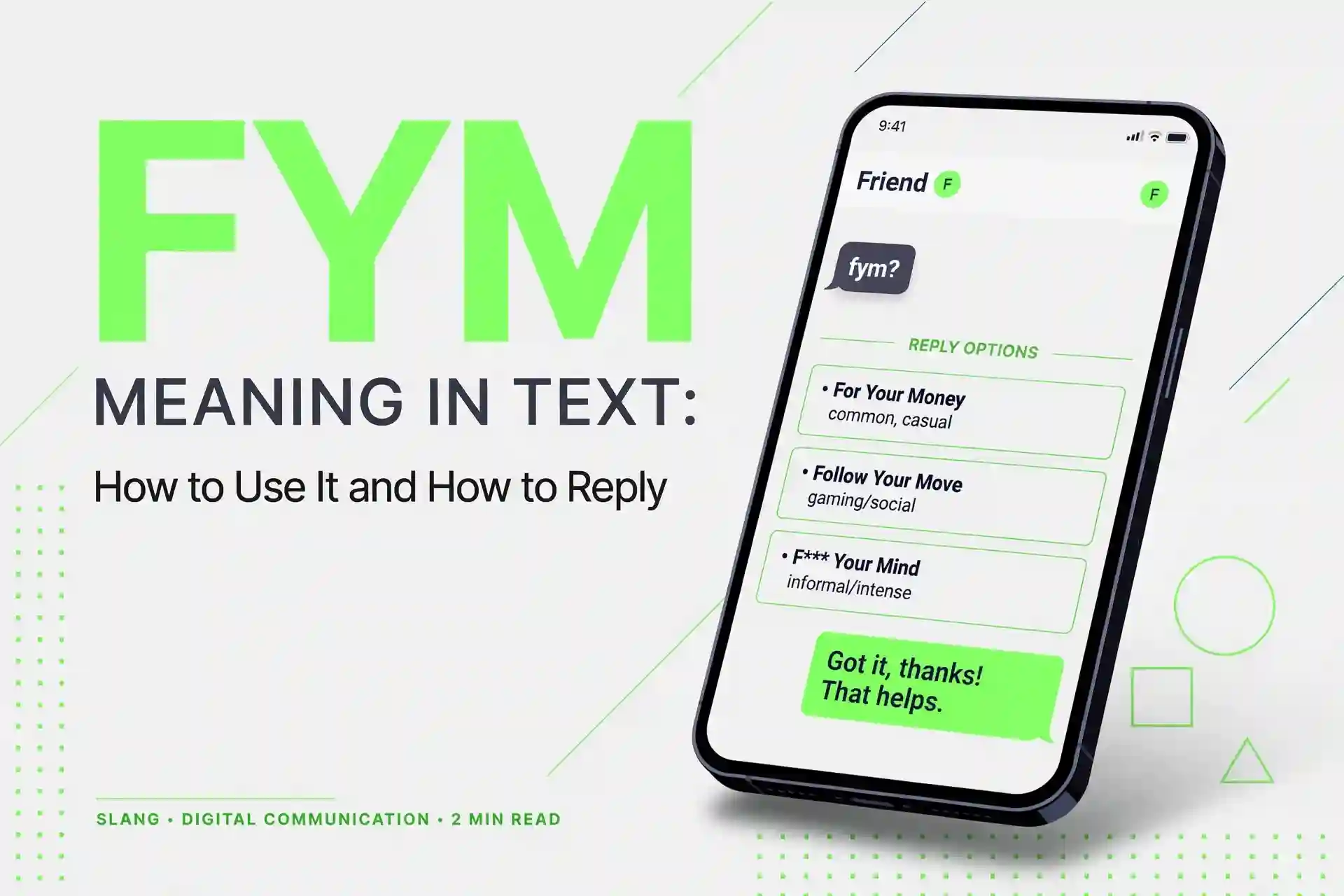
When it comes to online chats, short slang terms make conversations faster and more casual. FYM meaning in text is a common question among people who see this abbreviation in text messages, social media comments, and private chats. FYM usually stands for “F*** You Mean?” People use it to ask someone what they mean, show confusion, or express surprise. Its tone can sound playful, rude, or confrontational, depending on the conversation.
Understanding this slang can help you avoid confusion and respond with confidence. This guide explains what FYM means, where people use it, how to reply, and when you should avoid it. You will also find simple examples and similar texting abbreviations.
What Does FYM Meaning in Text?
FYM stands for “F*** You Mean?” in texting and online conversations. People use it when they want someone to explain a confusing, surprising, or unexpected statement. It often expresses disbelief, curiosity, or frustration.
The phrase works like “What do you mean?” but sounds stronger and more informal. The word “f***” adds emotion to the question. It can make a message sound funny between close friends. It can also make the same question sound aggressive in a serious conversation.
For example:
- Friend: “I’m not coming to your party.”
- You: “FYM? You said you would!”
- Friend: “I have to work tomorrow.”
In this example, FYM shows surprise and asks for an explanation.
Common meanings include:
- What do you mean?
- What are you talking about?
- Why would you say that?
- Can you explain that?
- Are you serious?
The exact meaning depends on the message and the relationship between the people chatting.
FYM Meaning in Texting and Social Media
The FYM abbreviation appears in different online spaces. People use it in private messages, comment sections, group chats, and social media posts. Its meaning usually stays the same, but the tone can change with the platform and situation.
FYM Meaning in Text Messages
In text messages, FYM helps people react quickly to something confusing or unexpected. Friends may use it when they disagree with a statement or want more details.
For example:
- Person A: “I think your favorite movie is boring.”
- Person B: “FYM? That’s a classic!”
Here, the sender uses FYM to show disbelief and defend their opinion.
You may also see it in short conversations:
- “FYM by that?”
- “FYM, bro?”
- “Wait, FYM?”
- “FYM you mean?”
These messages ask the other person to explain their statement. The abbreviation creates a casual tone, but it can sound harsh to someone who does not know the sender well.
FYM Meaning in text on Snapchat
Snapchat users often use short abbreviations to keep conversations quick. FYM can appear in snaps, private messages, and story replies.
A friend might post something surprising. You could reply with “FYM?” to ask what happened.
Example:
- Friend’s story: “Never trusting anyone again.”
- Your reply: “FYM? What happened?”
This response shows curiosity and invites the person to explain the situation.
FYM Meaning in text on Instagram
Instagram users may use FYM in comments, reels, and direct messages. It often appears when someone reacts to an unusual opinion, funny video, or surprising post.
For example:
- User: “Pizza tastes better without cheese.”
- Comment: “FYM? 😂”
The commenter expresses disbelief in a playful way.
Some users also use FYM to challenge opinions. The emoji and surrounding words help readers understand whether the comment is serious or humorous.
FYM Meaning in text on TikTok
TikTok users often use slang in video captions, comments, and replies. FYM can express surprise, confusion, or disagreement with a creator’s statement.
Example:
- Creator: “I don’t like weekends.”
- Viewer: “FYM? Weekends are the best!”
The viewer uses the abbreviation to question the creator’s opinion.
TikTok comments can reach people who do not know each other. Keep this in mind before using strong slang in public discussions.
How to Use FYM in a Sentence
You can use FYM in several ways. The best choice depends on what you want to express. It can show confusion, surprise, disbelief, or playful disagreement.
Here are common situations where people use it.
1. When You Feel Confused
Use FYM when someone says something unclear. It tells the other person that you need an explanation.
Examples:
- “FYM? I don’t understand.”
- “Wait, FYM by that?”
- “FYM, can you explain?”
- “I’m lost. FYM?”
These examples work best in casual conversations with people you know.
2. When Someone Surprises You
You can use FYM when a friend shares unexpected news. It shows that you did not expect their statement.
Examples:
- “FYM? You’re moving next week?”
- “FYM! You got the job?”
- “FYM? That’s crazy!”
- “FYM, you met him yesterday?”
The abbreviation adds emotion to your reaction.
3. When You Disagree With Someone
FYM can also challenge another person’s opinion. It shows that you strongly question what they said.
Examples:
- “FYM? That game was amazing.”
- “FYM, you think this song is bad?”
- “FYM? That doesn’t make sense.”
- “FYM, how can you say that?”
Use this style carefully. It can sound rude if the other person does not understand your humor.
4. When You Joke With Friends
Close friends often use slang to tease each other. FYM can make a funny reaction feel more natural.
Examples:
- “FYM 😂 You ate the whole pizza?”
- “FYM bro, that’s your new haircut?”
- “FYM? You really wore that?”
- “FYM 😭 I can’t believe you did that.”
Emojis can make the message feel less serious. Still, your relationship with the other person matters.
How to Reply to FYM in Text
Your reply should match the sender’s tone. First, understand whether the person feels confused, surprised, or annoyed. Then give a clear answer.
Here are some natural ways to respond.
1. Give a Clear Explanation on FYM Meaning in Text
If someone asks FYM because they do not understand your message, explain what you meant.
Examples:
- “I mean we should leave earlier.”
- “I’m saying the plan has changed.”
- “I meant that as a joke.”
- “Let me explain what happened.”
A simple explanation can prevent unnecessary confusion.
2. Reply in a Funny Way on FYM Meaning in Text
If a friend uses FYM playfully, you can answer with humor.
Examples:
- “You heard me 😂”
- “Exactly what I said!”
- “Don’t act surprised.”
- “I said what I said.”
- “Read it again, bro.”
These replies work well when both people enjoy casual jokes.
3. Respond When Someone Sounds Angry on FYM Meaning in Text
Sometimes FYM can sound aggressive. Avoid matching the other person’s anger. Ask them to explain their concern.
Examples:
- “What’s confusing you?”
- “I’m just trying to explain.”
- “Why are you upset?”
- “Let me clarify.”
- “I didn’t mean to offend you.”
A calm response can help keep the conversation respectful.
4. Set a Boundary
If someone uses FYM in a disrespectful way, you do not have to accept their tone.
Examples:
- “You can ask me without being rude.”
- “Let’s keep this conversation respectful.”
- “I’m happy to explain, but please be polite.”
- “What’s the issue? We can talk calmly.”
A respectful boundary helps you avoid an unnecessary argument.
FYM Meaning in text in Different Contexts
FYM does not always carry the same emotion. The words around it, the relationship, and the conversation all affect its tone.
| Context | Possible meaning | Example |
| Friendly chat | Playful confusion | “FYM 😂?” |
| Serious discussion | Strong disagreement | “FYM? That’s not true.” |
| Surprising news | Disbelief | “FYM? You’re leaving?” |
| Social media | Reaction to an opinion | “FYM 💀” |
| Argument | Frustration | “FYM? Explain yourself.” |
| Group chat | Funny reaction | “FYM bro!” |
Does FYM Sound Rude?
FYM contains profanity. It can sound rude, especially when you use it with strangers, teachers, coworkers, or people you do not know well.
Close friends may understand it as a normal part of their conversations. They may even use it as a joke.
Your tone matters. Compare these examples:
- “FYM 😂 I thought you were coming!” — playful surprise.
- “FYM? Don’t talk to me like that.” — frustration.
- “FYM by that?” — a request for clarification.
The same abbreviation can communicate different emotions. Consider the situation before deciding how to interpret it.
Can FYM Be Used in Professional Conversations?
FYM is not suitable for most professional conversations. It contains strong language and may sound disrespectful.
Use clearer alternatives when speaking with clients, managers, teachers, or coworkers.
For example:
- “Could you clarify what you mean?”
- “Can you explain that statement?”
- “I’m not sure I understand.”
- “Could you provide more details?”
These phrases communicate the same basic question without using profanity.
FYM vs. Similar Texting Abbreviations
Several texting abbreviations express confusion, surprise, or disbelief. They may look similar, but they do not always carry the same tone.
FYM vs. WYM
WYM stands for “What You Mean?” People use it to ask someone to explain a statement.
FYM has a similar meaning, but it includes stronger language.
Example:
- WYM: “WYM by that?”
- FYM: “FYM by that?”
WYM is usually more neutral. FYM sounds more emotional or informal.
FYM vs. WTF
WTF stands for “What the F***?” People use it to express shock, confusion, or disbelief.
FYM directly questions what someone means. WTF usually reacts to something surprising or strange.
Examples:
- FYM: “FYM? I never said that.”
- WTF: “WTF? What just happened?”
Both expressions contain profanity. Their meanings differ slightly.
FYM vs. WDYM
WDYM stands for “What Do You Mean?” It asks someone to explain their words.
WDYM is a more polite option than FYM. You can use it in casual and semi-formal conversations.
Examples:
- “WDYM by that?”
- “FYM? What are you saying?”
Choose WDYM when you want to sound less aggressive.
FYM vs. HUH
HUH is a simple reaction that shows confusion or surprise. It does not contain profanity.
Examples:
- “Huh? I didn’t hear you.”
- “Huh? What happened?”
HUH works well when you need a quick, neutral response.
Common Mistakes to Avoid When Using FYM
People sometimes misunderstand slang because they focus on the abbreviation instead of the full conversation. Avoid these common mistakes when using FYM.
1. Using It With Everyone
Not everyone feels comfortable with profanity. A close friend may understand your message, but a stranger may find it offensive.
Use neutral phrases when you do not know the person well.
2. Assuming It Always Shows Anger
FYM does not always mean someone is angry. It can express curiosity, surprise, or playful disbelief.
Read the complete message before judging the sender’s mood.
3. Ignoring the Conversation
Context helps you understand the intended meaning. A message sent during a joke may have a different tone from one sent during an argument.
Look at the previous messages, emojis, and relationship before replying.
4. Using It in Formal Writing
Avoid FYM in school assignments, business emails, official messages, and professional documents.
Write the complete question instead. It makes your message clearer and more respectful.
5. Misunderstanding Its Tone
A short message can sound harsher than the sender intended. If you are unsure, ask what the person means.
Do not assume every direct question is an insult.
Tips for Understanding FYM in Online Conversations
Understanding slang becomes easier when you pay attention to how people use it. A few simple habits can help you interpret FYM correctly.
- Read the full message: Do not judge the abbreviation alone.
- Check the relationship: Friends often use stronger slang than strangers.
- Notice emojis: Laughing and crying emojis can suggest a playful reaction.
- Consider the topic: A serious discussion may give the phrase a stronger tone.
- Look at previous messages: Earlier replies can explain the sender’s feelings.
- Ask for clarification: If you are unsure, ask the person what they mean.
- Choose your words carefully: Use neutral alternatives when you need a polite response.
These tips can help you understand casual texting without creating unnecessary misunderstandings.
Frequently Asked Questions About FYM Meaning in Text
1. What Does FYM meaning in Text?
FYM usually stands for “F*** You Mean?” It is an informal abbreviation that people use to ask what someone means. It can express confusion, surprise, disbelief, or frustration. The tone depends on the conversation and the relationship between the people.
2. Is FYM a Bad Word?
Yes, FYM contains profanity because it uses the word “f***.” However, people sometimes use it casually with close friends. It may sound rude or aggressive in other situations. Avoid it in professional and formal conversations.
3. What Does FYM Meaning in text on Snapchat?
On Snapchat, FYM usually means “F*** You Mean?” People use it in chats and story replies when they feel confused or surprised. For example, someone might reply “FYM?” to an unexpected statement.
4. How Should I Reply When Someone Says FYM?
You can explain your message, ask what confused them, or respond with humor. Try replies such as “I mean what I said,” “Let me explain,” or “Which part do you mean?” Choose a response that matches the sender’s tone.
5. Is FYM the Same as WYM?
No. Both abbreviations ask someone to explain what they mean. WYM stands for “What You Mean?” while FYM stands for “F*** You Mean?” WYM sounds more neutral, while FYM carries a stronger and sometimes more aggressive tone.
6. Can I Use FYM With Friends?
Yes. You can use FYM with friends who understand your humor and casual texting style. It may work as a playful reaction to surprising news or an unusual opinion. Avoid using it if your friend dislikes profanity.
Final Thoughts
Texting slang helps people express feelings with fewer words. FYM is one example of an abbreviation that can communicate confusion, surprise, or disbelief in casual conversations. Its common meaning is “F*** You Mean?” People use it in text messages, Snapchat chats, Instagram comments, and TikTok discussions.Understanding FYM meaning in text can help you follow online conversations and avoid misreading someone’s tone. Remember that context matters. A friend may use it as a joke, while another person may use it to express frustration.
You should also consider your audience before using this abbreviation. It contains profanity, so it may not suit every conversation. Choose WYM or WDYM when you want a softer question. Use a clear explanation when someone asks you to clarify your words.The best way to understand any slang term is to look at the complete conversation. This simple habit can help you communicate naturally and confidently online.