
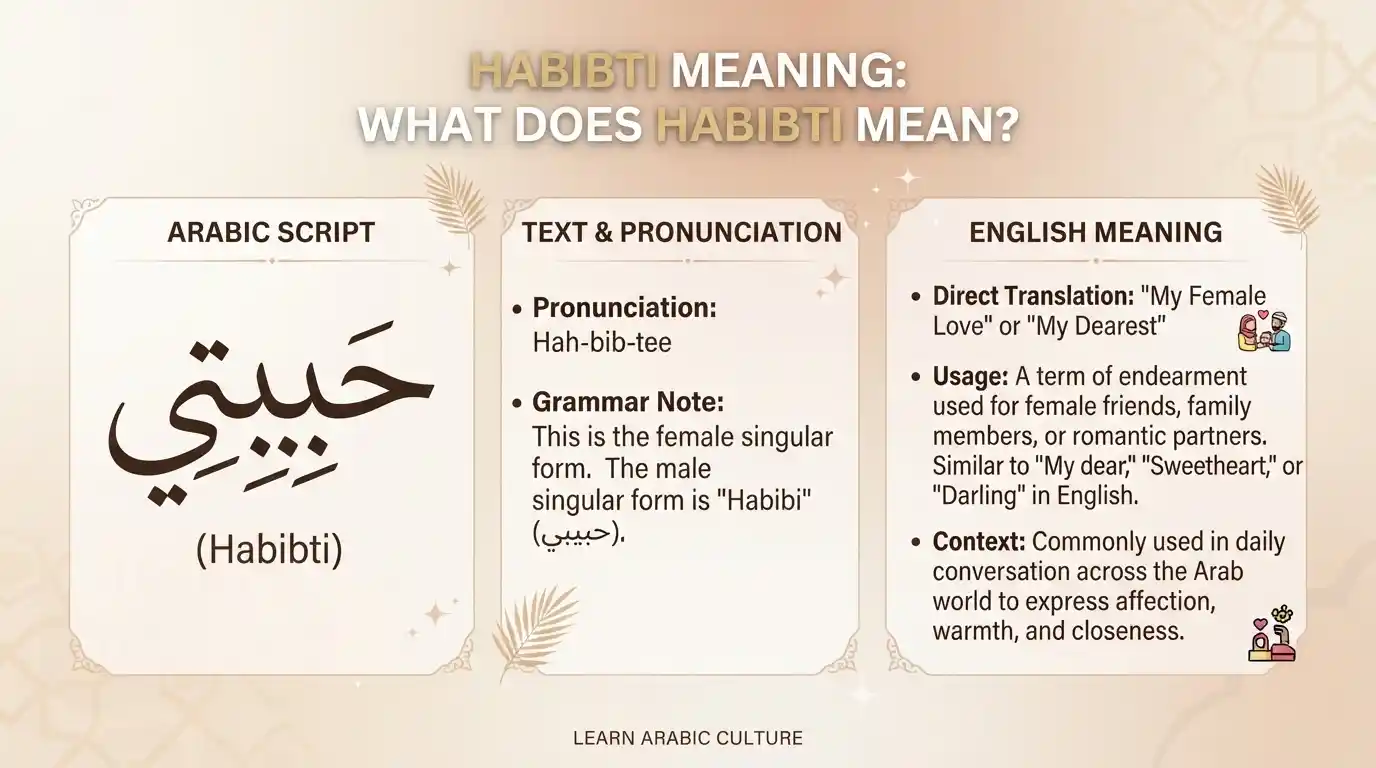
Habibti means “my beloved,” “my dear,” or “my love” in Arabic. It is commonly used when speaking to a female and can express affection, warmth, care, or love depending on the context.
If you have seen “habibti” in a text, Instagram caption, TikTok comment, Snapchat message, or online conversation, you may wonder what this Arabic word actually means. The meaning can vary slightly depending on who says it and how it is used.
In Arabic, habibti (حبيبتي) is the feminine form of the word and is generally addressed to a woman or girl. It can be used between friends, family members, or romantic partners, so it does not always have a romantic meaning.
In this guide, we will explain the Habibti meaning in text, Habibti meaning in Arabic and English, its use in chat and social media, pronunciation, variations, examples, and common ways people use this word.
Habibti Meaning in Arabic
The Habibti meaning in Arabic is “my beloved,” “my dear,” or “my love.”
The Arabic word is written as حبيبتي and is pronounced approximately as ha-BEEB-tee.
The word comes from habib, which means beloved or dear. The ending “-ti” indicates possession, giving the expression the sense of “my beloved” when addressing a female.
Habibti can be affectionate without necessarily being romantic. Arabic speakers may use it with close friends, relatives, children, or someone they love.
Habibti Meaning in English
In English, habibti can be translated as:
- My beloved
- My dear
- My love
- Darling
- Dear girl
The best translation depends on the context.
For example, if a mother calls her daughter “habibti,” it may simply mean “my dear” or “my beloved.” If a romantic partner uses it, it may mean “my love” or “darling.”
Therefore, there is no single English translation that fits every situation.
What Does Habibti Mean in Text?
When someone uses habibti in a text message, they are usually expressing affection, friendliness, or care toward a female.
For example:
“Thank you, habibti ❤️”
This could mean:
“Thank you, my dear.”
The exact meaning depends on the relationship between the people.
In a romantic conversation, habibti may sound more affectionate. Between close friends, it can simply be a warm way of addressing someone.
Habibti Meaning in Chat
In online chats, habibti is often used as a friendly or affectionate form of address.
Someone might write:
“Are you okay, habibti?”
Here, the person may be showing concern and warmth.
Another example is:
“Good night, habibti.”
Depending on the relationship, this could mean “Good night, my dear” or “Good night, my love.”
The surrounding conversation is important for understanding whether the word is friendly, caring, or romantic.
Habibti Meaning on TikTok
The Habibti meaning on TikTok is generally connected with affection, Arabic culture, friendship, and romantic expressions.
You may see the word in captions, comments, videos, or conversations involving Arabic language and culture.
For example:
“Habibti, you look beautiful.”
In this context, the speaker is using the word as an affectionate way to address a female.
TikTok users may also use habibti casually even when they are not native Arabic speakers.
Habibti Meaning on Snapchat
On Snapchat, habibti may appear in private messages, captions, stories, or conversations between friends.
Someone might send:
“Where are you, habibti?”
This can simply mean:
“Where are you, my dear?”
The word does not automatically indicate romance. The relationship between the people determines the tone.
Habibti Meaning on Social Media
Across Instagram, TikTok, Snapchat, and other social platforms, habibti is often used as an affectionate Arabic expression.
People may use it in:
- Instagram captions
- TikTok comments
- Snapchat messages
- Text conversations
- Friendship posts
- Romantic messages
- Arabic-language content
Because the word is widely recognized online, non-Arabic speakers may also use it as part of casual social media conversations.
Why Do People Say Habibti?
People use habibti because it is a warm and affectionate way to address a female.
Some common reasons include:
- Affection — It can show love or warmth.
- Friendship — Close friends may use it casually.
- Family — Parents and relatives may use it with female family members.
- Romance — Romantic partners may use it as a term of endearment.
- Arabic culture — It is a familiar expression in Arabic-speaking communities.
The exact meaning depends on the speaker and the relationship.
Examples of Habibti in Text Messages
Here are some examples showing how habibti may be used:
Example 1:
“Good morning, habibti.”
Meaning: “Good morning, my dear.”
Example 2:
“Thank you for helping me, habibti.”
Meaning: The speaker is warmly thanking a female.
Example 3:
“Are you feeling better, habibti?”
Meaning: “Are you feeling better, my dear?”
Example 4:
“Good night, habibti ❤️”
Meaning: “Good night, my love” or “Good night, my dear,” depending on the relationship.
Example 5:
“Come here, habibti!”
Meaning: A warm or affectionate way of addressing a female.
Habibti Meaning in Different Contexts
The meaning of habibti can change slightly depending on the situation.
1. Romantic Context
A romantic partner may use habibti to mean “my love” or “my beloved.”
2. Friendship Context
Close female friends or friends speaking affectionately may use habibti to mean “my dear.”
3. Family Context
Parents or relatives can use habibti when speaking warmly to a daughter, sister, niece, or another female family member.
4. Casual Context
Someone may use the word simply as a friendly and warm form of address.
5. Social Media Context
Online users may use habibti in captions, comments, memes, and messages to create an affectionate or Arabic-inspired tone.
Habibti vs Habibi
One common question is the difference between habibti and habibi.
Habibti is generally used when addressing a female.
Habibi is generally used when addressing a male.
Both can express meanings such as:
- My beloved
- My dear
- My love
- Darling
The main difference is the gender of the person being addressed.
Habibti Variations in Arabic
You may see several related forms online.
Habibti
حبيبتي — commonly used when addressing a female.
Habibi
حبيبي — commonly used when addressing a male.
Habib
The word habib can mean beloved or dear and forms the base of these expressions.
Ya Habibti
يا حبيبتي can be translated as “O my beloved” or more naturally as “my dear” when directly addressing a female.
These expressions are common in Arabic speech, songs, social media, and casual conversations.
How to Pronounce Habibti
Habibti is commonly pronounced approximately as:
Ha-BEEB-tee
The middle “bee” sound is emphasized.
In Arabic, it is written:
حبيبتي
Pronunciation can vary slightly depending on the Arabic dialect or region.
Is Habibti a Slang Word or an Arabic Word?
Habibti is an Arabic word, not an abbreviation.
It is not like texting abbreviations such as “LOL,” “BRB,” or “IDK.”
It comes from Arabic vocabulary related to affection and being beloved.
Although people frequently use it casually in online conversations, it is still a genuine Arabic expression rather than internet slang created by social media.
Is Habibti Formal or Informal?
Habibti is generally used in personal and affectionate communication.
It can be heard in everyday conversations and may be used with:
- Family members
- Friends
- Romantic partners
- Children
- Close acquaintances
Whether it sounds appropriate depends on the relationship and situation.
In formal professional communication, it is usually better to use the person’s name or an appropriate formal title instead.
How to Respond When Someone Says Habibti
Your response depends on who is saying it and the relationship you have with that person.
If someone uses habibti affectionately, you could respond naturally with:
- “Thank you!”
- “Aww, thank you.”
- “You’re so sweet.”
- “Thanks, my dear.”
- “Aww, habibti.”
If you are unsure whether the person means it romantically or casually, look at the surrounding conversation and your relationship with them.
Common Mistakes When Understanding Habibti
One common mistake is assuming that habibti always means “girlfriend” or “romantic partner.”
That is not necessarily true.
The word can be used affectionately with friends, family members, children, and romantic partners.
Another mistake is confusing habibti with habibi. Habibti is generally used when addressing a female, while habibi is generally used when addressing a male.
Context and the person being addressed help determine the intended meaning.
Habibti vs. Other Terms of Endearment
Habibti is one of many affectionate expressions used around the world.
| Term | Common Meaning | Language |
|---|---|---|
| Habibti | My dear / my beloved | Arabic |
| Habibi | My dear / my beloved | Arabic |
| Darling | Affectionate name | English |
| Sweetheart | Affectionate name | English |
| Mi amor | My love | Spanish |
The exact feeling behind each term depends on the speaker and context.
Is Habibti Still Used Today?
Yes. Habibti is still commonly used in Arabic-speaking communities and is also widely recognized online.
You may see it in social media captions, messages, comments, videos, music, and everyday conversations.
Its popularity online has also introduced the word to people who do not speak Arabic.
However, the way people use it can vary depending on their culture, language background, and relationship with the person they are addressing.
When Should You Use Habibti?
You can use habibti when speaking warmly or affectionately to a female, especially when the context and relationship make the expression appropriate.
It may work naturally in:
- Friendly conversations
- Family conversations
- Casual messages
- Affectionate texts
- Social media captions
- Arabic-language conversations
If you are not familiar with the person’s culture or relationship with you, using their name may be a clearer choice.
Habibti Meaning in Dating or Romantic Conversations
In romantic conversations, habibti can have a more affectionate meaning.
A boyfriend or husband may use it to address a female partner as:
“My love”
or
“My beloved.”
However, the word itself does not prove that two people are romantically involved. Arabic speakers may also use affectionate expressions with family members and friends.
The surrounding conversation and relationship provide the real context.
Habibti Meaning in Family Conversations
Family members can use habibti as a warm term of affection.
For example, a mother might say:
“Come here, habibti.”
In this context, it can simply mean:
“Come here, my dear.”
There is nothing necessarily romantic about the expression. It is simply a loving way of addressing a female family member.
Habibti Meaning in Arabic Culture
The word habibti is connected to Arabic expressions of affection and closeness.
Arabic has many ways to express warmth toward family, friends, and loved ones. Habibti is one of the familiar expressions people may use in everyday communication.
Its meaning can range from “my dear” to “my beloved,” depending on the situation.
This is why translating it with only one English word may not always capture the full feeling of the expression.
FAQs About Habibti Meaning
What does habibti mean?
Habibti means “my beloved,” “my dear,” or “my love” in Arabic. It is generally used when addressing a female.
What does habibti mean in text?
In text messages, habibti is usually an affectionate way of addressing a female. It can mean “my dear,” “darling,” or “my love,” depending on the context.
What does habibti mean in English?
Habibti can be translated as “my beloved,” “my dear,” “my love,” or “darling.”
What does habibti mean in Arabic?
Habibti is written حبيبتي in Arabic and is commonly used to address a female affectionately.
Is habibti romantic?
It can be romantic, but it is not always romantic. Friends and family members can also use habibti affectionately.
Does habibti mean girlfriend?
No. Habibti does not literally mean “girlfriend.” It is an affectionate expression that can mean “my dear,” “my beloved,” or “my love.”
What is the difference between habibi and habibti?
Habibi is generally used when addressing a male, while habibti is generally used when addressing a female.
How do you pronounce habibti?
Habibti is commonly pronounced approximately as ha-BEEB-tee.
What is habibti in Arabic writing?
Habibti is written as حبيبتي in Arabic.
Can a friend call you habibti?
Yes. A friend can use habibti as a warm and affectionate way of addressing a female.
Can a mother call her daughter habibti?
Yes. A mother can use habibti affectionately when speaking to her daughter.
Is habibti a slang word?
No. Habibti is an Arabic expression rather than a modern internet abbreviation. It is commonly used in everyday speech and online communication.
Is habibti formal English?
No. Habibti is an Arabic expression, so it is not a formal English term. It is mainly used in personal or affectionate communication.
What does ya habibti mean?
Ya habibti is an Arabic expression used to directly address a female and can mean “my dear” or “my beloved.”
Final Thoughts
The Habibti meaning is “my beloved,” “my dear,” or “my love” in Arabic. It is generally used when addressing a female and can express affection, care, friendship, or romantic feelings depending on the context.
You may see habibti in text messages, chats, TikTok comments, Instagram captions, Snapchat messages, and everyday Arabic conversations. It can be used by romantic partners, friends, parents, and other family members.
The word should not automatically be interpreted as romantic because its meaning depends on the relationship and situation. Understanding the surrounding conversation makes the intended meaning much clearer.
If someone calls you habibti, they are generally addressing you in a warm or affectionate way. The closest English translations are “my dear,” “my beloved,” “darling,” or “my love.”