Pressure relief devices protect tanks from conditions outside their intended operating range. They are not process-control valves and should never be blocked, defeated, or casually adjusted to stop a nuisance discharge. A brewery needs an asset list, correct ratings, accessible installation, inspection intervals, and a clear response when a device opens unexpectedly.
Match the device to the vessel
Record each tank’s nameplate rating, the relief device model and set condition, and the path by which gas or liquid is discharged. Have a qualified engineer or equipment maker confirm the design basis. A replacement that fits the connection is not necessarily correct for the vessel. Include vacuum protection where the tank design requires it; a vessel can be damaged during draining or cooling as well as by overpressure.
Check that the discharge route does not expose workers to concentrated carbon dioxide or create a blocked line. Relief outlets need to remain clear and protected from accidental isolation according to the design. Local pressure-vessel rules may impose inspection or certification requirements, so use the applicable authority and qualified service provider.
Inspect without changing the setting
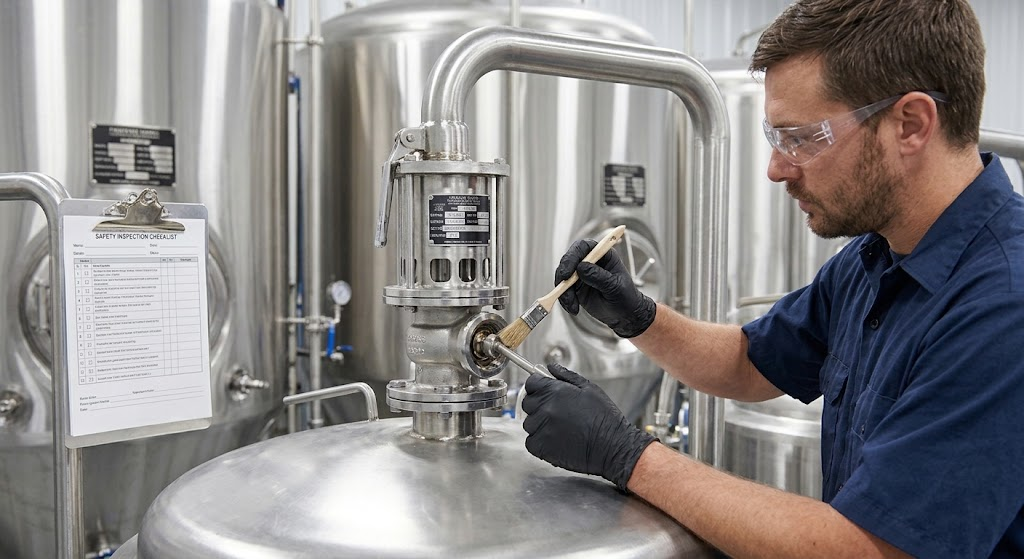
Look for leaks, corrosion, damaged seals, blocked vents, and evidence of repeated discharge. Follow the maker’s procedure for testing and maintenance. Do not lift or dismantle a relief valve on a live tank unless an approved procedure specifically allows it. If a device opens during normal production, investigate the process control, gas supply, temperature change, and valve alignment. Repeated venting is a fault to diagnose, not an excuse to raise the relief setting.
After service, record the replacement part, test documentation, and return-to-service approval. Keep tags readable so staff can identify the protected vessel and device. Coordinate relief-device access with platforms and insulation so the component can be inspected without unsafe improvisation.
When buying pressure rated fermentation tanks or broader brewery tank equipment, ask for nameplate data, relief and vacuum protection details, discharge arrangement, and maintenance instructions. A complete safety file makes future modifications and inspections much easier to manage.
Treat modifications as a new review
Adding a larger gas supply, changing a regulator, connecting tanks, or installing a new cleaning pump can alter the conditions a vessel might see. Review pressure and vacuum protection whenever the system changes. A relief device installed for the original layout may not address a new source of pressure or a blocked discharge path. Include the protected vessel and connected equipment on an updated drawing. Keep old drawings out of the operating binder so technicians are not guided by a superseded system.
If a tank is insulated or enclosed, ensure the device and tag remain accessible for inspection. A relief outlet hidden behind a new platform or pipe is a maintenance problem even if it was correct at delivery.
Respond to an unexpected discharge
Move people clear of the discharge and follow the site’s emergency procedure. Once conditions are safe, document the tank state, valve positions, gas supply, temperature, and any alarm history. Have qualified personnel determine whether the device operated correctly and whether it must be inspected or replaced before return to service. Do not reset or block it simply to finish the batch. A discharge is evidence about the process and protection system; preserving that evidence helps prevent a repeat.
Build a vessel protection register
List every pressurized or vacuum-sensitive vessel with its nameplate information, connected gas and liquid sources, relief and vacuum devices, set values from approved documentation, discharge route, and service date. The register should point to drawings and certificates rather than copying a number from a tag without context. Have a qualified person review the register against the installed plant. A relief device cannot protect a tank if a normally closed valve isolates it from the vessel.
Mark devices so a technician can identify them during routine inspection. Keep insulation, platforms, and pipework from blocking access or discharge. If a device is replaced, update the register and confirm that the replacement matches the engineered requirement.
Look for process causes of nuisance venting
Repeated discharge can be caused by overfilling, gas-regulator faults, heat input, blocked lines, or an inappropriate operating procedure. Record the event time, product state, pressures, temperatures, and control alarms before the system is changed. A single event may reveal a specific valve mistake; a repeated pattern may require control-system review. Do not raise a relief setting to stop a nuisance event. The device’s role is to protect the vessel, and changing it without engineering review can remove that protection.
Plan inspections around production
Agree on inspection and service intervals with the maker and applicable authority. Schedule work when a tank can be isolated and made safe. If a device is sent away for testing, use the approved temporary protection plan or keep the vessel out of service; do not operate an unprotected tank to avoid downtime. After return, record the test result and verify the installed discharge route. Safety depends on the whole arrangement, not merely on a stamped valve body.
Include vacuum scenarios
Cooling, draining, or pump-out can create a vacuum condition in a vessel even when no gas pressure is applied. Review the tank maker’s vacuum rating and protective device arrangement. Do not assume that a pressure relief valve also protects against vacuum. A cleaning or transfer change can introduce a new vacuum risk, so include these scenarios in modification reviews.
Train operators to recognize deformation, unusual sounds, or unexpected gauge behavior as reasons to stop and call qualified personnel. Do not try to “equalize” an uncertain vessel by opening a random port. The correct response depends on the design and current state, and a safe procedure should be available before such an event occurs.
In the asset register, include the last verified service date and the responsible service provider. If a device is removed for testing, tag the protected vessel out of service under the site’s procedure until approved protection is restored. This physical control prevents a different shift from using a tank whose paperwork still looks current but whose relief device is absent.