
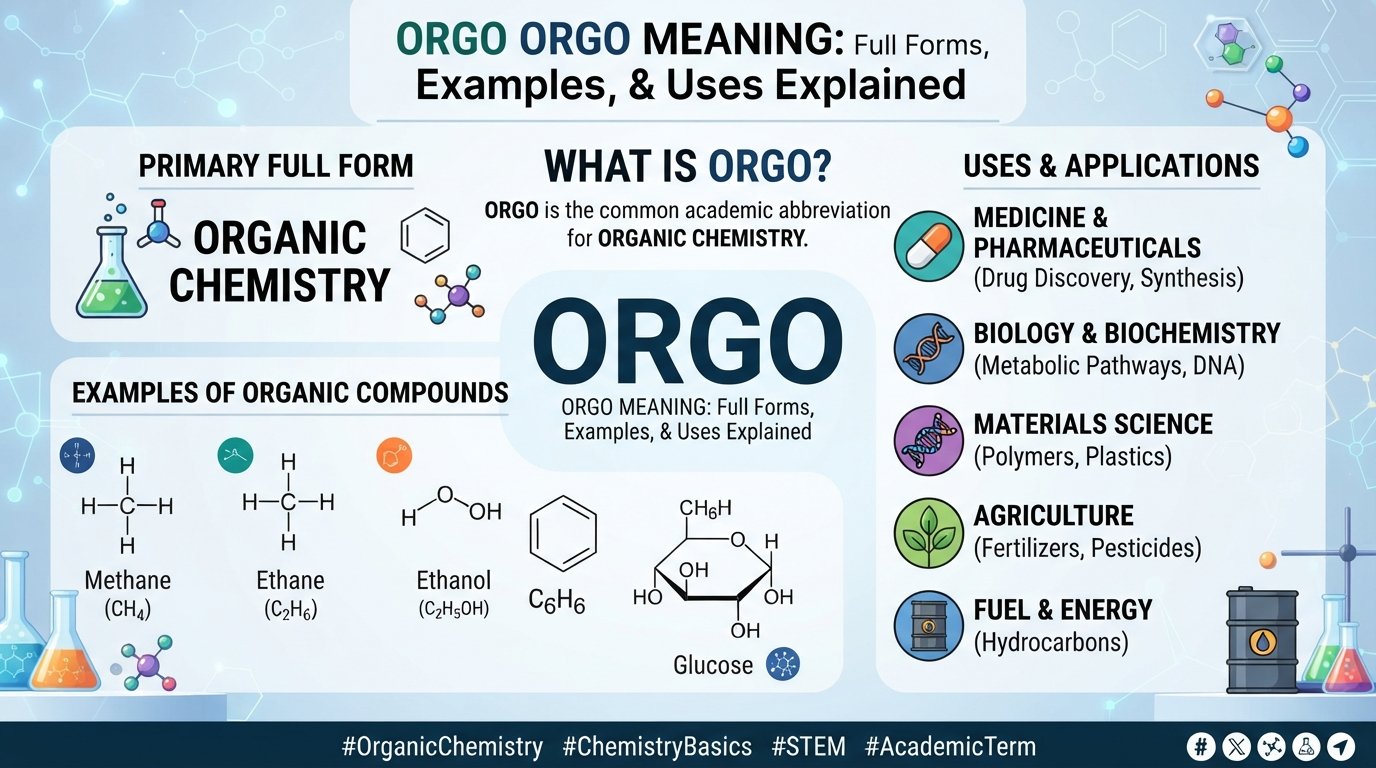
The important thing is that orgo meaning is usually much simpler than it first appears. It is generally an informal shortened form rather than a formal scientific term or official abbreviation.
The term orgo can look confusing when you see it for the first time. In most cases, the word is connected to organic chemistry, but its exact use can depend on the situation.
What Is Orgo?
Orgo is an informal shortened form of organic chemistry. It is commonly used by students, teachers, tutors, and people discussing chemistry in casual settings.
Organic chemistry is the branch of chemistry that studies the structure, properties, reactions, and preparation of carbon-containing compounds.
The word “orgo” is best understood as a clipped or shortened word. This makes conversations shorter and more casual.
For example, a student might say:
- “I have orgo at 10.”
- “My orgo exam is Friday.”
- “I need help with orgo.”
- “Orgo lab was difficult today.”
- “I am studying orgo all weekend.”
In each example, the speaker is talking about organic chemistry.
It is important to remember that orgo is informal. It works well in conversations, texts, student groups, and casual online communication. In a formal academic paper, laboratory report, research article, or professional document, writing organic chemistry is usually clearer.
The term is also not normally an acronym where each letter represents a separate word. It is simply a shortened form of the longer expression.
Orgo Meaning in English
When looking at orgo meaning in english, the easiest explanation is organic chemistry.
The term does not usually function as a standard everyday English word. Instead, it is informal student language. Its meaning comes from shortening the phrase “organic chemistry” into a more convenient word.
This type of shortening is common in English.Cambridge English grammar resources describe clipping as a type of word shortening in which part of a word is removed.
A Simple English Definition
A simple definition is:
Orgo = an informal term for organic chemistry.
For example:
“I have an orgo test tomorrow.”
The sentence means:
“I have an organic chemistry test tomorrow.”
Another example is:
“She is taking orgo this semester.”
This means:
“She is taking organic chemistry this semester.”
The shortened version does not normally change the subject being discussed. It simply makes the expression faster and more casual.
Why English Speakers Use It
Students often have repeated conversations about their classes. Saying “organic chemistry” several times a day can feel long, especially when talking with classmates who already know the subject.
That is why a shorter term becomes useful.
A student may write:
- “Are you going to orgo?”
- “Did you finish the orgo homework?”
- “Our orgo professor changed the exam date.”
- “I need an orgo tutor.”
- “Let’s study orgo together.”
The context makes the meaning clear.
Is Orgo a Formal English Word?
It is better to treat orgo as informal vocabulary rather than formal academic terminology.
You may see it in student conversations, informal websites, social media, text messages, and college communities. Wiktionary records “orgo” as an informal university slang term for organic chemistry.
For formal writing, the full term is safer:
Formal: Organic chemistry is a challenging subject.
Informal: Orgo is a challenging class.
Both communicate the same basic idea, but they suit different situations.
Orgo Meaning Slang
The orgo meaning slang is generally the same core idea: organic chemistry.
Here, “slang” does not mean the word has a completely different definition.
You might hear it in a college hallway, see it in a group chat, or find it in a student’s social media post.
For example:
“I can’t go out tonight. I have to study for orgo.”
This is casual student language. The person means they need to study organic chemistry.
Another example:
“Orgo destroyed me this week.”
The speaker is not describing a physical event. They are using humor to describe a difficult week of organic chemistry.
Common Slang Examples
Here are some natural examples:
- “I have orgo tomorrow.”
- “Orgo is killing my schedule.”
- “Did you pass orgo?”
- “I need to review orgo reactions.”
- “Our orgo professor gave us a huge assignment.”
- “I’m stuck on this orgo problem.”
- “We studied orgo for three hours.”
- “Orgo lab starts at noon.”
These examples show why context matters.
The word itself is informal, but the subject behind it is a serious academic field.
Orgo Can Sound Casual
One reason students like the term is that it makes a difficult subject sound more conversational.
Compare these:
Formal:
“I need to study organic chemistry before tomorrow’s examination.”
Casual:
“I need to study orgo before tomorrow’s exam.”
The second sentence sounds more natural in a text between classmates.
This is common with academic subjects. Students may use shortened names for classes, departments, buildings, assignments, or professors. The exact forms vary by school and community.
What Does Orgo Mean?
If you are wondering what orgo means, the most common answer is organic chemistry.
The surrounding words usually make the meaning obvious.
“My orgo professor assigned five chapters.”
The word “professor” and “chapters” strongly suggest a college course.
Another example:
“I have an orgo lab this afternoon.”
The word “lab” gives additional context. It indicates that the speaker is talking about an organic chemistry laboratory.
A third example:
“Does anyone have notes from orgo?”
Again, the academic setting makes the meaning clear.
What It Means in Different Situations
The word can appear in several situations:
College:
“Orgo is my hardest class this semester.”
Texting:
“Can’t hang out. Studying orgo.”
Social media:
“Survived another orgo exam.”
Tutoring:
“I need help with orgo mechanisms.”
Study groups:
“Let’s meet after class to review orgo.”
Academic planning:
“I am taking orgo next semester.”
the intended subject is usually organic chemistry.
Why Context Matters
A shortened word can sometimes be understood differently outside its usual environment.
If “orgo” appears beside words such as:
- exam
- class
- professor
- lab
- homework
- reactions
- molecules
- chemistry
- studying
- course
Orgo in College and Student Life
College is where you are most likely to encounter orgo.
Organic chemistry is an important course for many students in science, medicine, health, and related fields. Depending on the program, students may study chemical structures, bonding, reactions, mechanisms, functional groups, stereochemistry, spectroscopy, and laboratory techniques.
Because students spend so much time discussing the course.
Common College Uses
Students may use the term when discussing:
- class schedules
- exams
- laboratory sessions
- homework
- study groups
- tutoring
- grades
- professors
- textbooks
- assignments
- practice problems
For example:
“I have orgo right after biology.”
This is a quick way to describe a class schedule.
Another student might say:
“Our orgo exam covers chapters four through seven.”
Again, the shortened word saves time without creating confusion among classmates.
Orgo and Pre-Med Students
The term is especially familiar in conversations involving students preparing for medical or health-related careers because organic chemistry can be part of their coursework.
A student might say:
“I need a better grade in orgo before I apply.”
Or:
“I’m spending the weekend preparing for my orgo exam.”
These statements are examples of casual academic communication.
The word does not indicate a special type of chemistry. It simply gives the familiar subject a shorter name.
Orgo Classes and Labs
The shortened form can refer to both the lecture course and the broader subject.
For example:
“My orgo lecture starts at nine.”
or:
“We have orgo lab after lunch.”
The first sentence refers to the class lecture. The second refers to laboratory work connected with organic chemistry.
Orgo in Texting and Social Media
Short words are especially common in texting and online conversations. People often prefer expressions that are quick to type and easy for their friends to understand.
That makes orgo a natural choice for students.
You might see posts such as:
“Two more hours of orgo and then I’m free.”
Or:
“That orgo exam was brutal.”
Or:
“Coffee + notes + orgo = my weekend.”
These statements are informal and often humorous.
Social Media Examples
A student might post:
- “Made it through another orgo week.”
- “Orgo exam tomorrow. Wish me luck.”
- “Finally finished my orgo lab.”
- “Weekend plans: study orgo.”
- “My brain needs a break from orgo.”
- “Passed my orgo exam!”
The tone is usually casual, personal, and relatable.
Why Short Forms Work Online
Online communication encourages shorter expressions because people want to communicate quickly.
The same pattern appears with words such as:
- bio for biology
- chem for chemistry
- calc for calculus
- stats for statistics
- psych for psychology
- econ for economics
“Orgo” fits naturally into this pattern.
The reader usually does not need a dictionary because the academic context provides the answer.
Other Possible Uses of Orgo
Although organic chemistry is the main meaning discussed in student and academic contexts, a word can occasionally be used differently depending on the community.
For this reason, it is not wise to assume that every appearance of “orgo” has exactly the same meaning without checking the surrounding text.
Some informal online uses may connect the word with “organic” products, lifestyles, or branding. However, these uses are much less standard than the student slang associated with organic chemistry.
Context Can Change the Interpretation
Consider these two examples:
“I have an orgo exam tomorrow.”
This clearly points toward organic chemistry.
Now consider:
“This brand uses an orgo label.”
That sentence does not provide enough information by itself. The writer could be using the term in a personal, shortened, branded, or community-specific way.
The safest approach is to examine the surrounding words.
Do Not Assume Every Short Word Has One Meaning
Internet slang changes quickly. A shortened word may have different meanings in different communities.
However, when orgo appears in a college or chemistry-related setting, organic chemistry remains the most useful interpretation.
Real-World Examples of O
The best way to understand the word is to see how it works in everyday situations.
Example 1: College Schedule
A student says:
“I have orgo at 11 and biology at 2.”
Here, “orgo” clearly refers to an organic chemistry class.
Example 2: Group Chat
A classmate sends:
“Has anyone finished the orgo worksheet?”
The conversation is about an academic assignment.
Example 3: Exam Preparation
A student posts:
“I’m spending tonight reviewing orgo reactions.”
The phrase “reactions” strongly connects the term with chemistry.
Example 4: Tutoring
A student says:
“I need an orgo tutor before the final.”
This means they want tutoring for organic chemistry.
Example 5: Laboratory
Someone says:
“Our orgo lab starts at 1 p.m.”
The word refers to an organic chemistry laboratory session.
Example 6: Social Media
A student writes:
“Survived another orgo exam!”
The statement uses humor to describe completing an organic chemistry exam.
Example 7: Casual Conversation
One student asks:
“Are you taking orgo next semester?”
The question is about whether the other student plans to take organic chemistry.
Example 8: Study Group
A student messages:
“Let’s meet at the library and study orgo.”
The meaning is clear from “study” and the college setting.
Example 9: Course Difficulty
Someone says:
“Orgo is harder than I expected.”
The person is giving an opinion about organic chemistry.
Example 10: Academic Planning
A student says:
“I need orgo before I can take the next chemistry course.”
The word is being used as a shortened course name.
These examples show an important pattern: the surrounding words usually make the intended meaning easy to recognize.
Orgo vs. O-Chem vs. Organic Chemistry
These three expressions are closely related, but they are not identical in style.
| Term | Meaning | Style | Common Use |
| Orgo | Organic chemistry | Very informal | Student conversations, texts |
| O-Chem | Organic chemistry | Informal | College and academic conversations |
| Organic chemistry | The full subject name | Formal/standard | Classes, papers, textbooks, professional writing |
Orgo
“Orgo” is a casual shortened term. It is especially useful when talking with people who already know the subject.
Example:
“I need to study orgo tonight.”
O-Chem
“O-Chem” is another common shortened form of organic chemistry.
Example:
“Our O-Chem exam is Friday.”
Some students prefer “O-Chem,” while others use “orgo.” The preferred term can depend on the school, region, or personal habit.
Organic Chemistry
This is the complete and formal name.
It is the best choice when clarity and professionalism matter.
For example:
“Organic chemistry is the study of the structure, properties, reactions, and preparation of carbon-containing compounds.”
The American Chemical Society describes organic chemistry in these terms and notes that the field includes a wide range of carbon-containing compounds, including human-made materials.
Which One Should You Use?
Use orgo when talking casually with classmates.
Use O-Chem when it is the common term in your academic community.
Use organic chemistry in formal writing, academic papers, professional communication, and situations where the reader may not know the shortened form.
Common Mistakes and Misconceptions
The word is simple, but people can still misunderstand it.
Mistake 1: Thinking Orgo Is a Formal Scientific Name
“Orgo” is not the formal name of the scientific field.
The formal term is organic chemistry.
The shorter form is mainly used for convenience in informal communication.
Mistake 2: Assuming Orgo Is an Acronym
It is more accurate to describe it as a shortened or clipped form rather than an acronym.
An acronym is normally formed from initial letters, while clipping removes part of a longer word or expression.
Mistake 3: Thinking Orgo Means Any Type of Organic Product
The academic use is much more specific.
When a student says “I have orgo tomorrow,” they are almost certainly talking about organic chemistry, not organic food, organic farming, or an organic lifestyle.
Mistake 4: Using Orgo in Every Formal Situation
Informal vocabulary has its place.
If you are writing a research paper, laboratory report, application, formal email, or academic essay, writing “organic chemistry” is usually clearer.
Mistake 5: Believing Orgo and O-Chem Are Different Subjects
In ordinary student conversation, both terms usually refer to organic chemistry.
The difference is mainly style and personal preference.
Mistake 6: Ignoring Context
A shortened term should always be interpreted with its surrounding words.
If “orgo” appears next to “exam,” “professor,” “lab,” or “reactions,” the academic meaning is obvious.
How to Understand Orgo From Context
Context is one of the easiest ways to understand shortened words.
Look at the words immediately before and after the term.
Academic Context
Words such as:
- class
- exam
- professor
- homework
- course
- lab
- grade
- textbook
- assignment
strongly suggest organic chemistry.
Chemistry Context
Words such as:
- molecule
- reaction
- carbon
- functional group
- mechanism
- compound
- synthesis
make the meaning even clearer.
Functional groups are especially important in organic chemistry because they help identify characteristic chemical behavior across families of compounds. IUPAC defines a functional group as an atom or group of atoms that has similar chemical properties when present in different compounds.
Social Context
If someone writes:
“I can’t hang out because of orgo.”
The academic meaning is likely, even though the sentence does not explicitly say “chemistry.”
The speaker assumes the reader understands the shortened term.
A Simple Context Test
When you see the word, ask yourself:
What are the surrounding words talking about?
If they involve college, chemistry, studying, exams, or laboratories, “orgo” almost certainly means organic chemistry.
Why Students Prefer Short Forms
There is a practical reason students use shortened names.
Academic conversations can involve long and repeated terms. A student may say “organic chemistry” dozens of times during a semester. A shorter word makes casual communication faster.
Short forms can also create a sense of familiarity.
Compare:
“I am preparing for my organic chemistry examination.”
with:
“I’m studying for my orgo exam.”
The second sounds more like everyday student conversation.
The shortened term can also make messages easier to read:
“Can you send me the orgo notes?”
is quicker than:
“Can you send me the organic chemistry notes?”
Neither is wrong. The choice depends on the setting.
Orgo and Organic Chemistry: Why the Subject Matters
Understanding the slang is useful, but it also helps to understand the subject behind it.
Organic chemistry focuses on carbon-containing compounds. It covers how these compounds are structured, how they behave, how they react, and how chemists prepare them.
The field is important across many areas of science.
Organic chemistry contributes to the study and development of:
- medicines
- polymers
- fuels
- dyes
- solvents
- agricultural chemicals
- materials
- biological molecules
- consumer products
This is one reason organic chemistry appears in many university programs.
Students may study topics such as hydrocarbons, alcohols, aldehydes, ketones, carboxylic acids, amines, aromatic compounds, stereochemistry, reaction mechanisms, and spectroscopy.
So while “orgo” sounds like casual slang, the academic subject behind it is broad and scientifically important.
When to Use Orgo
The word works best in informal situations.
Good Situations
You can naturally use it in:
- text messages
- student group chats
- casual conversations
- study groups
- social media posts
- informal tutoring discussions
- conversations with classmates
For example:
“I have an orgo quiz tomorrow.”
That sounds natural in a student conversation.
Situations Where Organic Chemistry Is Better
Use the full term in:
- research papers
- formal assignments
- laboratory reports
- professional emails
- academic publications
- official documents
- formal presentations
For example:
“The organic chemistry laboratory examined the reaction between…”
The full term is clearer and more professional.
Frequently Asked Questions
What does orgo mean?
Orgo usually means organic chemistry. It is an informal shortened term commonly used by college and university students when discussing their organic chemistry course, exams, homework, labs, or study sessions. The surrounding context usually makes the intended meaning clear.
Is orgo short for organic chemistry?
Yes. In common student usage, orgo is a shortened form of organic chemistry. It is not normally treated as a formal scientific abbreviation. Students use it because it is quicker and more casual than saying the full subject name.
Is orgo slang?
Yes, orgo can be considered informal student slang. Its slang quality comes from the casual way students use the shortened term in conversations, texts, and online posts. The subject itself is not slang; only the shortened name is informal.
Is orgo the same as O-Chem?
In most college conversations, yes. Both orgo and O-Chem are informal ways to refer to organic chemistry. The preferred term can vary between students, schools, and regions, but they generally describe the same academic subject.
Can orgo be used in formal writing?
It is better to use “organic chemistry” in formal writing. Orgo is useful for casual conversations, text messages, student groups, and social media. In academic papers, laboratory reports, and professional documents, the full term is clearer.
Why do college students say orgo?
College students often shorten subject names to make everyday communication faster. Organic chemistry is a long phrase that students may discuss frequently. Using orgo saves time and feels natural when everyone in the conversation already understands the subject.
Does orgo always mean organic chemistry?
Not necessarily in every possible context, because informal language can vary between communities. However, in college, chemistry, and student conversations, organic chemistry is by far the most useful interpretation. Words around the term can help confirm what the writer means.
Final Thoughts on Orgo
The word orgo is a simple example of how language changes in everyday student communication. Instead of repeatedly saying “organic chemistry,” students often use a shorter and more casual form.
The orgo meaning is usually easy to identify when you look at the context. Words such as exam, lab, professor, homework, reactions, and course strongly point toward organic chemistry.