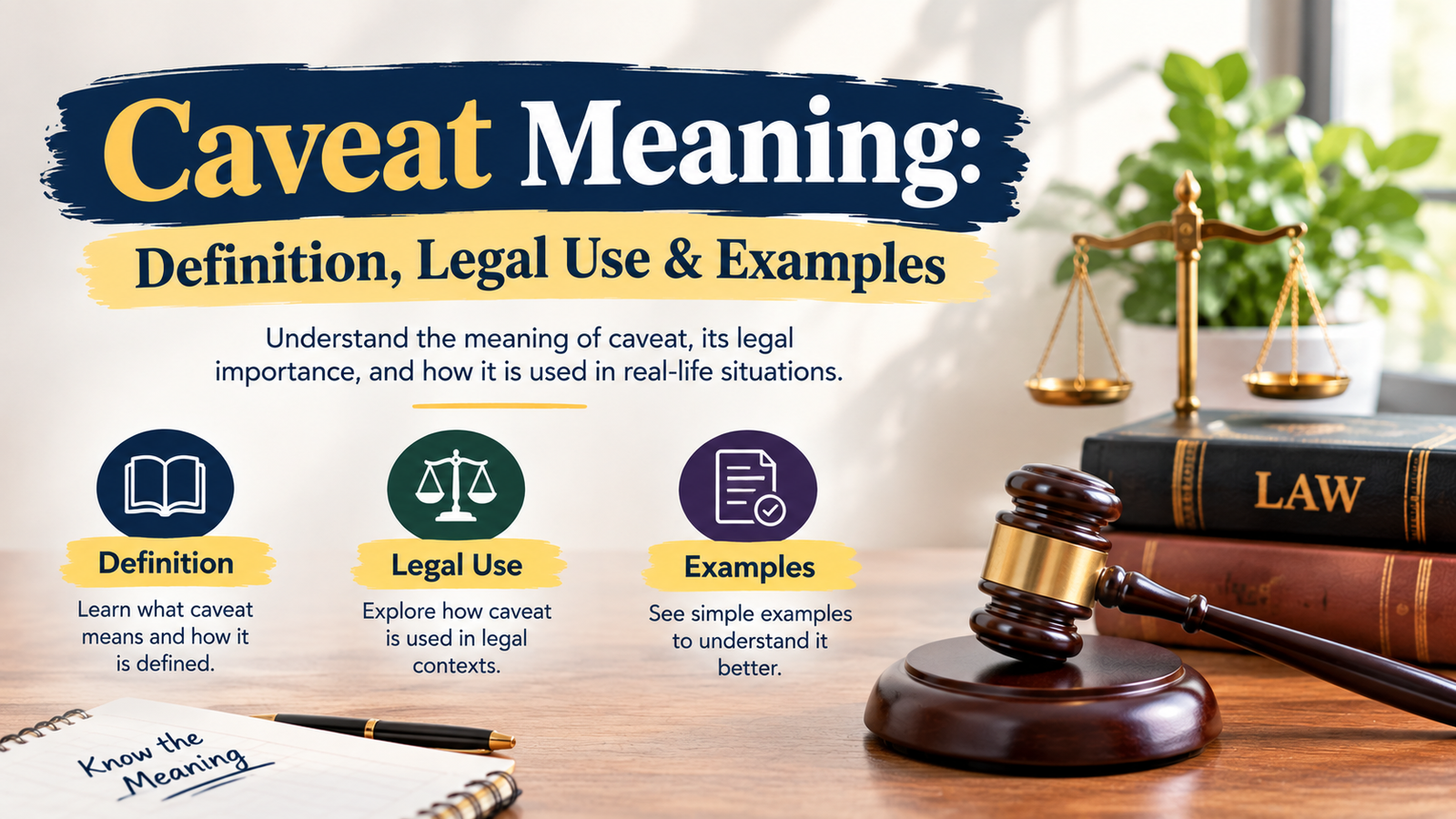
The caveat meaning is a warning, condition, or important point that should be considered before accepting something as completely true or certain. It adds extra information that may change how you understand a statement, plan, offer, or agreement.
You may come across the word caveat in everyday conversations, business writing, academic work, news reports, contracts, and legal documents. Although the word can sound formal, its basic idea is simple.
In plain English, a caveat tells you to pay attention to an important condition or limitation. It does not always mean that something is wrong. Instead, it shows that there is another detail that should not be ignored.
For example, someone might say, “The plan looks good, with one caveat.” This means the plan is generally positive, but one important condition needs attention.
Understanding this word can make formal English much easier to read. It can also help you understand phrases such as caveat emptor and the use of a caveat in legal settings.
What Is Caveat Meaning?
The caveat meaning refers to a warning, qualification, condition, or limitation attached to a statement or decision. It tells people that they should consider an additional fact before moving forward.
The word is often used when the main idea is acceptable, but it comes with a condition.
For instance, a company may offer flexible working hours with one caveat: employees must complete their work on time. The flexible schedule is still available, but the condition matters.
In simple English, a caveat can mean:
- A warning
- A condition
- A limitation
- A qualification
- An important point to consider
| Term | Simple Meaning |
| Caveat | A warning or condition |
| Caveat meaning | An important point that limits or qualifies something |
| Caveat emptor | Let the buyer beware |
| Caveat in law | A formal warning, notice, or legal request |
A caveat is useful because it gives more complete information. Without it, a statement may sound more certain than it really is.
Easy Example
“The product works well, with one caveat: it needs regular maintenance.”
Here, the main statement is positive. However, regular maintenance is an important condition. That condition is the caveat.
Caveat Emptor Meaning
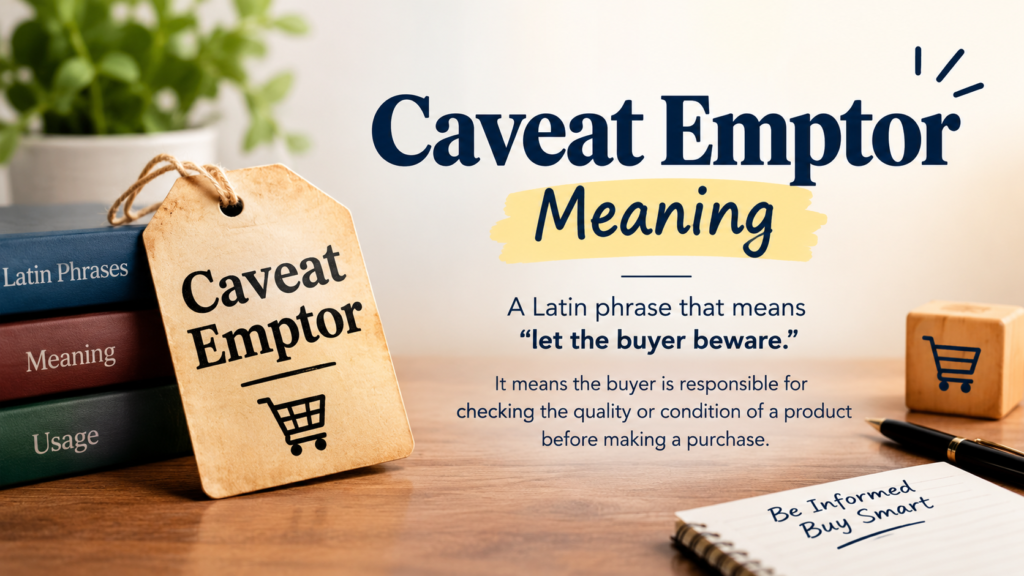
The caveat emptor meaning is “let the buyer beware.” It is a Latin phrase that places emphasis on the buyer taking care when purchasing something.
The phrase is commonly connected with buying goods, property, or other items. It suggests that a buyer should examine what they are purchasing and understand its condition before completing the transaction.
For example, a person buying a used car may need to check its condition, history, and documents. The idea behind caveat emptor is that buyers should not assume everything about a purchase without checking important details.
However, modern consumer and contract laws may give buyers protections and may limit how broadly the principle applies. The exact legal effect can depend on the country, type of transaction, and applicable law.
| Phrase | Meaning |
| Caveat emptor | Let the buyer beware |
| Buyer beware | Check carefully before buying |
| Caveat | Warning or condition |
| Emptor | Buyer |
The phrase is especially useful when discussing responsibility during a purchase.
Example of Caveat Emptor
Imagine that someone buys a second-hand machine without checking its condition. After the purchase, they discover that it needs expensive repairs.
The idea of caveat emptor suggests that the buyer should have taken reasonable care before purchasing it.
Today, however, buyers may have legal rights depending on the transaction. Therefore, caveat emptor should not be treated as an absolute rule in every situation.
Caveat Meaning in Law
The caveat meaning in law can be more specific than its everyday meaning. In legal settings, a caveat may refer to a formal notice, warning, objection, or request connected with a legal process.
The exact meaning depends on the legal system and the type of case. In some situations, a caveat can be used to alert a court or authority that a person has an interest in a matter.
For example, a person may want to be notified before a certain legal action takes place. A formal caveat may help communicate that interest.
| Legal Context | Possible Meaning |
| Court proceedings | A formal warning or request |
| Property matters | Notice concerning an interest |
| Contracts | A condition or limitation |
| Commercial matters | A qualification or restriction |
| General legal writing | A warning or formal notice |
Because legal systems differ, the exact procedure and effect of a caveat can vary. A legal caveat may have a formal process that is very different from the everyday use of the word.
Simple Legal Example
A person has an interest in a property and wants to make sure that their interest is considered before a particular legal action occurs.
In a legal system that provides for such a procedure, a caveat may be used as a formal notice or protective step.
The key idea is that a legal caveat alerts the relevant authority or party to an important interest or concern.
Caveat Definition
A simple caveat definition is:
A caveat is a warning, condition, or qualification that should be considered before accepting or acting on something.
The word comes from Latin and is connected with the idea of taking care or being cautious.
In modern English, it is often used as a noun. It commonly appears after a positive statement to introduce a limitation.
For example:
“The plan is practical, with one caveat: it may take longer than expected.”
The word can also appear in the plural form caveats.
For example:
“The report has several caveats.”
This means the report has several limitations or conditions that readers should consider.
Caveat in Simple English
You can think of caveat as meaning:
“There is one important thing you should know before you accept this.”
That simple idea covers many common uses of the word.
Caveat Examples
Examples make the meaning much easier to understand. Here are several simple sentences:
- “The offer is attractive, with one caveat: it expires tomorrow.”
- “The study supports the idea, but there is a caveat.”
- “She accepted the job with a caveat about weekend work.”
- “The plan should work, with one small caveat.”
- “The results look positive, although there are several caveats.”
- “I agree with your idea, with one caveat.”
- “The service is affordable, but there is a caveat.”
- “The property looks suitable, with one important caveat.”
| Sentence | Caveat Meaning |
| The deal is attractive, with one caveat. | An important condition exists |
| The results look positive, but there is a caveat. | The results have a limitation |
| He agreed with a caveat. | His agreement included a condition |
| The offer is good, with one caveat. | One important detail limits the offer |
These examples show that a caveat often follows a statement that sounds positive or certain.
It then adds information that makes the statement more accurate.
How to Use Caveat in a Sentence
The word caveat is common in formal and semi-formal English. You can use it when you want to add a condition or limitation without rejecting the main idea.
Here are some useful sentence patterns:
- “There is one caveat.”
- “With one caveat, I agree.”
- “The plan works, with a small caveat.”
- “The results are encouraging, but there is a caveat.”
- “She accepted the proposal with a caveat.”
- “The offer sounds good, with one important caveat.”
- “The research is useful, although it has some caveats.”
The expression “with one caveat” is especially common.
Example
“The hotel is affordable, with one caveat: it is far from the city center.”
The sentence first gives a positive point. Then, the caveat explains the limitation.
Another example is:
“I can finish the project this week, with one caveat: I need all the files today.”
Here, the speaker agrees to the plan but adds a condition.
Caveat vs Warning
A caveat and a warning are similar, but they are not always identical.
A warning usually tells someone about a possible danger, problem, or risk. A caveat often adds a condition, qualification, or limitation to an idea.
| Caveat | Warning |
| Adds a condition or qualification | Points out possible danger |
| Often limits a statement | Often urges caution |
| Can be neutral | Usually suggests a problem |
| Common in formal writing | Common in everyday communication |
| Adds context | Alerts someone to risk |
For example:
Warning:
“Do not touch the hot surface.”
This directly tells someone about danger.
Caveat:
“The treatment may be effective, with the caveat that results can vary.”
This does not simply warn about danger. Instead, it adds a limitation to the main statement.
Therefore, the two words can overlap, but their purposes are slightly different.
Common Uses of Caveat
The word caveat appears in many areas of communication. It is especially common when people need to give balanced information.
Business
Businesses often use caveats when discussing plans, investments, offers, or results.
For example:
“The investment could be profitable, with the caveat that returns are not guaranteed.”
The caveat makes the statement more realistic.
Academic Writing
Researchers may use caveats to explain the limitations of a study.
For example:
“The results are encouraging, but the study has several caveats.”
This tells readers that the findings should not be treated as perfect or universal.
News Reports
News writers may add a caveat when a fact needs additional context.
For example:
“The economy showed improvement, with one important caveat: some sectors continued to struggle.”
The extra detail prevents readers from forming an overly simple conclusion.
Everyday Conversations
Although caveat sounds formal, it can also appear in normal conversations.
For example:
“I can lend you my car, with one caveat: bring it back before dinner.”
The speaker agrees but sets a condition.
Contracts and Agreements
Caveats can also appear when discussing agreements.
For example:
“The company accepted the proposal with the caveat that the delivery date could change.”
The condition helps both sides understand the limits of the agreement.
Caveat and Caveat Emptor Difference
Although the words are related, caveat and caveat emptor do not have the same meaning.
A caveat is a general warning, condition, or qualification. Caveat emptor is a specific Latin phrase meaning “let the buyer beware.”
| Feature | Caveat | Caveat Emptor |
| Language | English word from Latin | Latin phrase |
| Basic meaning | Warning or condition | Let the buyer beware |
| Common use | General and formal writing | Buying and legal contexts |
| Focus | Limitation or caution | Buyer responsibility |
| Example | “There is one caveat.” | “Caveat emptor applies in some transactions.” |
For example, a business report may contain several caveats about its findings.
By contrast, caveat emptor focuses specifically on the buyer’s responsibility to take care when making a purchase.
Understanding this difference makes both terms easier to use correctly.
Why Is a Caveat Important?
A caveat is important because it helps people understand the complete picture.
Without a caveat, a statement may sound too broad or certain. An additional condition can make the statement more accurate.
There are several reasons to use a caveat.
It Prevents Misunderstandings
A caveat makes an important condition clear. This can prevent people from making decisions based on incomplete information.
It Adds Balance
A statement can be positive while still having limitations. A caveat allows both sides to be presented fairly.
It Improves Formal Writing
Caveats are useful in reports, research papers, business documents, and professional communication because they add precision.
It Highlights Limitations
Research, plans, offers, and agreements often have limits. A caveat makes those limits easier to notice.
It Supports Better Decisions
When people know both the benefits and conditions, they can make more informed choices.
In this way, a caveat is not necessarily negative. It simply adds information that deserves attention.
Caveat Meaning in Everyday English
The word can seem difficult at first because it has a formal sound. However, its everyday idea is easy.
Think of a caveat as an “important condition” attached to something.
For example:
“The job pays well, with one caveat: the working hours are long.”
The main point is positive. The caveat tells you about the condition that may affect your decision.
Another example is:
“I will join the trip, with one caveat: I need to return home early.”
Again, the speaker agrees but adds a condition.
This simple pattern is useful:
Main idea + caveat = complete information
Once you understand this pattern, you can recognize the word in many different situations.
Common Synonyms for Caveat
Several English words can have a similar meaning, depending on the context.
Common alternatives include:
- Warning
- Condition
- Qualification
- Limitation
- Restriction
- Reservation
- Caution
- Provision
However, these words are not always exact replacements.
For example, condition usually refers to something that must be met. Warning focuses more on possible danger. Limitation shows a boundary or weakness.
The word caveat is useful because it can cover several of these ideas at once.
FAQs About Caveat Meaning
What is the caveat meaning?
The caveat meaning is a warning, condition, or qualification that should be considered before accepting or acting on something.
What does caveat mean in simple English?
In simple English, caveat means an important condition or warning to keep in mind.
What is the caveat emptor meaning?
The caveat emptor meaning is “let the buyer beware.” It refers to the idea that a buyer should take care when making a purchase.
What is caveat meaning in law?
In law, a caveat may refer to a formal warning, notice, objection, or request connected with a legal process. Its exact meaning depends on the legal system and context.
Is a caveat the same as a warning?
Not exactly. A warning usually points to danger or risk, while a caveat often adds a condition, limitation, or qualification.
What is an easy caveat example?
“The plan is good, with one caveat: it may cost more than expected.” The possible extra cost is the caveat.
Is caveat a formal word?
Yes. Caveat is generally considered a formal or semi-formal word. It is common in business, academic, legal, and professional writing.
What is the plural of caveat?
The plural form is caveats. For example, “The report includes several caveats.”
Conclusion
The caveat meaning is simple: it refers to a warning, condition, qualification, or limitation that adds an important point to a statement.
The word can appear in everyday conversations, business writing, academic research, news reports, contracts, and legal contexts. Its purpose is usually to make information more complete and accurate.
The caveat emptor meaning is more specific. It means “let the buyer beware” and focuses on the buyer’s need to take care when making a purchase.
Meanwhile, the caveat meaning in law can refer to a formal notice, warning, or legal request, depending on the legal system and situation.
When you see the word caveat, look for the detail that comes with it. That extra point often explains a condition, limit, or reason for caution.
In short, a caveat does not always mean that something is bad. It simply reminds you that there is more to consider before reaching a final conclusion.