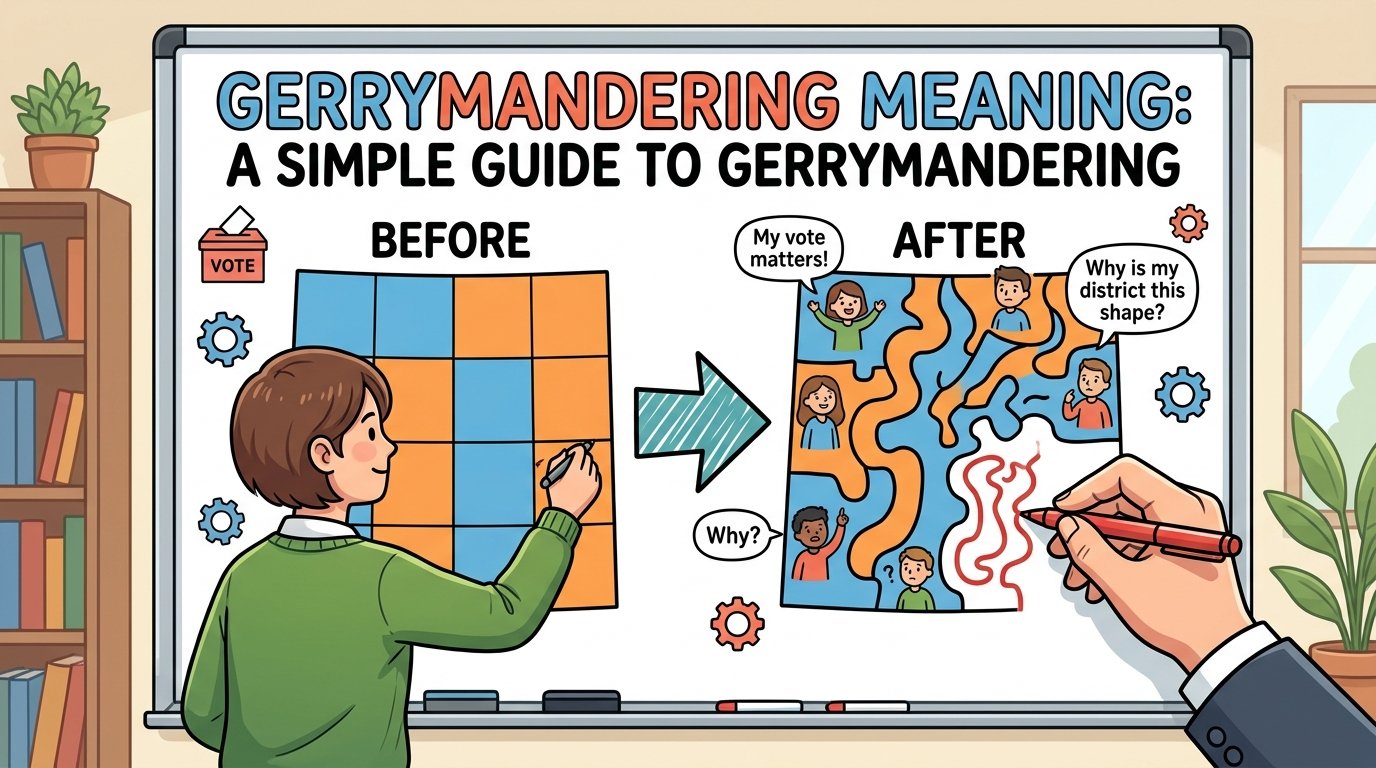
The gerrymandering meaning is connected to the way voting districts are drawn. It describes a practice in which district boundaries are arranged to give a political party or group an advantage.
District lines can affect who votes together and how many seats each party may win. For this reason, the way these boundaries are created can have a major effect on elections.
Gerrymandering can be difficult to understand at first.
What Is Gerrymandering Meaning?
The gerrymandering meaning refers to the practice of drawing electoral district boundaries for political advantage.
Instead of creating districts only around geography or population, mapmakers may consider voting patterns. They can then arrange boundaries to help one party or group gain more influence.
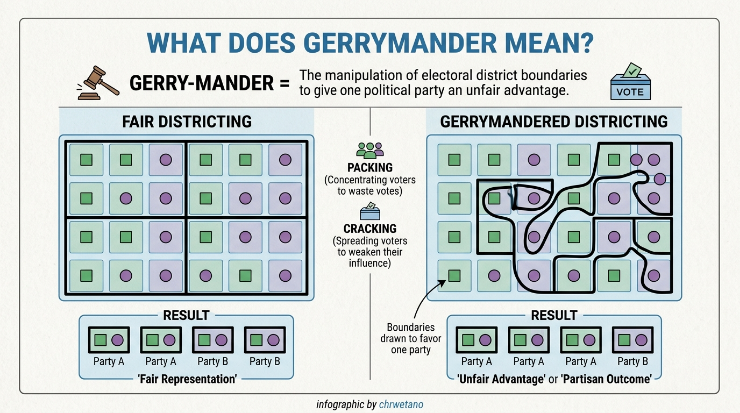
Two common strategies are packing and cracking. Packing puts many similar voters into fewer districts. Cracking divides those voters among several districts.
| Term | Simple Meaning |
| Gerrymandering | Drawing districts for political advantage |
| Packing | Concentrating voters in fewer districts |
| Cracking | Splitting voters across several districts |
| Redistricting | Changing district boundaries |
These methods can change election outcomes even when the total number of voters stays the same.
What Is Gerrymandering?
Gerrymandering occurs when electoral boundaries are deliberately designed to influence political power.
Imagine a city where voters from two parties live across several neighborhoods. A mapmaker could draw fair boundaries that keep communities together. However, the same voters could also be arranged into districts that favor one party.
The important part is not simply the shape of a district. The purpose behind the boundary changes also matters.
A district with a strange shape is not automatically gerrymandered. Geography, population, and legal rules can create unusual boundaries for other reasons.
Gerrymandering Definition
A simple gerrymandering definition is the deliberate arrangement of electoral district boundaries to give a political party or group an advantage.
The word has an interesting history. It is linked to Elbridge Gerry, who served as governor of Massachusetts. In 1812, a Massachusetts district was criticized for its unusual shape.
A newspaper cartoon compared the district to a salamander. The name “gerrymander” later became associated with the practice of manipulating electoral boundaries.
| Word | Meaning |
| Gerrymandering | The practice of manipulating district boundaries |
| Gerrymander | A manipulated district or the act of creating one |
| District | An area represented by an elected official |
| Redistricting | The process of changing district lines |
Gerrymandering Example
A simple gerrymandering example can make the idea clearer.
Suppose a town has 100 voters. Fifty support Party A, while the other 50 support Party B.
If the town is divided into five districts fairly, both groups may have a reasonable chance to win representation.
Now imagine that the district lines are changed. Many Party A voters could be placed together in one district. The remaining voters could then be spread across the other four districts.
Party A might win one district by a large margin but have less influence elsewhere.
| Situation | Possible Effect |
| Voters are fairly distributed | More balanced representation |
| Similar voters are packed together | Fewer districts may be competitive |
| Voters are split across districts | Their voting power may be reduced |
| Boundaries favor one party | That party may gain more seats |
This example shows how the same voters can produce different political results when district boundaries change.
What Does Gerrymander Mean?
Gerrymander can be used as both a noun and a verb.
As a noun, it can describe a district that has been created to give one group a political advantage.
As a verb, it means to manipulate electoral boundaries for that purpose.
For example, someone might say that lawmakers gerrymandered a district to improve one party’s chances.
The term is closely connected to the broader idea of gerrymandering.
How Does Gerrymandering Work?
Creating voting districts requires detailed information. Mapmakers may consider population, geography, communities, and existing boundaries.
Political voting patterns can also become part of the process.
Two methods appear often in discussions about the practice.
Packing
Packing means placing many voters from a particular group into a small number of districts.
Cracking
Cracking works in the opposite direction.
As a result, the group may struggle to form a majority in any single district.
| Method | What Happens | Possible Result |
| Packing | Similar voters are concentrated | They win fewer districts by larger margins |
| Cracking | Similar voters are divided | They may have less influence in each district |
Why Is Gerrymandering Used?
The main purpose of gerrymandering is usually to gain political advantage.
A party may benefit from districts where its candidates have a stronger chance of winning. In some cases, favorable boundaries can also protect existing seats.
Gerrymandering may affect campaign strategies as well. Candidates may focus more attention on districts where elections are competitive.
Population growth, migration, census results, and legal requirements can all lead to new maps.
Types of Gerrymandering
Gerrymandering is often discussed in different forms. The most common categories include partisan and racial gerrymandering.
Partisan Gerrymandering
Partisan gerrymandering involves drawing district boundaries to favor one political party.
Voting history and political patterns may be used when creating the map. The goal is to give one party an electoral advantage.
Racial Gerrymandering
Racial gerrymandering involves district boundaries that are drawn around racial groups in ways that can affect representation.
This issue is closely connected to voting rights and election law. Courts and lawmakers may apply specific legal standards when evaluating such districts.
Gerrymandering and Voting Districts
A voting district is an area where residents choose a representative. Large areas are divided into smaller districts so voters can elect officials.at process is called redistricting.
Gerrymandering is more specific. It refers to manipulating those boundaries to create an advantage for a party or group.
| Gerrymandering | Redistricting |
| Focuses on political advantage | Focuses on changing district boundaries |
| Can involve packing or cracking | May happen because of population changes |
| Often creates controversy | Is a normal part of election administration |
| Refers to a particular purpose | Refers to the broader process |
Understanding this difference helps prevent confusion between the two terms.
Why Does Gerrymandering Matter?
District maps can influence political representation. A carefully designed map may determine which communities vote together and which candidates have stronger chances of winning.
Gerrymandering can also reduce competition in some elections. When a district strongly favors one party, the general election may become less competitive.
Voters may question the fairness of an electoral system if they believe district lines were created mainly for political gain.
Common Gerrymandering Examples
Several patterns may raise concerns about gerrymandering.
- Concentrating one group of voters in a small number of districts
- Splitting a community between different districts
- Connecting distant neighborhoods to create a favorable district
- Creating unusual boundaries without an obvious geographic reason
- Protecting certain political seats through carefully planned boundaries
- Dividing voting groups so they cannot form a majority
These patterns can provide useful clues, but none proves gerrymandering by itself.
A complete analysis may also consider election results, population data, geography, and the process used to create the map.
How to Recognize Gerrymandering
A district’s appearance alone does not tell the whole story.
To identify possible gerrymandering, analysts may study several factors. They can compare voting patterns with district boundaries and examine how different maps affect representation.
Useful information may include:
| Factor | Why It Matters |
| Voting history | Shows how different areas usually vote |
| Population | Helps explain district composition |
| Geography | Shows natural and physical boundaries |
| Election results | Reveals possible political effects |
| Community boundaries | Shows whether communities were divided |
| Mapmaking process | Provides context about how the district was created |
The more evidence that points toward intentional political manipulation, the stronger the argument may become.
Gerrymandering vs Redistricting
Gerrymandering and redistricting are related, but they are not identical.
Redistricting is the process of changing electoral district boundaries. It can happen for normal administrative reasons.
Gerrymandering involves using district boundaries to create a political advantage.
A quick comparison makes the difference clear:
| Feature | Gerrymandering | Redistricting |
| Main idea | Political manipulation | Boundary changes |
| Purpose | Gain an advantage | Adjust districts |
| Always political? | Yes, by definition | No |
| Can be required by population changes? | Not necessarily | Yes |
| Common methods | Packing and cracking | Census-based mapping and boundary adjustments |
So, gerrymandering can happen during redistricting, but the two terms should not be treated as synonyms.
Gerrymandering in Simple Terms
Think about a school with 100 students that needs five teams.
The students are already divided evenly between two groups. If the teams are created fairly, both groups may receive similar representation.
Now imagine someone rearranges the team boundaries. They place most students from one group into a single team and spread the rest across the other teams.
The number of students has not changed. Only the grouping has changed.
Gerrymandering follows a similar idea. Voters stay the same, but district boundaries can change how their votes translate into representation.
FAQs About Gerrymandering Meaning
What is the gerrymandering meaning?
The gerrymandering meaning is the practice of drawing electoral district boundaries to give a political party or group an advantage.
What is gerrymandering in simple words?
Gerrymandering means arranging voting districts in a way that can influence political representation.
What is a simple gerrymandering example?
One example is concentrating many voters from the same political group into one district while dividing the remaining voters among other districts.
What does gerrymander mean?
Gerrymander means to manipulate electoral district boundaries for political advantage. It can also refer to a district created through that process.
Is redistricting the same as gerrymandering?
No. Redistricting means changing district boundaries. Gerrymandering refers specifically to manipulating those boundaries for political advantage.
What are packing and cracking?
Packing concentrates similar voters in fewer districts. Cracking divides them across several districts to reduce their influence.
Why is gerrymandering controversial?
It can affect representation, reduce election competition, and create concerns about fairness and political influence.
Conclusion
The gerrymandering meaning centers on one simple idea: the way voting districts are drawn can affect political power.
Gerrymandering occurs when those boundaries are arranged to benefit a particular party or group. Packing and cracking are two common strategies used to explain how this can happen.
Redistricting is a broader process and does not automatically mean gerrymandering. Population changes and legal requirements can also lead to new district maps.
By understanding the gerrymandering definition, examples, and related terms, it becomes easier to understand how district boundaries can shape elections and political representation.