The contingent meaning is simple when you know that it describes something that depends on another condition. A plan, decision, payment, or event can be contingent when it cannot happen until something else happens first. You may see this word in everyday English, business documents, legal agreements, and property listings. It is especially common in real estate, where a home can have an accepted offer but still have conditions to complete. The word can also describe a group of people in some sentences. Learning the different uses makes the word much easier to understand. This guide explains the word with clear meanings, examples, real estate terms, comparisons, and common mistakes.
What Does Contingent Mean?
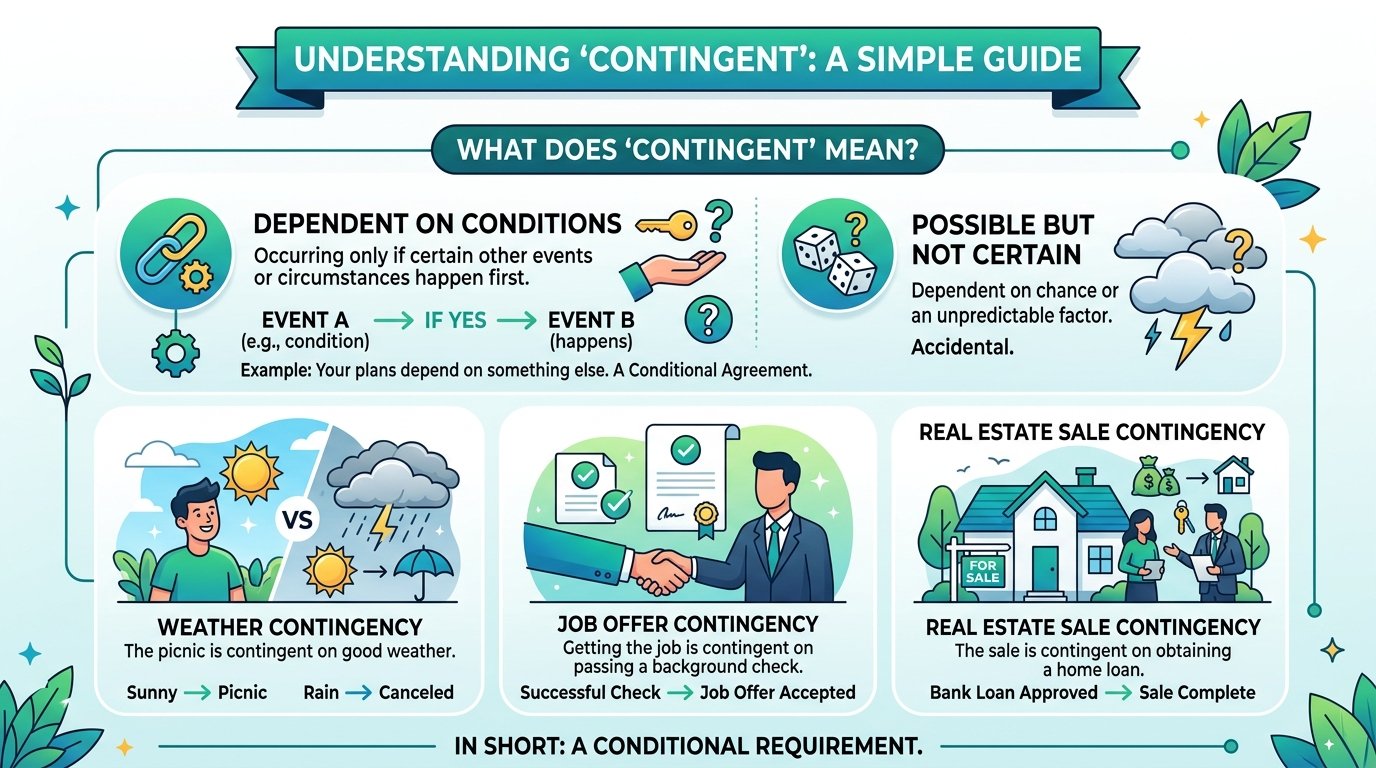
The word contingent means dependent on something else. It describes an action, event, or result that relies on a specific condition. If that condition is not met, the expected result may not happen.
For example, a company may offer a bonus that is contingent on strong performance. The employee will receive the bonus only if the required performance target is reached.
The main idea is dependence. One thing is connected to another thing, so the final result is not fully certain yet.
A Simple Definition
A simple definition is:
Contingent means dependent on a condition or event.
Think about a picnic that depends on the weather. If the weather stays good, the picnic can happen. If heavy rain arrives, the plan may change.
That picnic plan is contingent on the weather. The same idea works in many other situations.
Why the Word Can Be Confusing
The word can seem difficult because it is often used in formal writing. Contracts, business papers, and property listings use it frequently.
However, the basic idea is not difficult. When you see the word, look for the condition that controls the result.
For example, “The trip is contingent on approval” means the trip depends on approval. Once you identify that connection, the sentence becomes much clearer.
Contingent Meaning in English
The contingent meaning in English is usually connected to dependence, possibility, or uncertainty. Something contingent is not completely fixed because another event or condition can affect the outcome.
For example, “The project deadline is contingent on receiving the materials.” This means the deadline depends on when the materials arrive.
The word is useful because it shows a relationship between two things. One event can control whether another event takes place.
Contingent in Everyday English
People can use contingent in normal conversations, although simpler words such as “depending on” are more common.
You might say, “Our plans are contingent on the weather.” A simpler version would be, “Our plans depend on the weather.”
Both sentences have nearly the same idea. The word contingent simply sounds more formal.
Contingent in Formal English
The word appears more often in formal writing. You may see it in contracts, policies, business agreements, legal documents, and professional emails.
For example, a contract might state that payment is contingent on completing the agreed work. This means the payment depends on that work being completed.
Understanding the word can therefore help when reading important documents.
Meaning of Contingent
The contingent meaning can change slightly based on how the word is used. As an adjective, it usually means dependent on something. As a noun, it can mean a group of people.
Contingent as an Adjective
As an adjective, contingent describes something that depends on a condition.
Examples include:
- A payment contingent on results
- A trip contingent on approval
- A job offer contingent on verification
- A purchase contingent on financing
- A plan contingent on the weather
In each example, one thing depends on another.
Contingent as a Noun
Contingent can also be used as a noun. In this form, it means a group of people who represent a larger group or organization.
For example:
“An international contingent attended the event.”
Here, contingent means a group of people.
Another example is:
“The school sent a student contingent to the competition.”
This means a group of students represented the school.
Contingent and Dependence
The strongest idea behind the word is dependence. When something is contingent, another factor can affect the result.
This does not always mean the result will fail. It only means the result depends on something that must happen or be decided first.
What Does Contingent Mean in Real Estate?
What does contingent mean in real estate is an important question for anyone reading property listings. In most real estate contexts, a contingent listing means the seller has accepted an offer, but certain conditions still need to be satisfied.

These conditions are known as contingencies. They can protect the buyer, seller, or both parties during the transaction.
A buyer may need to complete a home inspection. The buyer may also need mortgage approval or an acceptable appraisal before the purchase can continue.
Because the exact meaning of a listing status can vary by market and platform, buyers should always check the details provided by the listing agent.
How Contingent Offers Work
A buyer makes an offer on a property. The seller accepts that offer. However, the agreement includes certain conditions that must be completed.
For example, the buyer may have a financing contingency. This means the buyer needs to obtain a suitable mortgage before the transaction can move forward.
Another common condition is an inspection. The buyer may want the right to inspect the home and respond to serious problems according to the contract.
The transaction can continue when the required conditions are satisfied.
Common Real Estate Contingencies
Real estate contracts can include different types of contingencies. The exact terms depend on the agreement and local rules.
- Inspection contingency: Allows the buyer to inspect the property.
- Financing contingency: Depends on obtaining a mortgage or other financing.
- Appraisal contingency: Connects the purchase to the property’s appraised value.
- Sale contingency: Depends on selling another property.
- Title contingency: Requires acceptable title information.
- Insurance contingency: May depend on obtaining suitable home insurance.
- Repair contingency: Can cover agreed repairs or responses to inspection findings.
- Document contingency: May require review of specific property documents.
- Legal contingency: Can depend on certain legal requirements.
- Closing contingency: Connects the transaction to required closing conditions.
Not every property has every contingency. The contract determines which conditions apply.
What Does Contingent Mean in Real Estate Listings?
What does contingent mean in real estate listings can be understood by looking at the property’s current status. A contingent listing generally shows that an offer has been accepted, but the transaction is not yet fully complete.
The buyer and seller may still need to complete one or more agreed conditions. The property therefore has a deal in progress, but the sale has not necessarily reached the final closing stage.

Some sellers may still accept backup offers while the first transaction is active. This depends on the seller, contract, local market, and listing service.
A buyer should not assume that every contingent property is available for a new offer. Checking the listing details is the safest approach.
Contingent vs Pending
Contingent and pending are related real estate terms, but they can describe different stages of a property transaction.
A contingent listing usually has an accepted offer with one or more conditions still in place. A pending listing often means the transaction has moved further toward completion.
| Status | Basic Meaning | General Situation |
| Active | Property is being offered | No accepted offer is shown |
| Contingent | Offer accepted with conditions | Some conditions remain |
| Pending | Sale is progressing | Transaction is closer to closing |
| Sold | Sale completed | Transaction has closed |
Real estate platforms can define these statuses differently. Local practices and contract terms also matter.
Contingent vs Conditional
Contingent and conditional have very similar meanings. Both can describe something that depends on a requirement.
The word conditional is broader and can apply to many situations. Contingent often emphasizes that one event depends on another event or circumstance.
For example, “The offer is conditional on financing” and “The offer is contingent on financing” communicate a similar idea.
The preferred term may depend on the contract, location, or industry. Always read the surrounding language to understand the exact meaning.
Real-Life Examples of Contingent
The word becomes easier to remember when you see it in everyday examples.
Example 1: The concert is contingent on the weather.
This means the concert depends on suitable weather.
Example 2: Her promotion is contingent on her performance.
This means the promotion depends on how well she performs.
Example 3: The payment is contingent on completing the project.
This means the payment depends on project completion.
Example 4: The trip is contingent on getting permission.
This means permission must be received before the trip can happen.
Example 5: The agreement is contingent on both parties signing.
This means the agreement depends on both parties signing it.
Example 6: The team’s participation is contingent on funding.
This means the team can participate only if funding is available.
Example 7: The purchase is contingent on inspection results.
This means inspection results can affect the purchase.
Each example follows the same pattern. Something depends on another condition.
Common Uses of the Word Contingent
The contingent meaning appears in many areas of life. Business is one common example. Companies may make payments or agreements dependent on certain results.
Employment is another area where the word is useful. A job offer can be contingent on completing a background check, providing documents, or meeting another requirement.
Travel plans can also be contingent. A flight, event, or outdoor activity may depend on weather conditions.
Contracts often use the word because it clearly explains that an obligation depends on a specific condition.
Contingent in Business
Businesses may use contingent agreements when the final result depends on future events.
For example, a bonus can be contingent on meeting sales goals. A payment can be contingent on completing a project.
This helps define when a person or company becomes entitled to receive something.
Contingent in Employment
A job offer can include conditions before employment becomes final. These conditions may involve paperwork, verification, or other requirements.
For example, an employer may make an offer contingent on successful completion of a required process.
The exact conditions should be clearly stated in the offer.
Contingent in Contracts
Contracts often contain conditions because both parties need to know what must happen before an obligation takes effect.
A contract might say that payment is contingent on delivery. This means delivery must occur before payment becomes due under that condition.
Reading the full contract is important because one word does not explain every legal detail.
Common Mistakes About Contingent
People sometimes misunderstand the word because they connect it with failure or cancellation. Contingent does not automatically mean canceled.
Something can be contingent and still happen normally. It simply depends on another condition.
Another mistake is thinking that contingent always means temporary. A contingent arrangement can remain in place until the required condition is satisfied.
In real estate, another common mistake is assuming that a contingent home is completely sold. Usually, the transaction is still moving through conditions before closing.
Mistake: Thinking Contingent Means Cancelled
A contingent event is not necessarily canceled. It may happen once the required condition is met.
For example, a trip contingent on approval can still happen after approval is received.
Mistake: Thinking Contingent Means Guaranteed
Contingent does not mean guaranteed. The result depends on another event, so there is still uncertainty.
If the condition fails, the result may change.
Mistake: Treating Contingent and Pending as Identical
These terms can describe different stages in real estate. A contingent listing often has active conditions, while pending usually indicates further progress.
However, listing definitions can vary by service.
How to Understand Contingent in a Sentence
The easiest way to understand the contingent meaning in a sentence is to find the condition.
Look for phrases such as “on,” “upon,” or “depending on.” These phrases often show what the result relies on.
For example:
“The event is contingent on approval.”
The condition is approval. The event depends on that approval.
Another example is:
“The payment is contingent upon completion.”
The condition is completion. Payment depends on the work being completed.
This simple method works in most everyday examples.
What Does Contingent Mean in Real Estate Contracts?
What does contingent mean in real estate contracts depends on the exact wording of the agreement. Generally, it means a part of the transaction depends on a stated condition.
For example, a purchase agreement may depend on financing. If the buyer cannot obtain the required financing, the contract may provide certain rights or remedies.
Another agreement may include an inspection condition. The buyer may have specific rights if the inspection reveals serious issues.
Because contracts can have important legal effects, the exact wording matters more than the label alone.
Contingent Meaning in Simple Words
The easiest contingent meaning to remember is “depending on something else.”
If an event depends on a condition, it is contingent
the trip is contingent on receiving permission.
the purchase is contingent on financing.
The word may sound formal, but the idea is simple. Find what must happen first, and you will usually understand the sentence.
Frequently Asked Questions
What is the simple meaning of contingent?
Contingent means dependent on another condition, event, or situation. The final result is connected to something that must happen first.
What does contingent mean in real estate?
What does contingent mean in real estate usually refers to a property with an accepted offer that still has one or more conditions to satisfy. The sale is not necessarily complete.
Is contingent the same as pending?
No. They can describe different stages of a real estate transaction. Contingent generally involves conditions that remain active, while pending often indicates that the deal has progressed further.
Does contingent mean the house is sold?
No. A contingent property usually has an accepted offer, but the transaction has not necessarily closed. The sale still depends on the terms of the agreement.
Can a buyer make an offer on a contingent home?
In some situations, a buyer may be able to submit a backup offer. Whether this is possible depends on the seller, contract, local rules, and listing status.
What is an example of contingent?
“The payment is contingent on finishing the project” is a simple example. It means the payment depends on the project being completed.
What is the opposite of contingent?
Depending on the sentence, useful opposites include certain, unconditional, independent, or definite. The best opposite changes with the context.
Why is contingent common in contracts?
Contracts often involve conditions. The word clearly shows that an action, payment, or obligation depends on a specific event or requirement.
What does contingent mean in real estate?
What does contingent mean in real estate is best understood as “an accepted offer with conditions that still need to be handled.” The exact status depends on the listing service and contract.
Can a contingent offer fall through?
Yes. A transaction can fail to move forward if a required contingency is not satisfied and the contract allows the parties to end or change the agreement.
Conclusion
The contingent meaning is based on one simple idea: dependence. Something contingent depends on another event, condition, or situation before the final result can happen. The word appears in everyday English, business, employment, contracts, and real estate. In property listings, it often means an offer has been accepted while certain conditions remain. Once you understand the condition behind the word, its meaning becomes much easier to recognize. Whether you see contingent in a contract, conversation, or house listing, look for what the result depends on.