This article breaks the humility meaning down properly: what it actually is, how it shows up in real situations, where people get it wrong, and how it’s different from the traits it constantly gets confused with. By the end, you’ll have a working definition you can actually apply — not just recite.
A CEO once turned down credit for a company-wide success in front of the entire board and pointed straight at the interns who caught the bug nobody else saw. That single moment — power choosing to step back instead of forward — captures the humility meaning better than any dictionary line ever could.
Most people think they already know this word. Ask them to define it, though, and the answers get shaky fast. Some call it weakness. Some call it low self-esteem. Some think it means never speaking up about your own achievements. None of that is quite right, and the confusion causes real problems — people either avoid practicing humility because they think it makes them look small, or they mistake self-doubt for humility and end up undervaluing themselves for no good reason.
What Is Humility?
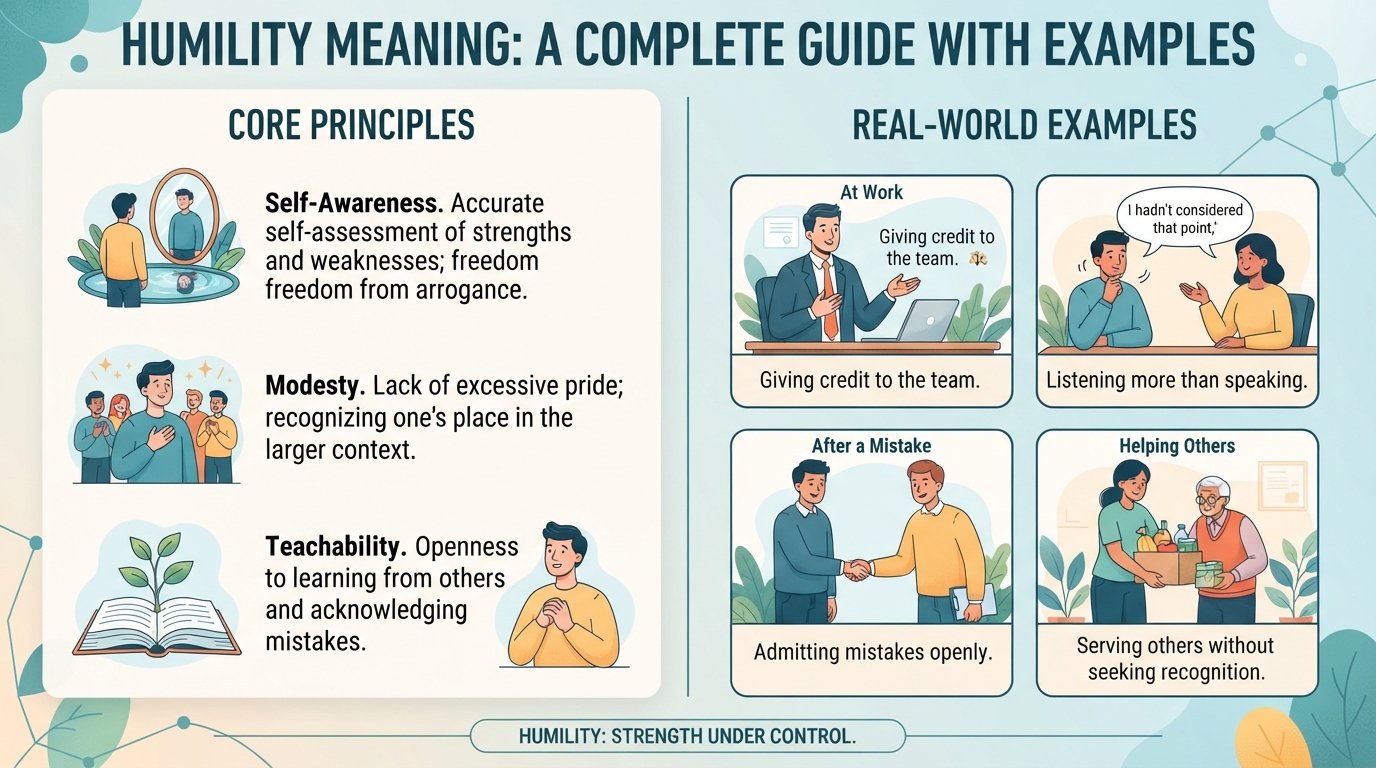
At its core, humility is the quality of having an accurate, grounded view of yourself — your strengths, your limits, and your place relative to other people — without needing to inflate or diminish any of it. The meaning of humility isn’t about thinking less of yourself. It’s about thinking about yourself less, and thinking more clearly when you do.
This distinction matters because it separates humility from two things it’s constantly confused with: false modesty and low self-worth. A humble person can absolutely know they’re skilled at something. The difference is they don’t need everyone else to know it constantly, and they stay open to the possibility that they’re wrong or that someone else knows better.
Philosophers and psychologists who study this trait generally agree on a few core pieces:
- Self-awareness — an honest read on your own abilities and limitations
- Openness — willingness to learn, be corrected, and change your mind
- Other-orientation — genuine interest in other people’s contributions, not just your own
- Restraint — choosing not to dominate credit, attention, or conversation even when you could
Put together, that’s the working humility meaning most experts land on: grounded self-perception paired with genuine regard for others.
Meaning of Humility in Everyday Life
Strip away the philosophy, and the meaning of humility shows up in small, ordinary decisions far more often than in dramatic ones. It’s the coworker who says “actually, that was your idea” in a meeting. It’s the parent who admits to their kid that they were wrong about something. It’s the expert who says “I don’t know” instead of bluffing through a question.
None of these moments look impressive on paper. That’s the point. Humility rarely announces itself — it shows up as a quiet correction rather than a grand gesture. A person practicing it in daily life tends to:
- Ask questions instead of assuming they already know the answer
- Give credit specifically rather than vaguely (“the team did great” vs. “Sarah caught that error before it shipped”)
- Accept feedback without getting defensive, even when it stings a little
- Apologize clearly, without padding it with excuses
The everyday version of humility is less about big sacrifices and more about consistently choosing accuracy over ego. That consistency is what actually builds trust with the people around you over time.
Humility Meaning With Example
Abstract definitions only go so far — seeing the humility meaning play out in real scenarios makes it far easier to recognize.
Example 1 — Workplace
A senior developer notices a junior teammate solved a bug faster and more elegantly than they would have. Instead of quietly fixing it themselves next time, they publicly mention it in the team standup: “Alex’s fix here was cleaner than what I would’ve written — nice catch.” That’s humility in action: accurate acknowledgment, given openly, without resentment.
Example 2 — Sports
An athlete wins a major title after a career built on setbacks. In the post-game interview, instead of listing personal achievements, they credit their coach, their training partners, and even a rival who pushed them to improve. This is a textbook demonstration of the humility meaning — success acknowledged without erasing the people who contributed to it.
Example 3 — Family Life
A parent snaps at their child after a stressful day, then later sits down and says, “I was wrong to raise my voice like that, and it wasn’t about you.” No excuses, no “but you also…” — just a clean, direct acknowledgment.
Example 4 — Leadership
A manager’s project fails to hit its target. In the review meeting, rather than pointing at market conditions or blaming a teammate, they say, “I misjudged the timeline, and that’s on me. Here’s what I’ll do differently.” That single sentence does more for team trust than months of confident talk would.
Across all four examples, the pattern repeats: accurate self-assessment, credit given where it’s due, and no need to protect an inflated self-image.
What Is the Meaning of Humility in Leadership and Relationships
Humility in Leadership
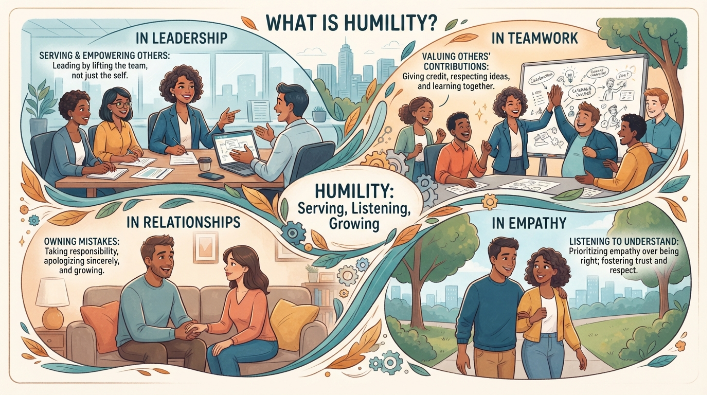
In leadership circles specifically, the meaning of humility gets studied more than almost any other soft skill, because research consistently links it to stronger, more loyal teams. Leaders who show humility tend to ask for input before making decisions, admit mistakes publicly rather than quietly correcting them, and actively make room for other people’s ideas to shape outcomes.
This doesn’t mean humble leaders are passive or indecisive. Some of the most decisive, high-performing leaders in business and history have also been the most humble — the two traits aren’t opposites. Humility just changes how decisions get made: with more input gathered first, and more credit distributed afterward.
Humility in Personal Relationships
In personal relationships, the pattern looks similar. Humility shows up as the willingness to say “I was wrong,” to genuinely listen instead of waiting for your turn to talk, and to let a partner or friend be right about something without needing to win the point. Relationships where both people practice this tend to handle conflict faster and hold less resentment over time, simply because neither person is spending energy protecting their ego during disagreements.
Signs of a Truly Humble Person
Because humility is often quiet, it can be hard to spot directly. A few consistent signs tend to give it away:
- They ask more questions than they answer in conversations about topics outside their expertise
- They credit specific people by name rather than making vague, generic acknowledgments
- They apologize without immediately following it with a justification
- They’re comfortable saying “I don’t know” or “I was wrong” without visible discomfort
- They don’t need to be the loudest voice in the room to feel secure
None of these signs involve self-deprecation or downplaying real accomplishments. That distinction is critical, because it’s exactly where most people get the concept wrong.
Common Mistakes and Misconceptions About Humility
Confusing humility with low self-esteem.
This is the single most common mix-up. A humble person can be fully confident in their abilities — the difference is they don’t need constant external validation for it. Someone with low self-esteem, by contrast, often struggles to accept praise even when it’s accurate.
Believing humility means staying silent about achievements.
Never mentioning your own work isn’t humility — it’s often just avoidance, and it can even come across as fishing for compliments. Genuine humility allows you to state facts about your accomplishments plainly, without needing to inflate or hide them.
Assuming humble people are pushovers.
Because humility involves restraint, people sometimes assume it means avoiding conflict or always deferring to others. In reality, a humble person can hold a firm position — they just hold it without needing to be right for the sake of ego.
Treating apologies as automatically humble.
An apology stacked with excuses (“I’m sorry, but you also…”) isn’t really humility — it’s a deflection wearing humility’s clothing. Real humility takes the correction cleanly.
Thinking humility can’t coexist with ambition.
Some assume humble people don’t chase big goals. In practice, plenty of highly ambitious, successful people credit humility — the willingness to learn and be corrected — as exactly what got them there faster.
Humility vs Confidence vs Arrogance vs Modesty
These four traits get lumped together constantly, but they’re meaningfully different once you break them apart.
| Trait | Core Focus | How It Sounds |
|---|---|---|
| Humility | Accurate self-view + regard for others | “I got help from a great team on this.” |
| Confidence | Trust in your own ability | “I know I can handle this.” |
| Arrogance | Inflated self-view, dismissive of others | “I did this basically alone; nobody else mattered.” |
| Modesty | Downplaying achievements, sometimes inaccurately | “It was nothing, really.” |
Confidence and humility aren’t opposites — they can exist in the same person at the same time. Arrogance is what happens when confidence loses its accuracy and stops making room for anyone else. Modesty, meanwhile, can actually drift away from the truth if it means downplaying something real. The meaning of humility sits in the middle of all this: accurate, other-aware, and honest — including honest about your own strengths when it’s relevant.
Frequently Asked Questions
What is the simplest way to explain the humility meaning?
It’s having an honest, grounded view of your own strengths and limits, while genuinely valuing other people’s contributions instead of needing constant credit for your own.
Is humility the same as being shy or quiet?
No. Humility is about how you handle credit, feedback, and self-perception — not about personality type. Outgoing, confident people can be just as humble as quiet ones.
Can someone be both confident and humble at the same time?
Yes, and this combination is common among strong leaders. Confidence is trust in your own ability; humility is not needing everyone else to constantly validate that trust.
Does humility mean you shouldn’t talk about your achievements?
Not at all. Stating facts about what you’ve done isn’t the opposite of humility — refusing to acknowledge other people’s contributions while doing it would be.
How is humility different from modesty?
Modesty often involves downplaying achievements, sometimes inaccurately. Humility is about accuracy — acknowledging real strengths honestly while staying open to feedback and crediting others.
Why do people confuse humility with weakness?
Because humility involves restraint rather than dominance, some mistake it for a lack of assertiveness. In reality, humble people can be firm and decisive — they just don’t need ego to drive those decisions.
Can humility be learned, or is it a fixed personality trait?
It can absolutely be practiced and built over time, much like a habit. Small, consistent choices — giving specific credit, accepting feedback without defensiveness, admitting mistakes clearly — gradually shape it.
Conclusion
The humility meaning isn’t about shrinking yourself or staying quiet about what you’ve earned. It’s about seeing yourself clearly — strengths included — while making genuine room for the people around you. That combination is rarer than it sounds, which is exactly why it stands out so much when you actually see it in action.
Once you strip away the misconceptions — the idea that it means low self-esteem, silence, or weakness — what’s left is a trait that’s remarkably practical. It builds trust faster than confidence alone ever could, and it costs nothing more than a willingness to be accurate about yourself and generous about everyone else.