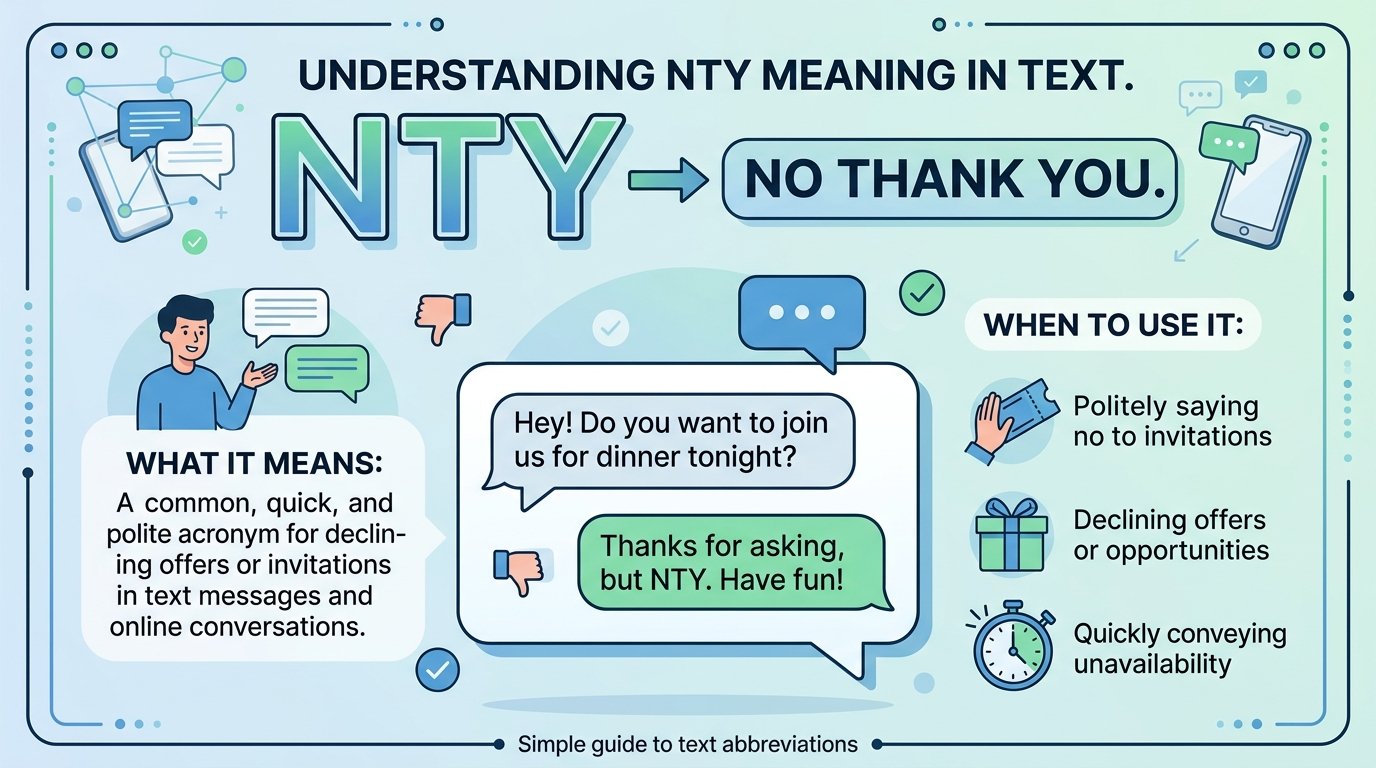
If someone sends you NTY in a text message, you may wonder what these three letters mean. Text conversations often use short forms to make messages faster and easier to type. The NTY meaning in text is usually simple and easy to understand once you know the full form. In most casual chats, NTY means “No Thank You.”
People use NTY when they want to politely reject an offer, invitation, suggestion, or request. It can save time while still showing that the person does not want something. For example, if a friend asks, “Want some coffee?” you might reply, “NTY.” This means, “No thank you.”
NTY is common in text messages, online chats, gaming conversations, social media, and direct messages. It usually sounds casual and brief rather than formal. The tone can also depend on the conversation, so the same abbreviation may sound polite, neutral, or slightly blunt in different situations.
Understanding NTY meaning in text can help you read short online messages more easily. This guide explains what NTY stands for, how people use it, what it means in texting and social media, and how to respond when someone sends NTY.
What Does NTY Mean in Text?
The most common NTY meaning in text is “No Thank You.” People use this abbreviation when they want to politely say no to something.
For example:
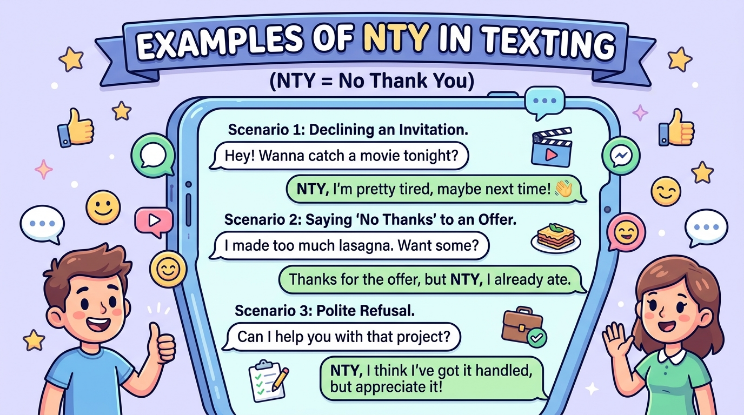
“Do you want to join us?”
“NTY, I have plans.”
Here, NTY means “No thank you.”
The abbreviation keeps the message short while still expressing a clear refusal. It works best in casual conversations.
NTY Meaning: Simple Definition
NTY is a short form of “No Thank You.” It usually shows that someone does not want an offer or does not agree to a suggestion.
The basic meaning is:
NTY = No Thank You
You may see it when someone declines food, an invitation, a request, a product, an activity, or another offer.
For example:
“Want to come with us?”
“NTY.”
The person is simply saying no in a short way.
What Does NTY Stand For?
NTY stands for “No Thank You.” It is an informal texting abbreviation rather than a formal English term.
People often shorten common phrases when chatting online. NTY follows the same pattern as other texting abbreviations such as TY, BTW, LOL, and IDK.
Instead of typing:
“No, thank you.”
a person can simply write:
“NTY.”
The meaning stays almost the same, but the message becomes much shorter.
NTY Meaning in Chat
In chat conversations, NTY usually means that the person is declining something. The message may refer to an invitation, offer, suggestion, or request.
For example:
Friend: “Want to watch a movie?”
You: “NTY, I’m tired.”
Here, NTY clearly means “No thank you.”
It does not normally show anger or dislike. The tone depends on the rest of the conversation.
NTY Meaning in Text Message
The NTY meaning in text message is usually “No thank you.” People use it when they want to give a quick negative response.
For example:
- “Want some pizza?” — “NTY.”
- “Can I call you?” — “NTY, maybe later.”
- “Do you need help?” — “NTY, I’m good.”
- “Want to come over?” — “NTY, I have work.”
- “Would you like one?” — “NTY.”
These examples show how NTY works in everyday texting.
NTY Meaning in Social Media
On social media, NTY is often used in comments, direct messages, and casual conversations. Someone may use it to reject an offer or respond to a suggestion.
For example:
“Want to buy this?”
“NTY.”
It can also appear in playful conversations:
“Free homework for everyone!”
“NTY 😂”
The meaning remains “No thank you,” but the emoji or surrounding words can change the tone.
NTY Meaning on Snapchat
On Snapchat, people often use short forms because conversations move quickly. NTY can be used when someone wants to decline an invitation or offer.
For example:
“Wanna hang out tonight?”
“NTY, maybe tomorrow.”
This means:
“No thank you, maybe tomorrow.”
The abbreviation makes the reply quick and casual.
NTY Meaning on Instagram
On Instagram, NTY may appear in DMs, comments, or replies. It can be used when someone declines something without writing a long response.
For example:
“Want this?”
“NTY 😊”
The smile emoji can make the short reply feel softer and friendlier.
Without extra words or an emoji, “NTY” may sound more direct. Context helps you understand the intended tone.
NTY Meaning on TikTok
TikTok comments and messages often contain short internet expressions. NTY can appear when someone responds to an offer, idea, or suggestion.
For example:
“Try this challenge!”
“NTY 😂”
Here, the person is casually saying:
“No thank you.”
The abbreviation is usually informal and works best in relaxed online conversations.
NTY Meaning in Slang
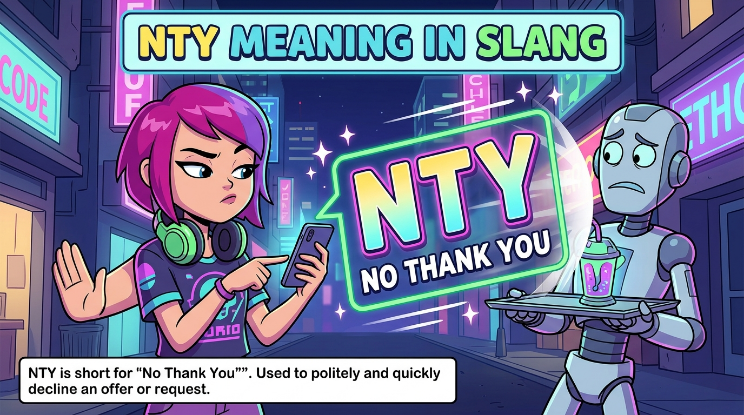
NTY is commonly used as informal internet shorthand. It is not a separate slang word with a different definition. Instead, it shortens the phrase “No Thank You.”
The abbreviation can sound polite because the full phrase includes “thank you.” However, the short form may sometimes feel blunt if someone sends only “NTY” without any additional words.
For example:
“NTY, but thanks for asking.”
sounds warmer than simply:
“NTY.”
The surrounding message controls much of the tone.
NTY Meaning in Texting for Boys and Girls
The meaning of NTY does not change based on who uses it. Boys, girls, friends, coworkers, and other people can all use NTY to mean “No thank you.”
For example:
“Do you want to join the group?”
“NTY.”
The person is declining the invitation. There is no special male or female meaning behind the abbreviation.
The tone depends on the conversation rather than the gender of the sender.
NTY Meaning in a Friendly Conversation
Friends may use NTY when they want to reject something without making the conversation serious. The phrase can sound relaxed when used with friendly wording or emojis.
For example:
“Want another slice?”
“NTY 😂 I’m full.”
This response clearly means no while keeping the conversation friendly.
Another example is:
“Want to play another game?”
“NTY, I need a break.”
The person is simply saying no for that moment.
NTY Meaning in a Polite Conversation
NTY can communicate a polite refusal, but it is still an informal abbreviation. In a more formal conversation, writing “No, thank you” is usually clearer.
For example:
Casual: “NTY, I’m okay.”
Formal: “No, thank you. I appreciate the offer.”
The second version gives a more professional impression.
So, NTY works well in casual chats but may not fit every situation.
NTY Examples in Texting
Here are some easy examples of the NTY meaning in text:
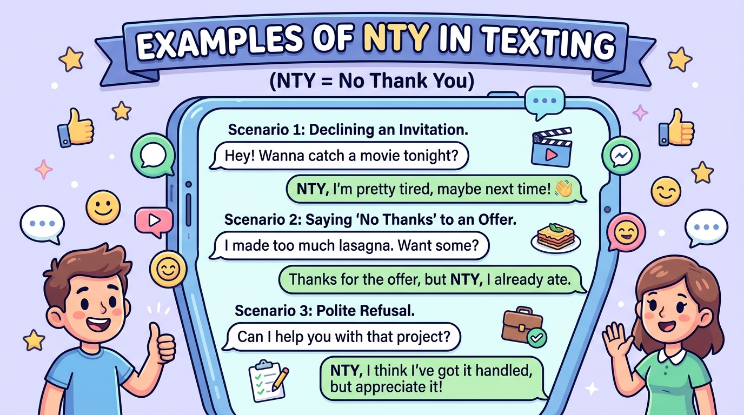
“Want some tea?”
“NTY, I just had some.”
“Do you want to come with us?”
“NTY, I have other plans.”
“Need a ride?”
“NTY, I can walk.”
“Want to try this game?”
“NTY, maybe later.”
“Would you like another one?”
“NTY, I’m good.”
Each example uses NTY as a short form of “No thank you.”
NTY vs No Thanks
NTY and “No thanks” have a similar purpose. Both can politely reject an offer or suggestion.
| Expression | Meaning | Tone |
| NTY | No thank you | Casual |
| No thanks | No thank you | Casual |
| No, thank you | Polite refusal | More standard |
| I appreciate it, but no | Polite refusal | Warm and polite |
NTY is shorter than all these options. It works best when the conversation is already informal.
NTY vs TY
NTY = No Thank You
TY = Thank You
For example:
“Want some cake?”
“NTY.”
The person declines the offer.
But:
“Thanks for the cake!”
“TY!”
The person is expressing appreciation.
The letters may look similar, but their meanings are different.
NTY vs NVM
NTY = No Thank You
NVM = Never Mind
For example:
“Want to join us?”
“NTY.”
This means the person is declining.
But:
“Can you help me? NVM, I figured it out.”
Here, NVM means “Never mind.”
Knowing common texting abbreviations can help prevent confusion.
Is NTY Rude?
NTY is not automatically rude. It usually means “No thank you,” which is a polite way to decline something.
However, sending only “NTY” can sometimes feel short or cold. This depends on the relationship between the people and the topic of the conversation.
Compare these replies:
“NTY.”
and
“NTY, but thanks for asking 😊.”
The second reply sounds warmer because it adds friendly words.
So, the abbreviation itself is not rude. The overall tone comes from the context.
How to Reply to NTY
If someone sends you NTY, you usually do not need to continue pushing the offer. A simple response can keep the conversation comfortable.
You can reply with:
- “No problem!”
- “Sure!”
- “All good.”
- “Okay!”
- “That’s fine.”
- “No worries.”
- “Maybe next time.”
For example:
You: “Want to come to dinner?”
Friend: “NTY, I’m busy.”
You: “No worries!”
This keeps the conversation friendly and respectful.
When to Use NTY
NTY works best in informal digital conversations. You can use it with friends, family members, gaming friends, and people who are comfortable with texting shorthand.
Common situations include:
- Casual text messages
- Group chats
- Social media DMs
- Online gaming
- Friendly comments
- Informal conversations
The abbreviation saves time and keeps the message short.
When Not to Use NTY
NTY may not be suitable for formal or professional communication. Business emails, official messages, school assignments, and formal requests usually require standard English.
Instead of:
“NTY for the offer.”
a professional message could say:
“No, thank you for the offer.”
This version is clearer and more appropriate for formal communication.
Common Mistakes About NTY
One common mistake is thinking that NTY means something negative or insulting. In most casual conversations, it simply means “No thank you.”
Another mistake is using NTY when you actually want to accept something. NTY clearly communicates a refusal.
Some people also assume that NTY always sounds polite. While the full phrase is polite, the abbreviation can feel blunt when used alone.
Adding a few friendly words can make the meaning warmer.
Why People Use NTY in Texts
People use NTY because texting often favors short and quick messages. A three-letter abbreviation can replace a longer phrase without changing the basic meaning.
It also fits naturally into fast conversations. Someone can quickly decline an offer without typing a complete sentence.
For example:
“Want some?”
“NTY.”
The reply is short, clear, and easy to understand when the context is obvious.
NTY in Different Contexts
The meaning of NTY usually stays the same, but its tone can change with the situation.
| Context | Meaning | Possible Tone |
| Friend chat | No thank you | Friendly |
| Group chat | No thank you | Casual |
| Social media | No thank you | Informal |
| Gaming chat | No thank you | Quick |
| Professional email | No thank you | Too informal |
| Formal letter | No thank you | Not recommended |
The abbreviation works best when the conversation itself is informal.
Frequently Asked Questions
What does NTY mean in text?
NTY usually means “No Thank You.” People use it to politely decline an offer, invitation, suggestion, or request.
What does NTY stand for?
NTY stands for “No Thank You.” It is a common informal abbreviation used in digital conversations.
Is NTY slang?
NTY is informal texting shorthand. It is commonly used in casual chats, social media, and online conversations.
Is NTY rude?
NTY is not normally rude. However, a one-word or three-letter reply can sometimes sound blunt depending on the situation and relationship.
What does NTY mean on Snapchat?
On Snapchat, NTY usually means “No thank you.” A person may use it to quickly decline an invitation, offer, or suggestion.
What does NTY mean on Instagram?
On Instagram, NTY generally means “No thank you.” It can appear in DMs, comments, or casual replies.
What does NTY mean on TikTok?
On TikTok, NTY can be used as casual shorthand for “No thank you.” Its meaning depends on the surrounding comment or message.
What is the difference between NTY and TY?
NTY means “No thank you,” while TY means “Thank you.” NTY usually declines something, while TY expresses appreciation.
How should I respond to NTY?
You can respond with simple phrases such as “No problem,” “No worries,” “Okay,” or “Maybe next time.” The best response depends on the conversation.
Is NTY formal English?
No. NTY is informal texting shorthand. Use “No, thank you” in formal or professional communication.
Conclusion
The NTY meaning in text is usually “No Thank You.” People use it as a quick way to decline an offer, invitation, suggestion, or request. It is common in casual text messages, social media conversations, group chats, and online communities.
NTY is simple once you know what it stands for. If someone writes “NTY,” they are usually saying that they do not want something while keeping the response short.
The tone can change depending on the conversation. A simple “NTY” may sound direct, while “NTY, but thanks!” can sound warmer.
For casual chats, NTY is easy to understand and convenient to use. For formal messages, writing “No, thank you” is a clearer and more professional choice.