The phrase “what does pedantic mean” is commonly searched by people who want to understand the meaning of the word in simple English. It is usually used to describe someone who pays too much attention to small details, rules, or minor points, especially when those details are not very important. You may see this word in everyday conversations, text messages, social media posts, online discussions, and academic settings. Although can sometimes describe careful attention to detail, it often has a slightly negative meaning when someone focuses too much on correcting others.
What Does Pedantic Mean?
Pedantic describes a person who gives too much importance to small details, rules, or technical points. The word often suggests that someone is correcting others or showing their knowledge when the detail does not really matter.
For example, if someone makes a small grammar mistake and another person immediately corrects it during a casual conversation, they may be called pedantic. The word does not simply mean “intelligent” or “careful.” It usually suggests that the person is being overly concerned with minor details.
Simple Meaning of Pedantic
- Overly focused on small details
- Too concerned with rules or technicalities
- Often correcting minor mistakes
- Sometimes used in a negative or critical way
- Can describe overly formal behavior
Common Meanings of Pedantic in Texting
The meaning of pedantic in texting is usually connected to how someone behaves during a conversation. People may use the word when another person keeps correcting tiny mistakes or focuses on technical details instead of the main point.
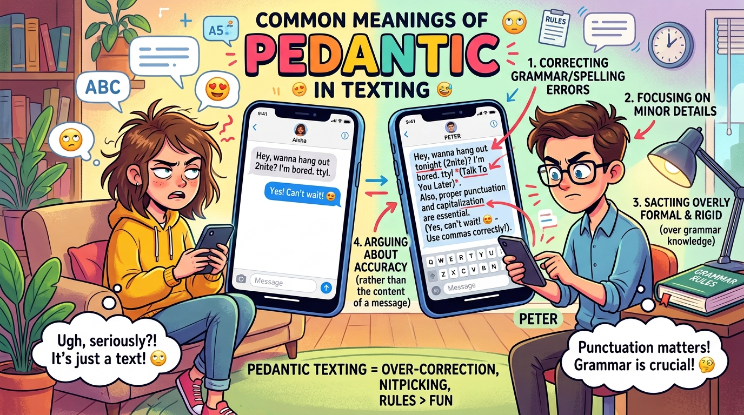
In text messages, pedantic is usually not slang in the same way as internet abbreviations. It is a standard English word that can be used casually. The tone depends on the conversation and the relationship between the people involved.
1. Pedantic as a Critical or Overly Detailed Expression
Someone may call another person pedantic when they feel that the person is being unnecessarily precise.
For example:
“You know what I meant. Stop being so pedantic.”
Here, the speaker is saying that the other person is focusing too much on a small detail.
2. Pedantic as a Formal or Academic Term
Pedantic can also appear in academic discussions. A teacher, writer, or student might use the word to describe an approach that focuses heavily on rules and technical details.
In this context, the word may still have a negative meaning, especially if the attention to detail makes communication less useful or natural.
3. Pedantic in Professional or Technical Contexts
In professional settings, someone may be described as pedantic if they spend too much time discussing minor technical differences.
For example, a person may understand the main idea of a project but continue arguing about a tiny wording issue. Someone might describe this behavior as pedantic.
Why Pedantic Can Be Confusing Online
The word pedantic can be confusing because it is sometimes used as criticism and sometimes as a simple description of precise behavior. Being careful with details is not automatically pedantic.
The difference usually depends on whether the attention to detail is useful. If accuracy is important, being precise can be a good thing. If someone keeps correcting unimportant details just to prove a point, the behavior may be called pedantic.
This is why context matters when understanding what does pedantic mean.
The Origin of Pedantic
The word pedantic comes from the Italian word pedante, which was used for a teacher or schoolmaster. The word later developed a more negative sense connected with someone who shows too much learning or gives excessive attention to formal details.
Over time, pedantic became an English adjective used for people who focus heavily on rules, technicalities, and small points of knowledge.
Today, the word can be used in everyday English, academic writing, professional discussions, and online conversations.
How Pedantic Is Used on Social Media
On social media, people often use pedantic when someone corrects another person’s wording, grammar, spelling, or minor detail.
The word can appear in comments, debates, posts, and replies. It is especially common when people disagree about whether a correction is actually important.
For example:
“You’re being pedantic. Everyone understood the point.”
This means the speaker thinks the correction was unnecessary.
Common situations include:
- Correcting spelling
- Arguing over exact wording
- Focusing on tiny details
- Correcting grammar in casual posts
- Debating technical differences
Pedantic on TikTok and Instagram
On TikTok and Instagram, pedantic may appear in comments when users disagree about a small detail in a video or caption.
For example:
“Technically, that’s not the right word.”
Another person might reply:
“Don’t be so pedantic.”
In this case, the second person feels that the correction is unnecessary.
The word can also be used humorously. Friends may call each other pedantic when someone takes a joke or casual statement too literally.
Pedantic in Text Messages
In text messages, pedantic usually describes someone’s behavior rather than a special slang meaning.
For example:
Friend 1: “I walked a mile to your house.”
Friend 2: “Actually, it was 0.9 miles.”
Friend 1: “Why are you being so pedantic?”
The speaker is criticizing the other person for focusing on an exact measurement instead of the main idea.

The meaning can be playful or serious depending on the tone.
Pedantic in Gaming Communities
Gaming communities can also use pedantic when players argue about technical details, game rules, or exact wording.
For example:
“You won the match. Stop being pedantic about the score.”
A player may also be called pedantic when they correct a small detail about a game mechanic that does not affect the main discussion.
In gaming chats, the word is often used casually and may not be meant as a serious insult.
Real-World Examples of Pedantic Usage
To understand what does pedantic mean, it helps to see how the word works in different conversations.
Example 1: Casual Friend Conversation
Friend 1: “The movie was two hours long.”
Friend 2: “Actually, it was one hour and fifty-eight minutes.”
Friend 1: “You’re being pedantic.”
Here, pedantic means focusing on a very small and unimportant difference.
Example 2: Online Comment
User 1: “This phone is the fastest on the market.”
User 2: “Technically, another phone has a slightly higher benchmark score.”
User 1: “That’s a bit pedantic.”
The person is focusing on a technical detail instead of the general point.
Example 3: Group Chat
Friend 1: “Let’s meet at 7.”
Friend 2: “Do you mean exactly 7:00 or sometime during the 7 o’clock hour?”
Friend 1: “Don’t be pedantic.”
The word suggests that the second person is being unnecessarily exact.
Example 4: Gaming Chat
Player 1: “We won easily.”
Player 2: “Technically, we only won by one point.”
Player 1: “Bro, you’re being pedantic.”
The correction is technically accurate but not important to the main statement.
Example 5: Correcting Someone’s Small Detail
Person 1: “There were hundreds of people there.”
Person 2: “It was actually 97 people.”
Person 1: “That’s a little pedantic.”
The speaker believes that the exact number is not important to the conversation.
How to Respond When Someone Calls You Pedantic
If someone calls you pedantic, they usually mean that you are focusing too much on a small detail. Your response can depend on whether you were trying to be helpful or simply making a correction.
You do not always need to take the word as a serious insult. In friendly conversations, people may use it jokingly.
Friendly Responses
You can respond casually with:
- “Fair enough.”
- “I just like being accurate.”
- “Okay, you got me.”
- “Maybe I am being a little too specific.”
- “I was only trying to clarify.”
When You Are Unsure
If you are not sure why someone called you pedantic, you can ask:
“What part was too specific?”
This can help you understand whether the other person was joking or genuinely annoyed.
Why Context Matters More Than the Word
The meaning of pedantic becomes clearer when you look at the situation. A person who corrects a medical measurement in a professional setting may be helping. The same behavior during a casual joke may seem pedantic.
Consider these factors:
- What was being discussed?
- Was accuracy important?
- Was the correction necessary?
- Was the person trying to help?
- Was the correction made repeatedly?
These details help determine whether pedantic is being used fairly or simply as criticism.
Common Places Where You May See Pedantic
The word pedantic can appear in many types of communication. It is not limited to texting or social media.
Text Messages
Friends may use it when someone focuses too much on a minor detail.
Social Media Comments
Users may call a commenter pedantic when they make an unnecessary correction.
Gaming Chats
Players may use the word during arguments about rules, scores, or game mechanics.
Online Forums
Forum users may describe detailed corrections as pedantic, especially during long discussions.
Private Messages
People may use pedantic casually when talking about someone’s habit of correcting others.
Common Mistakes and Misconceptions About Pedantic
The word pedantic is sometimes misunderstood because people assume it simply means intelligent, careful, or knowledgeable. Those meanings are not exactly the same.
Mistake 1: Assuming Pedantic Always Means Intelligent
A pedantic person may be knowledgeable, but the word focuses on how they use that knowledge. It often suggests excessive attention to minor details.
Mistake 2: Using Pedantic as a Simple Synonym for Smart
Pedantic does not simply mean smart or educated. Someone can be very intelligent without being pedantic.
Mistake 3: Expecting Everyone to Understand the Word
Pedantic is a less common word than simple terms like “picky” or “specific.” Some people may not immediately understand it in casual conversations.
Mistake 4: Using Pedantic Without Considering Context
Not every correction is pedantic. Sometimes exact information is important. The word usually suggests that the attention to detail is unnecessary or excessive.
Pedantic vs Similar Words
Understanding similar words can make the meaning of pedantic easier to remember.
Pedantic vs Precise
Precise usually has a positive or neutral meaning. It describes something accurate and exact.
Pedantic often suggests that someone is too focused on small details.
For example:
- “She gave a precise answer.” — She gave an accurate answer.
- “He was being pedantic about the wording.” — He focused too much on a minor detail.
Pedantic vs Perfectionist
A perfectionist wants things to be done perfectly. A pedantic person focuses heavily on rules, details, or technical correctness.
A person can be both, but the words describe different behaviors.
Pedantic vs Precise in Casual Conversations
The difference between pedantic and precise is especially important in everyday conversations.
Being precise can help prevent confusion. For example, giving an exact time for an appointment is useful.
Being pedantic may happen when someone corrects a tiny detail that does not affect the meaning.
For example:
“The meeting starts around 10.”
If someone responds:
“Actually, it starts at 10:03.”
That correction may be considered pedantic if the exact three minutes do not matter.
How to Know the Correct Meaning of Pedantic
Understanding what does pedantic mean becomes easier when you look at the situation around the word.
1. Where Did You See It?
Look at whether the word appeared in a text, social media comment, academic discussion, or professional conversation.
2. Who Used the Word?
Think about who said it. A friend may use pedantic jokingly, while a colleague may use it as a serious criticism.
3. What Is the Conversation About?
The topic can tell you whether attention to detail is useful or unnecessary. In technical discussions, precision may be important. In casual conversations, excessive correction may seem pedantic.
Frequently Asked Questions About Pedantic
1. What does pedantic mean?
Pedantic means being overly concerned with small details, rules, or technical points, especially when those details are not important to the main discussion.
2. What does pedantic mean in text?
In text messages, pedantic usually describes someone who focuses too much on minor details or keeps correcting another person’s wording.
3. Is pedantic a negative word?
Usually, yes. Pedantic often has a mildly negative meaning because it suggests that someone is paying too much attention to unnecessary details.
4. What does it mean when someone calls you pedantic?
It usually means they think you are being overly precise or focusing too much on a small detail. The comment can be serious or playful depending on the context.
5. Is being pedantic the same as being precise?
No. Being precise means being accurate and exact. Being pedantic suggests that someone is excessively focused on small details or technicalities.
6. How should I respond if someone calls me pedantic?
You can respond calmly with something like, “Fair enough, I was just trying to be accurate.” If the comment was playful, you can simply laugh it off.
7. Why do people use the word pedantic?
People use pedantic to describe behavior where someone gives too much attention to minor details, rules, corrections, or technical points.
Conclusion
Understanding what does pedantic mean is easier when you look at how the word is used in context. It generally describes someone who focuses too much on small details, rules, or technical points.
The word pedantic can appear in text messages, social media comments, online discussions, gaming chats, and professional conversations. Its tone can range from playful criticism to a more serious complaint about someone’s behavior.
In most cases, the key difference is whether attention to detail is useful or excessive. Once you understand that difference, you can recognize pedantic meaning more easily and use the word correctly in everyday English.