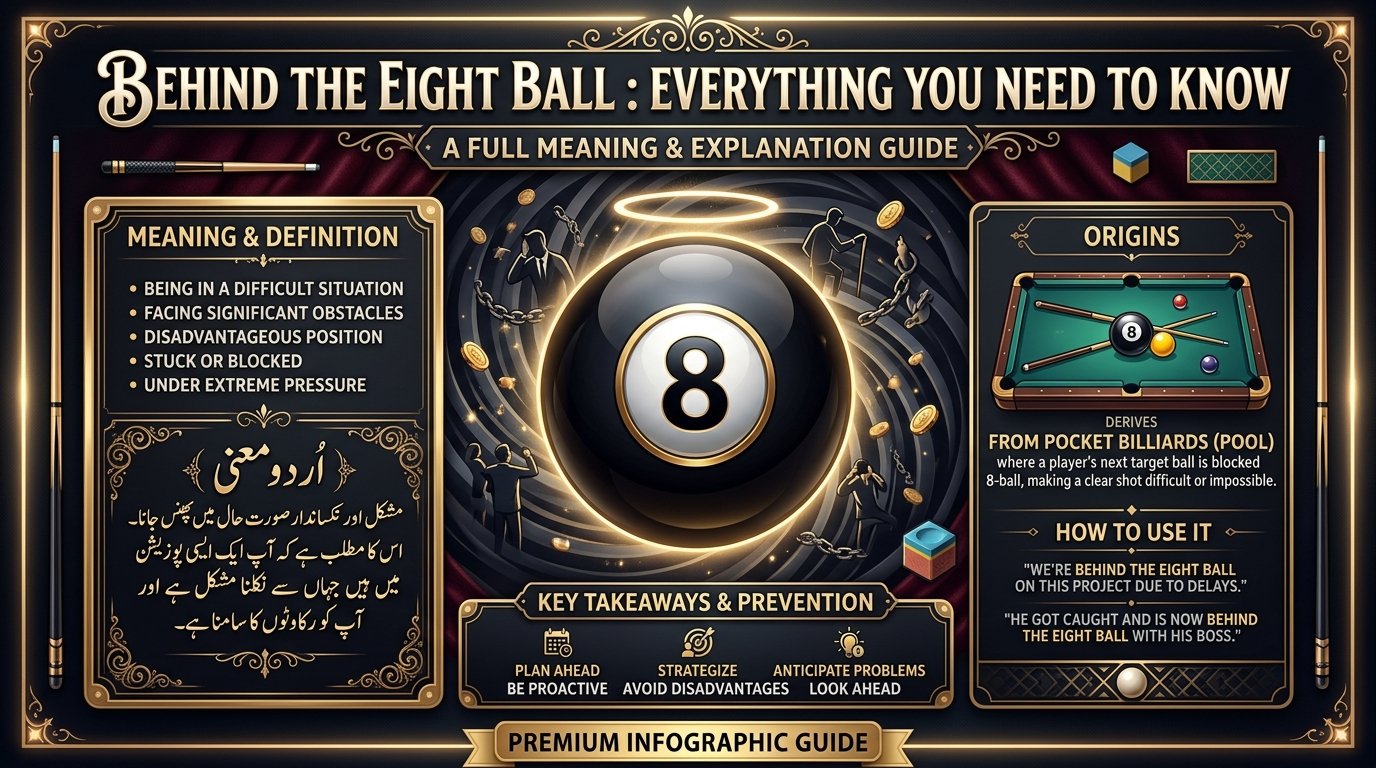
The phrase ” behind the eight ball meaning usually refers to being in a difficult, unfavorable, or challenging situation. When someone is “behind the eight ball,” they are generally at a disadvantage and may have limited options for improving their circumstances.
You may hear someone say, “I’m behind the eight ball with this project,” or “We’re already behind the eight ball because we missed the deadline.” You understand the general idea from the sentence, but the phrase itself can be confusing if you have never heard it before. Why would being “behind the eight ball” describe a difficult situation?
The expression is connected with the game of pool, where the position of the eight ball can create a difficult situation for a player. Over time, the phrase developed a figurative meaning and became a common English idiom for being in trouble, facing difficulties, or starting from a disadvantage.
Understanding the help you recognize this idiom in everyday conversations, workplace communication, books, movies, and online discussions. This guide explains its meaning, origin, examples, synonyms, and the correct ways to use “behind the eight ball” in English.
What Is the Behind the Eight Ball Meaning?
The term behind the eight ball does not literally mean standing behind a pool ball in everyday English. Instead, it is an idiomatic expression used to describe a person who is in a difficult position or at a disadvantage.
When someone says, “We are behind the eight ball,” they usually mean that a problem has made their situation more difficult and that they may need extra effort, time, or resources to recover.
For example:
- “We’re behind the eight ball because the project started late.”
- “I was behind the eight ball after missing two important meetings.”
- “The company is behind the eight ball financially.”
In each example, the phrase describes an unfavorable situation.
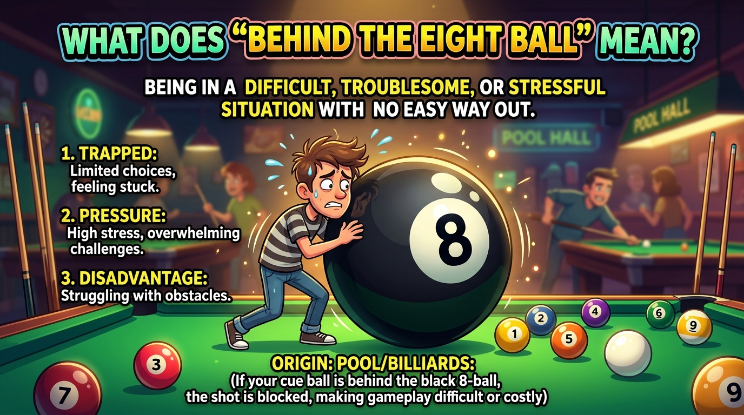
The meaning of behind the eight ball can therefore be understood as being in trouble, being behind schedule, or having to deal with circumstances that make success more difficult.
Why Does Behind the Eight Ball Mean Being at a Disadvantage?
The phrase is commonly associated with pool and billiards. In pool, players must carefully plan their shots and position the cue ball to make future shots easier.
The eight ball has a special role in many forms of pool because it is usually the final ball that must be legally pocketed to win the game. Being in a poor position relative to the eight ball can make the next shot difficult.
The expression eventually moved beyond the pool table and began to describe difficult situations in everyday life.
Today, people use the phrase when someone:
- Has fallen behind
- Faces a difficult problem
- Has limited choices
- Is under pressure
- Is working from a disadvantage
- Needs to recover from a setback
The phrase is usually figurative rather than literal.
1. Being Behind Schedule
Someone may use the idiom when a project or task is running late.
For example:
“We’re behind the eight ball because the deadline is tomorrow.”
Here, the speaker means that the team is in a difficult position because there is not much time left.
2. Facing Financial Problems
The expression can also describe financial difficulties.
For example:
“After several unexpected expenses, we’re behind the eight ball.”
This means the person or organization is facing financial pressure and has fewer options than before.
3. Dealing With a Setback
A person can be behind the eight ball after experiencing an unexpected problem.
For example:
“Missing the first week of training put me behind the eight ball.”
The person has fallen behind and now has to work harder to catch up.
Common Behind the Eight Ball Meanings in English
When people search what does behind the eight ball mean, they are usually looking for the figurative meaning of this common English idiom.
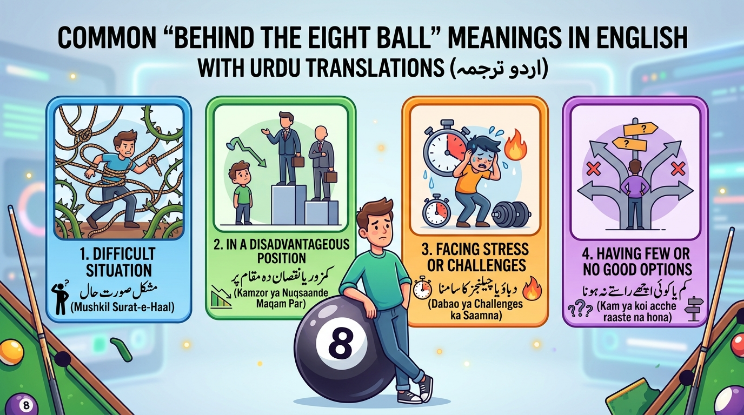
Below are some of its most common uses.
1. Being in a Difficult Situation
The most common meaning is being in a situation that is difficult to manage.
Example:
“I’m behind the eight ball with all these assignments.”
The speaker has too many assignments and feels that their situation is difficult.
2. Being at a Disadvantage
The phrase can describe someone who starts from a weaker position than others.
Example:
“Our team was behind the eight ball after losing our best player.”
Here, the team is at a disadvantage because an important player is unavailable.
3. Being Behind
The idiom can also refer to falling behind in work, school, finances, or another responsibility.
Example:
“I’ve been sick all week, so I’m really behind the eight ball at work.”
The speaker has fallen behind and now needs to catch up.
4. Having Limited Options
Sometimes the expression emphasizes that there are not many easy solutions available.
Example:
“We’re behind the eight ball, and there aren’t many ways to fix the problem quickly.”
The phrase communicates pressure and difficulty rather than simply being busy.
How Behind the Eight Ball Became Popular in English
The phrase is generally linked to American English and the game of pool. Pool terminology has influenced many English expressions because players and spectators use specific situations from the game to describe everyday experiences.
The exact historical development of the idiom is discussed in reference works, but its connection with pool is central to its modern meaning.
As the expression became more widely used, people began applying it outside gaming.
Instead of describing a literal pool position, speakers started using behind the eight ball to describe being in a difficult position in life.
The idiom eventually became common in:
- Everyday conversations
- Newspapers
- Books
- Business communication
- Movies and television
- Sports discussions
- Informal writing
Behind the Eight Ball Meaning in Everyday Conversation
The phrase is commonly used in informal and semi-formal English when someone wants to describe a difficult situation without explaining it in a long sentence.
For example:
Friend A:
“Did you finish the report?”
Friend B:
“Not yet. I’m behind the eight ball because I had three other deadlines.”
Here, the speaker means that several responsibilities have put them in a difficult position.
Another example:
Friend A:
“Are you ready for the exam?”
Friend B:
“Not really. I missed a lot of classes, so I’m behind the eight ball.”
In this conversation, the phrase means that the student is at a disadvantage because they missed important classes.
Behind the Eight Ball Meaning in Different Contexts
The meaning stays generally the same, but the situation in which the phrase is used can change.
Workplace Context
Employees may use the idiom when a project is delayed or a deadline is approaching.
Example:
“We’re behind the eight ball because the client changed the requirements.”
This means the team is now in a difficult position.
School Context
Students may use the expression when they fall behind with assignments or preparation.
Example:
“I’m behind the eight ball because I didn’t study for the test.”
Financial Context
Businesses and individuals can use the phrase when dealing with financial pressure.
Example:
“Rising costs have put the company behind the eight ball.”
Sports Context
The idiom can describe a team or player facing an unfavorable situation.
Example:
“We were behind the eight ball after giving up two early goals.”
The team is at a disadvantage and must work harder to recover.
Real-World Examples of Behind the Eight Ball
Understanding examples is one of the easiest ways to learn how an idiom works.
Example 1: Workplace
“I’m behind the eight ball because I have to finish two reports today.”
Meaning:
The speaker is under pressure and has a difficult workload.
Example 2: School
“She fell behind the eight ball after missing several classes.”
Meaning:
She is now at a disadvantage because she missed important lessons.
Example 3: Business
“The company was behind the eight ball after its main supplier closed.”
Meaning:
The company faced an unexpected problem that put it in a difficult position.
Example 4: Personal Situation
“I was already behind the eight ball when my car broke down.”
Meaning:
The person was already dealing with difficulties, and another problem made the situation worse.
Example 5: Sports
“Our team was behind the eight ball after conceding three goals.”
Meaning:
The team was in an unfavorable position and needed to recover.
Common Mistakes People Make When Using Behind the Eight Ball
English learners sometimes misunderstand idioms because the literal meaning is different from the figurative meaning.
Here are some common mistakes to avoid.
Mistake 1: Taking the Phrase Literally
“Behind the eight ball” usually does not mean physically standing behind a pool ball.
When used as an idiom, it describes a difficult or disadvantageous situation.
Mistake 2: Using It for Every Small Problem
The phrase generally suggests a meaningful disadvantage or difficult situation.
For example, forgetting to buy a snack would not normally be described as being “behind the eight ball.”
However, missing an important deadline or facing a serious setback could naturally fit the expression.
Mistake 3: Using It in Very Formal Writing
Although the idiom is widely understood, it is still an idiomatic expression and may not fit every formal document.
In professional or academic writing, clearer alternatives can sometimes be better, such as:
- At a disadvantage
- In a difficult position
- Facing difficulties
- Behind schedule
Mistake 4: Confusing It With Similar Idioms
Several English idioms describe difficult situations, but they do not always mean exactly the same thing.
For example:
In hot water → in trouble
Up against the wall → facing serious pressure or limited choices
Behind the eight ball → in a difficult or disadvantageous position
Understanding these differences can help you use the expressions more naturally.
How to Know When to Use Behind the Eight Ball
If you want to use this idiom correctly, think about whether someone is facing a disadvantage or difficult circumstances.
1. Look at the Situation
Ask whether the person is experiencing a setback, delay, pressure, or disadvantage.
2. Consider the Context
The phrase can be used in work, school, business, sports, and everyday conversations.
3. Check the Tone
“Behind the eight ball” is generally conversational and idiomatic. It works well in casual and many semi-formal situations.
4. Use a Clear Alternative When Necessary
If your audience may not know the idiom, you can simply say:
“We are in a difficult position.”
This communicates the same general idea more directly.
Is Behind the Eight Ball an Idiom or Slang?
Behind the eight ball is an English idiom, not normally classified as slang.
An idiom is a phrase whose overall meaning is different from the literal meanings of its individual words.
For example, if someone says:
“I’m behind the eight ball.”
They are usually not saying that they are physically behind a pool ball. They are saying that they are in a difficult or disadvantageous situation.
The expression can appear in everyday conversation, journalism, business discussions, and other forms of English.
Behind the Eight Ball vs. Similar English Expressions
Several expressions can describe being in a difficult situation, but each has a slightly different use.
| Expression | Common Meaning | Example |
| Behind the eight ball | At a disadvantage | “We’re behind the eight ball.” |
| In hot water | In trouble | “He’s in hot water.” |
| Up against the wall | Under serious pressure | “We’re up against the wall.” |
| In a tight spot | In a difficult situation | “I’m in a tight spot.” |
| Behind schedule | Late or delayed | “We’re behind schedule.” |
The best expression depends on the exact situation and the tone of the conversation.
What Is the Origin of Behind the Eight Ball?
The phrase is associated with pool and billiards and later developed a figurative meaning in American English.
The eight ball is an important ball in common forms of pool, and being positioned in an unfavorable way during a game can make a player’s next move more difficult.
The pool-related image became a useful metaphor for everyday problems. Instead of talking about a difficult position on a pool table, people began using the expression to describe being at a disadvantage in real-life situations.
Although explanations of the phrase’s exact early history can vary, its modern figurative meaning is well established.
Frequently Asked Questions About Behind the Eight Ball Meaning
1. What does behind the eight ball mean?
“Behind the eight ball” means being in a difficult, unfavorable, or disadvantageous situation. It can describe someone who is behind schedule, facing problems, or dealing with limited options.
2. Is behind the eight ball an idiom?
Yes. “Behind the eight ball” is a common English idiom. Its figurative meaning is different from its literal reference to a pool ball.
3. Where does behind the eight ball come from?
The expression is associated with the game of pool or billiards. Its pool-related meaning developed into a metaphor for being in a difficult or disadvantageous position.
4. Is behind the eight ball slang?
It is generally considered an idiom rather than slang. It is used in everyday English and can appear in many different types of communication.
5. What is an example of behind the eight ball?
An example is: “We’re behind the eight ball because the project is already two weeks late.” Here, the phrase means that the team is in a difficult position because of the delay.
6. What are synonyms for behind the eight ball?
Depending on the context, possible alternatives include “at a disadvantage,” “in a difficult position,” “in a tight spot,” “under pressure,” and “behind schedule.”
7. Can I use behind the eight ball in professional English?
Yes. The idiom is understandable in many professional conversations, especially in informal or conversational settings. In highly formal writing, a direct phrase such as “at a disadvantage” may be clearer.
Final Conclusion
The behind the eight ball meaning is being in a difficult, unfavorable, or disadvantageous situation. The expression is associated with pool and billiards but is now commonly used to describe challenges in everyday life.
People may use the idiom when they are behind schedule, facing financial difficulties, dealing with a setback, or working with limited options.
When someone says, “We’re behind the eight ball,” they generally mean that their current circumstances have put them at a disadvantage and that they need to make an effort to improve the situation.
Understanding this idiom makes it easier to recognize and use natural English expressions in conversations, workplace discussions, books, and other forms of communication.