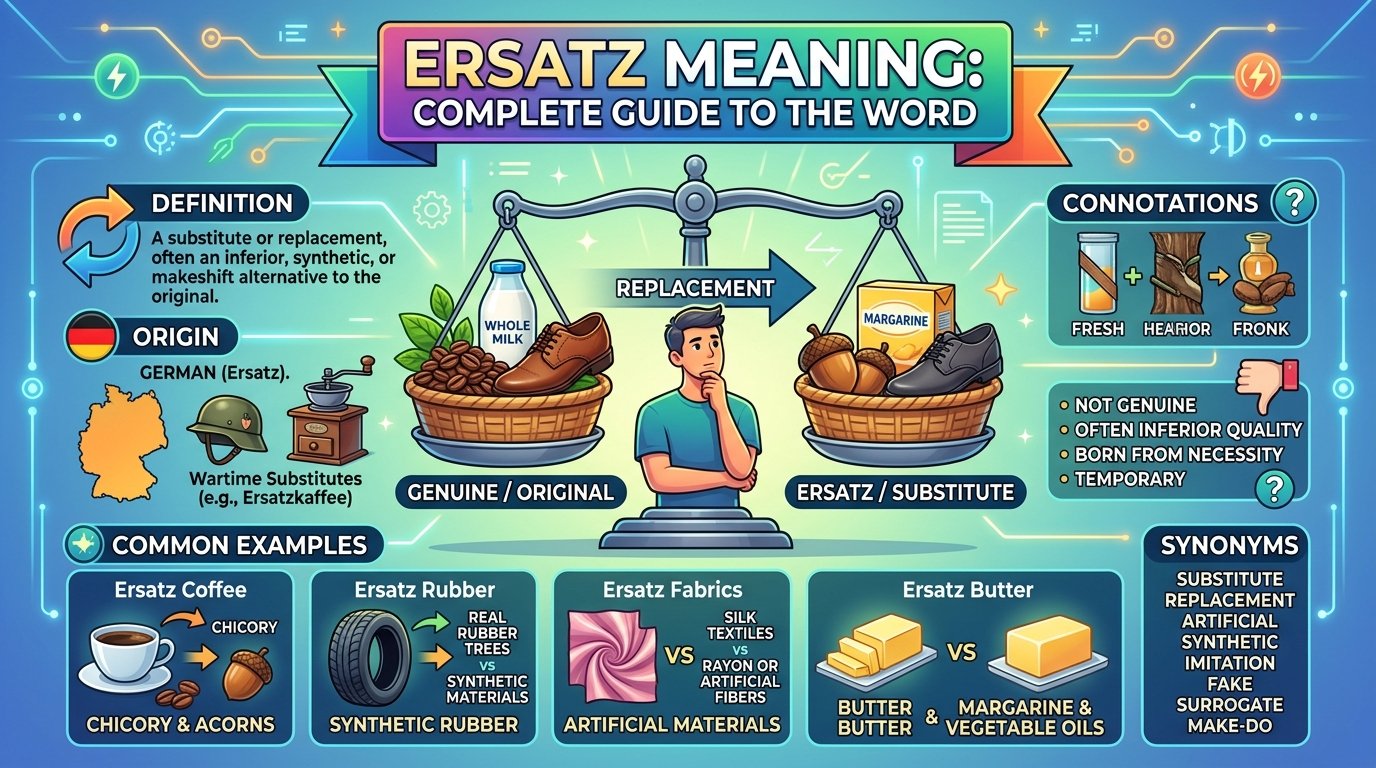
The word ersatz meaning points to a substitute or replacement.
People often use it for something that copies the real thing.
The word comes from German and means “replacement.”
In English, it can suggest a cheap or poor substitute.
The meaning can change a little with the context.
You may see this word in books, news, and daily writing.
This guide explains the word with simple examples.
What Does Ersatz Mean?
Ersatz means a substitute for something real or original. It can describe a product, material, idea, or person that takes the place of another. The word often suggests that the substitute does not match the original in quality. For example, an ersatz leather bag looks like leather but uses another material.
The word can work as a noun or an adjective. As a noun, it means a substitute or replacement. As an adjective, it describes something that acts as a substitute. The word usually carries a negative or doubtful tone.
Simple Examples
- Ersatz coffee = a coffee substitute
- Ersatz leather = artificial leather
- Ersatz food = food used instead of the real product
- Ersatz luxury = something made to look expensive
Meaning of Ersatz
The basic meaning of ersatz is “substitute.” It refers to something that takes the place of another thing. The replacement may look similar, but it may not have the same quality. This idea gives the word its special tone.
For example, someone may buy an ersatz diamond instead of a real diamond. The stone may look attractive, but it does not have the same value. In this case, ersatz highlights the difference between the copy and the original.
The word does not always mean “fake.” A substitute can serve a useful purpose. However, writers often choose ersatz when they want to show that the replacement feels less genuine.
Ersatz Meaning in English
The phrase ersatz meaning in english can be explained with three simple words: substitute, replacement, or imitation. English borrowed the word from German. Today, English speakers use it when they want to describe an alternative that replaces the original.
The word often has a critical tone. For example, “ersatz butter” may describe a product that replaces real butter. The phrase does not simply describe an alternative. It can also suggest lower quality or less authenticity.
Easy English Meaning
| Word | Simple meaning |
|---|---|
| Ersatz | Substitute |
| Ersatz product | Replacement product |
| Ersatz material | Alternative material |
| Ersatz luxury | Imitation luxury |
| Ersatz version | Copy or substitute version |
Ersatz Meaning Slang
The ersatz meaning slang search can cause some confusion. Ersatz is not mainly modern slang. It is a standard English word that people sometimes use in an informal way.
In casual writing, someone may use ersatz to mean fake, imitation, knockoff, or poor substitute. The exact tone depends on the sentence. A writer may use it to make a copy sound less authentic.
For example, “That restaurant serves ersatz Italian food” suggests that the food tries to copy Italian cuisine but does not feel truly Italian. The word adds a critical feeling to the sentence.
Ersatz in Casual Use
- Ersatz designer = fake-looking designer style
- Ersatz luxury = imitation luxury
- Ersatz friend = someone who acts like a replacement
- Ersatz culture = copied culture
- Ersatz food = substitute food
Calliope Meaning
The word calliope has a completely different meaning from ersatz. A calliope is a musical instrument. It produces loud musical sounds through pipes.
Traditional calliopes used steam or compressed air to create sound. People often connect them with circuses, fairs, parades, and old amusement shows. Their sound can carry over long distances.

The word also has a connection to Greek mythology. Calliope was one of the nine Muses. She represented epic poetry and eloquence.
Simple Calliope Definition
A calliope is:
- A musical instrument
- A pipe-based instrument
- A traditional fairground instrument
- An instrument linked with circuses
- A name from Greek mythology
Calliope Name Meaning
The calliope name meaning comes from ancient Greek. The name is commonly explained as “beautiful voice” or “beautiful-voiced.” It comes from Greek elements connected with beauty and voice.
Calliope was an important figure in Greek mythology. Ancient stories describe her as the Muse of epic poetry. Writers and poets later used the name because of this strong literary connection.
Today, Calliope can work as a personal name. It also appears in literature, music, art, and popular culture.
Calliope Complex Meaning
The phrase calliope complex meaning does not have one widely accepted standard definition. It does not refer to a common dictionary term or a well-established psychological condition.
The meaning may depend on where you found the phrase. A writer could create the expression for a specific story, character, idea, or theory. In that case, the surrounding text gives the real meaning.
Do not treat “Calliope complex” as a fixed medical or psychological diagnosis. Always check the source and context before giving it a specific definition.
Calliope Meaning Greek
The calliope meaning greek connection goes back to ancient Greek mythology. Calliope was one of the nine Muses. She was linked with epic poetry and eloquent speech.
Her Greek name is usually written as Kalliope. The name combines Greek elements associated with “beautiful” and “voice.” This gives the name its familiar meaning of “beautiful voice.”
The mythological Calliope also had a strong connection with poetry and storytelling. Because of this, the name still feels artistic and literary today.

Ersatz Meaning in Different Contexts
The ersatz meaning can feel slightly different depending on the context. The central idea always involves a substitute or replacement. However, the word can also suggest that the replacement lacks the quality or authenticity of the original.
Food
Ersatz food replaces a traditional ingredient or product. A writer may use the word when the replacement tastes or feels different from the real thing.
Example: “The recipe used ersatz cream during the shortage.”
Fashion
Ersatz fashion can describe clothing that copies a luxury style. The design may look similar without using the original materials or brand.
Example: “The store sold ersatz designer bags.”
Materials
People can use ersatz for artificial materials. These materials replace natural or original materials.
Example: “The company used ersatz leather for the seats.”
Culture
Writers may also use the word for copied cultural experiences. The phrase can suggest that something looks authentic but lacks a deeper connection.
Example: “The resort offered an ersatz version of village life.”
Ersatz Examples in Sentences
These examples show how people can use the word in normal writing. Each sentence gives the substitute idea a clear context.
- The shop sold ersatz leather jackets.
- He drank ersatz coffee during the shortage.
- The film showed an ersatz version of Paris.
- The bag looked like an ersatz designer product.
- They used ersatz materials to reduce costs.
- The restaurant served ersatz cheese.
- The toy offered an ersatz version of the real machine.
- She disliked the ersatz luxury of the hotel.
- The product became an ersatz replacement for the original.
- The writer called the item an ersatz copy.
Ersatz vs Genuine
Ersatz points to a substitute or imitation. Genuine describes something real, authentic, or original.
The difference becomes clear when you compare products. An ersatz diamond may look like a diamond, but a genuine diamond is the real stone. The two items may look similar, but their value and origin can differ.
| Ersatz | Genuine |
|---|---|
| Substitute | Real item |
| Replacement | Original |
| May imitate | Authentic |
| May cost less | May cost more |
| Can suggest lower quality | Suggests real quality |
| Not the original | The original |
The word ersatz does not always mean useless. A substitute can solve a real problem. The word simply tells readers that something stands in for another thing.
Common Misunderstandings About Ersatz
Many people think ersatz always means “fake.” That idea is close, but it does not cover the full meaning. Ersatz mainly means a substitute or replacement.
Another mistake involves pronunciation. The word comes from German, so its spelling may look unusual to English readers. In English, it is commonly pronounced roughly like “AIR-sahts.”
Some readers also assume that ersatz always describes physical products. It can describe ideas, experiences, styles, and other things that imitate or replace something else.
Finally, do not confuse ersatz with Calliope. These words have separate origins and meanings. Ersatz refers to a substitute, while Calliope can refer to a musical instrument or a figure from Greek mythology.
Frequently Asked Questions
What is the basic ersatz meaning?
Ersatz means a substitute or replacement. It often describes something that imitates the real or original item. The word can also suggest lower quality or less authenticity.
Is ersatz a negative word?
It can have a negative tone. Writers often use it when a substitute seems inferior or less genuine. However, the exact tone depends on the context.
What is ersatz meaning in English?
The ersatz meaning in English is substitute, replacement, or imitation. The word came into English from German.
Is ersatz slang?
No, ersatz is not mainly modern slang. It is a standard English word. People may use it casually to describe something fake or imitation-like.
What does Calliope mean?
Calliope can mean a musical instrument that uses pipes to create sound. It can also refer to one of the nine Muses in Greek mythology.
What is the Calliope name meaning?
The Calliope name meaning is commonly given as “beautiful voice” or “beautiful-voiced.” The name comes from ancient Greek.
What does Calliope mean in Greek?
Calliope meaning Greek relates to beauty and voice. Greek mythology uses the name for the Muse of epic poetry.
Is Calliope complex a medical term?
No standard medical definition exists for “Calliope complex.” The phrase may have a special meaning in a particular book, story, or source. Context matters.
Conclusion
The ersatz meaning is simple: it means a substitute or replacement. The word often describes something that copies or replaces the original. It can also suggest lower quality or weaker authenticity.
The word comes from German but now appears in English writing. You may see it in discussions about food, fashion, materials, culture, and products. It is useful when “substitute” feels too plain.
Calliope has a separate history. It can name a musical instrument, a Greek Muse, or a personal name. Understanding these differences helps you use each word with confidence.