In this guide, we will explore the Sling Your Hook meaning, its meaning in text and English, its possible origin, common examples, synonyms, and appropriate ways to use it.
Have you ever heard someone say “sling your hook” and wondered why they were talking about a hook when they actually wanted someone to leave? This unusual expression is a good example of how English idioms can have meanings that are very different from their individual words.
“Sling your hook” is an informal expression mainly associated with British English, and it is used to tell someone to leave, go away, or stop hanging around. Depending on the situation, it can sound playful between friends or rather blunt when said seriously.
The phrase has an interesting old-fashioned character that makes it easy to notice in conversations, books, television shows, and other forms of informal English. However, knowing its meaning is only part of understanding it because tone and context can completely change how it sounds.
Sling Your Hook Meaning
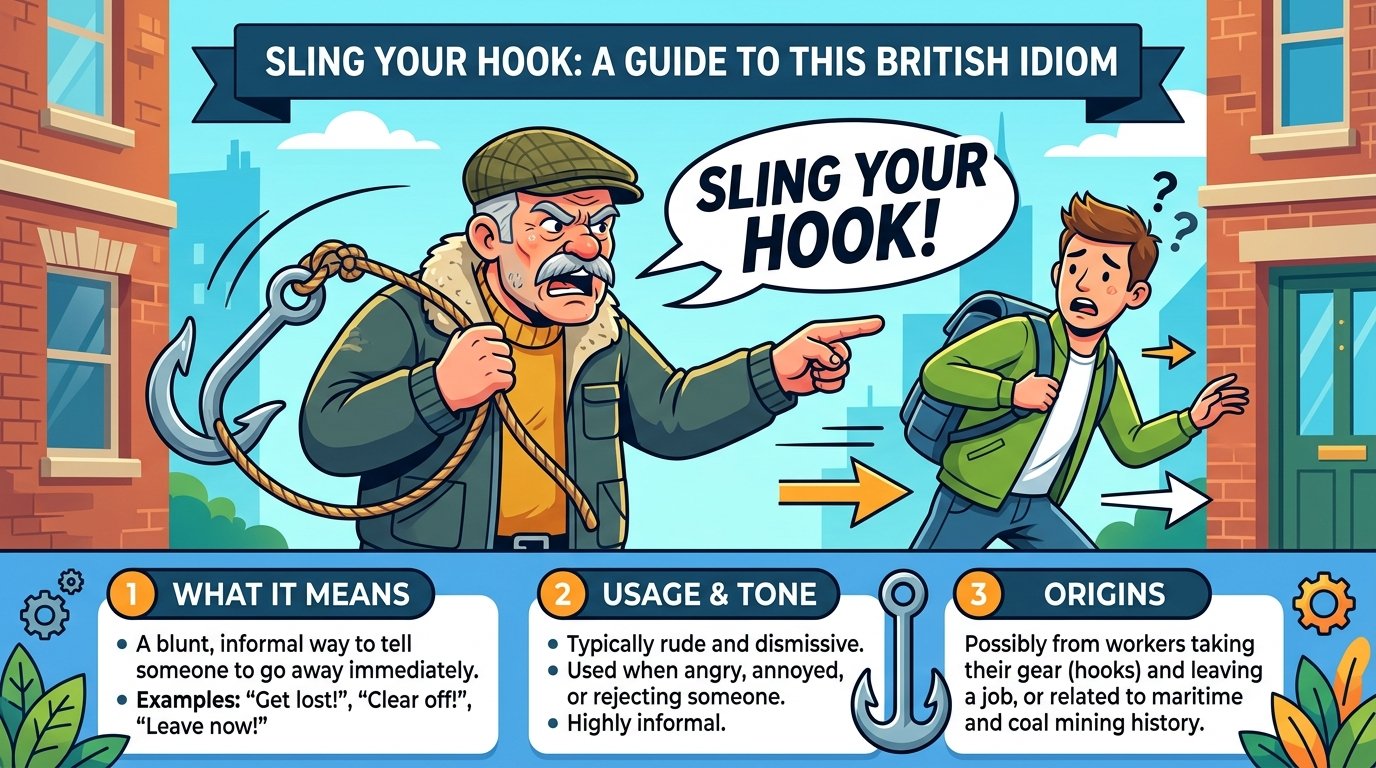
“Sling your hook” means to leave, go away, or get out of a particular place.
It is normally directed at another person as a command. For example:
“You’ve been here long enough, so sling your hook.”
The speaker is telling the person to leave.
The expression is informal and can be dismissive. It may be used when someone is annoyed, but it can also be used jokingly among people who know each other well.
For example, a friend might say:
“Sling your hook! I’m trying to watch the match.”
If said with a smile, this could simply be playful teasing rather than a serious insult.
Sling Your Hook Meaning in Text
When “sling your hook” appears in a text message, its meaning is usually straightforward: the person is being told to leave or go away.
For example:
“I’ve got work to finish, so sling your hook for a while!”
In a message between close friends, this could be humorous. However, if someone sends the phrase during an argument, it may be intended as a genuine dismissal.
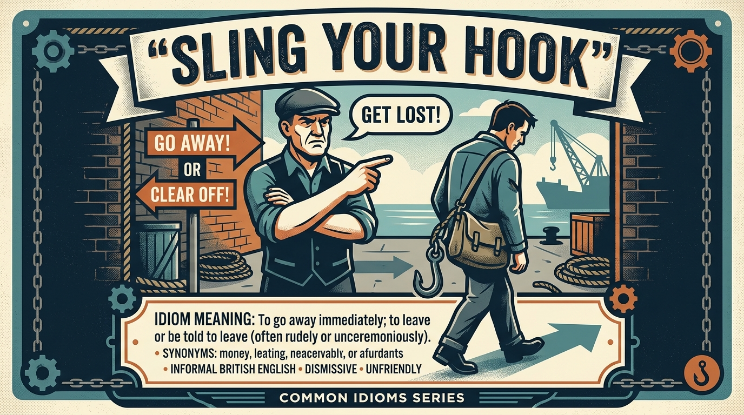
Text messages do not always show tone clearly, so the relationship between the people involved is important. Emojis, punctuation, and the rest of the conversation can also help show whether the phrase is being used seriously or jokingly.
Examples in Text Messages
| Text message | Likely tone | What the sender means |
| “Sling your hook, mate!” | Playful | Go away for now |
| “Just sling your hook and leave me alone.” | Angry | Leave me alone |
| “Come on, sling your hook. We’re late.” | Casual | Let’s leave/go |
| “The boss told him to sling his hook.” | Informal | The boss told him to leave |
Sling Your Hook Meaning in English
In simple English, “sling your hook” means “go away” or “leave.”
Some straightforward alternatives are:
- Go away
- Leave
- Get out
- Move along
- Stop hanging around
- Be off
The difference is that “sling your hook” has a more colorful and idiomatic quality. Instead of giving a plain instruction, the speaker uses a traditional expression that can sound humorous, old-fashioned, or blunt.
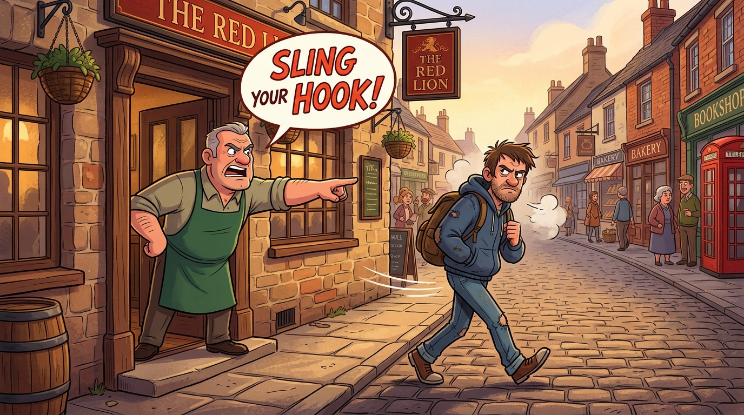
For an English learner, understanding this phrase is especially useful when watching British programs or reading informal British dialogue.
Quick Guide to the Expression
The following table makes the basic usage easier to understand:
| Feature | Description |
| Phrase | Sling your hook |
| Basic meaning | Leave or go away |
| Type | Idiomatic expression |
| Style | Informal |
| Strong association | British English |
| Tone | Can be playful, blunt, or rude |
| Usually directed at | Another person |
| Formal use | Generally best avoided |
Is Sling Your Hook an Idiom?
Yes, “sling your hook” is an idiomatic expression.
Its individual words do not provide the full meaning. The phrase is understood as a whole rather than as a literal instruction involving a physical hook.
The word “sling” can literally mean to throw or move something, while a “hook” can refer to a curved object used for catching, holding, or fishing. However, in the expression, the words work together to communicate the idea of leaving.
Like many idioms, it is best learned as a complete phrase.
Origin of Sling Your Hook
The precise origin of “sling your hook” is not completely certain, and different explanations have been associated with the expression over time.
The phrase is strongly connected with older British informal speech. The word “sling” has long been used in English in the sense of throwing, carrying, or moving something away. “Hook” has also had several literal and figurative uses in English.
Over time, “sling your hook” became established as an informal way of telling someone to depart.
Because its exact historical development is uncertain, it is safer to understand the expression through its established meaning rather than attach it to one definite origin story.
How to Use Sling Your Hook in a Sentence
The most common use is as a direct instruction to another person.
For example:
“You’re not welcome here, so sling your hook.”
“Come on, sling your hook. We have work to do.”
“The shopkeeper told the troublemakers to sling their hooks.”
The phrase can also appear in reported speech:
“He told them to sling their hooks.”
Notice that the wording can change depending on who is being addressed.
When speaking directly to one person, “sling your hook” is common. When referring to several people, you may hear “sling your hooks.”
Sling Your Hook vs. Sling My Hook
These two expressions are related but have different meanings.
“Sling your hook” tells another person to leave.
“You’ve had enough fun. Sling your hook.”
“Sling my hook” means that the speaker is going to leave.
“It’s getting late, so I’m going to sling my hook.”
This distinction is important because changing your to my changes who is leaving.
You may also encounter:
“I think we should sling our hooks.”
This means that the speakers themselves are going to leave.
Your, My, and Our: A Simple Comparison
| Expression | Who leaves? | Example |
| Sling your hook | Another person | “Sling your hook and leave me alone.” |
| Sling my hook | The speaker | “I’m going to sling my hook.” |
| Sling our hooks | The speaker and others | “We should sling our hooks before it gets dark.” |
| Sling their hooks | Other people | “They decided to sling their hooks.” |
Is Sling Your Hook Rude?
The phrase can sound rude or dismissive, particularly if it is said seriously to someone who is not a close friend.
For example:
“Sling your hook and don’t come back.”
This clearly sounds hostile.
On the other hand, friends may use it as playful teasing:
“Sling your hook, mate. I need the computer now.”
The tone, relationship, and circumstances all matter.
If you are learning English, it is usually better to understand this expression before using it yourself. In a professional or unfamiliar setting, a polite alternative is safer.
When Is Sling Your Hook Used?
There are several situations in which you might hear this expression.
When Someone Is Annoying You
A person who is becoming irritating may be told to leave:
“You’ve been bothering everyone. Sling your hook.”
When Someone Has Stayed Too Long
It can also be used when someone is overstaying their welcome:
“It’s nearly midnight. Time to sling your hook.”
As Friendly Teasing
Friends may use it without genuine anger:
“Sling your hook and let me finish this game!”
In Arguments
The expression can become much stronger during a disagreement:
“I’ve had enough. Sling your hook!”
The context determines whether the phrase sounds humorous or hostile.
Polite Alternatives to Sling Your Hook
Because “sling your hook” can sound blunt, you may want a softer phrase in polite situations.
Instead of saying:
“Sling your hook.”
you could say:
“Could you please leave?”
Or:
“Would you mind giving me some space?”
Other alternatives include:
- “I think it’s time to go.”
- “Could you move along, please?”
- “I need some time alone.”
- “Please give me a little privacy.”
- “I need to get back to work now.”
Choosing the Right Expression
| Expression | Formality | Possible tone |
| Sling your hook | Informal | Blunt/playful/rude |
| Go away | Informal | Direct |
| Clear off | Informal | Annoyed/blunt |
| Move along | Neutral to informal | Firm |
| Please leave | Neutral/formal | Polite and direct |
| Could you give me some space? | Polite | Respectful |
| I think it’s time to go | Neutral | Softer |
This comparison shows why choosing a synonym depends on the relationship and situation.
Sling Your Hook Synonyms
Several English expressions can have a similar meaning, although their tone is not always identical.
Go Away
A simple and direct alternative.
“Please go away for a few minutes.”
Clear Off
An informal expression, especially associated with British English.
“Clear off and leave me alone.”
Get Lost
A stronger expression that can sound rude.
“Get lost! I’m busy.”
Move Along
Often used to tell someone to continue on their way.
“There’s nothing to see here, so move along.”
Hit the Road
An informal way of saying that someone should leave.
“It’s getting late, so we should hit the road.”
Be Off
A short, somewhat old-fashioned way to tell someone to leave.
“Be off before I change my mind.”
The best alternative depends on how polite, serious, or informal you want to sound.
Sling Your Hook vs. Clear Off
“Sling your hook” and “clear off” can both tell someone to leave, particularly in informal British English.
However, they have slightly different flavors.
“Clear off!”
is short, direct, and potentially aggressive.
“Sling your hook!”
has a more colorful idiomatic quality and can sound humorous or old-fashioned depending on the speaker.
Both can be rude if delivered angrily, so neither is ideal for formal communication.
Sling Your Hook vs. Hit the Road
“Hit the road” is another informal expression meaning to leave, but it is not exactly the same in every situation.
For example:
“It’s getting late, so I’d better hit the road.”
Here, the speaker is choosing to leave.
By contrast:
“You’ve caused enough trouble. Sling your hook!”
Here, the speaker is telling another person to leave.
Therefore, “hit the road” can describe your own departure, while “sling your hook” is often used as a command directed at someone else.
Examples of Sling Your Hook in Conversation
Here are some natural examples that show different tones.
| Situation | Example | Tone |
| Annoyance | “You’ve been making noise all morning. Sling your hook!” | Angry |
| Friendly teasing | “Sling your hook, mate. It’s my turn to use the computer.” | Playful |
| Closing time | “The shop is closing, so you’d better sling your hook.” | Firm |
| Argument | “I don’t want to discuss this anymore. Sling your hook!” | Hostile |
| Personal departure | “I’ve finished everything, so I’m going to sling my hook.” | Casual |
These examples demonstrate why context is so important when interpreting the expression.
Common Mistakes When Using Sling Your Hook
One mistake is assuming that “sling your hook” is appropriate in every English-speaking situation. It is an informal expression and may sound strange or overly old-fashioned in some contexts.
Another mistake is using it with people who expect formal or polite language. Telling a customer, teacher, manager, or stranger to “sling their hook” could easily be interpreted as disrespectful.
Learners also sometimes confuse the possessive forms. Remember:
- Sling your hook = telling someone else to leave.
- Sling my hook = saying that you are leaving.
- Sling our hooks = saying that you and others are leaving.
Getting the possessive right makes the intended meaning much clearer.
Is Sling Your Hook Still Used Today?
Yes, the expression is still recognizable and can be used today, especially in informal British English.
However, it is not necessarily the phrase people use in every ordinary conversation. Modern speakers often choose simpler expressions such as “go away,” “leave,” “clear off,” or “move along.”
You are more likely to encounter “sling your hook” in British dialogue, humorous conversations, literature, television, films, or situations where a speaker deliberately uses colorful language.
Understanding the phrase is therefore useful even if you do not use it frequently yourself.
How to Respond to “Sling Your Hook”
Your response should depend on the context.
If a friend says it jokingly, you could respond playfully:
“All right, I’m going!”
If someone is clearly annoyed, a calm response may be better:
“Okay, I’ll leave.”
If you think the speaker is being unnecessarily rude, you can avoid escalating the situation and respond calmly.
Possible Responses
| Situation | Possible response |
| Friend joking | “All right, I’m going!” |
| Someone is serious | “Okay, I’ll leave.” |
| Someone is angry | “I understand. I’ll give you some space.” |
| Light teasing | “Fine, fine. I’ll sling my hook!” |
The appropriate response depends more on the relationship and tone than on the words alone.
Frequently Asked Questions
What does sling your hook mean?
“Sling your hook” means to leave or go away. It is an informal expression particularly associated with British English.
What does sling your hook mean in text?
In text messages, it usually means “go away,” “leave,” or “stop hanging around.” The exact tone depends on the conversation.
Is sling your hook a British phrase?
Yes. It is strongly associated with British informal English and has a distinctly British conversational character.
Is sling your hook offensive?
It is not necessarily offensive, but it can sound rude, blunt, or dismissive when used seriously.
What is a polite alternative to sling your hook?
You could say “Could you please leave?”, “Would you mind giving me some space?”, or “I think it’s time to go.”
What is the difference between sling your hook and sling my hook?
“Sling your hook” tells another person to leave, while “sling my hook” means that the speaker is leaving.
What is the opposite of sling your hook?
There is no single exact opposite idiom, but expressions such as “come in,” “stay,” or “stick around” can communicate the opposite idea depending on the situation.
Can I use sling your hook in formal writing?
It is better to avoid it in formal or professional writing because it is informal and can sound dismissive. A neutral phrase such as “please leave” is more appropriate.
Conclusion
“Sling your hook” is an informal British expression that means to leave, go away, or stop hanging around. Although its wording may seem strange when taken literally, it functions as an idiom and is generally understood from the context.
The phrase can be playful among friends, but it may also sound rude or dismissive when used seriously. For that reason, it is useful to understand its tone before using it.
Whether you encounter it in a text message, British TV show, novel, or everyday conversation, recognizing the phrase will make informal English much easier to understand. If you need to ask someone to leave politely, expressions such as “Could you please leave?” or “Would you mind giving me some space?” are safer choices.